Sector Mean Reversion in Korea: Best Risk-Adjusted Returns of 14

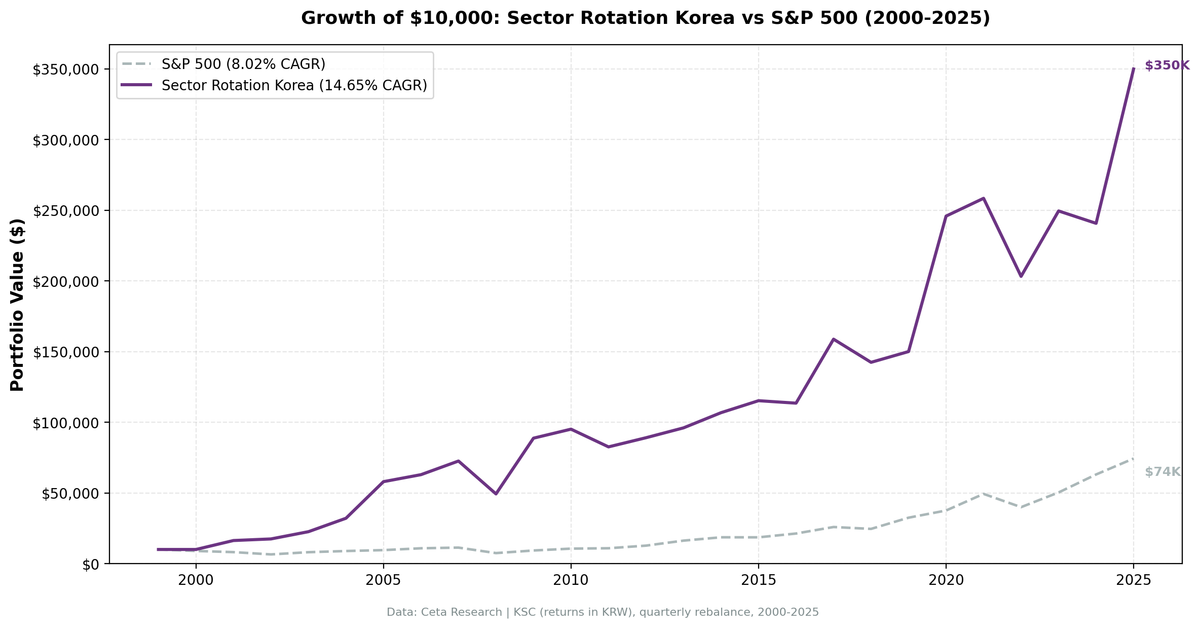
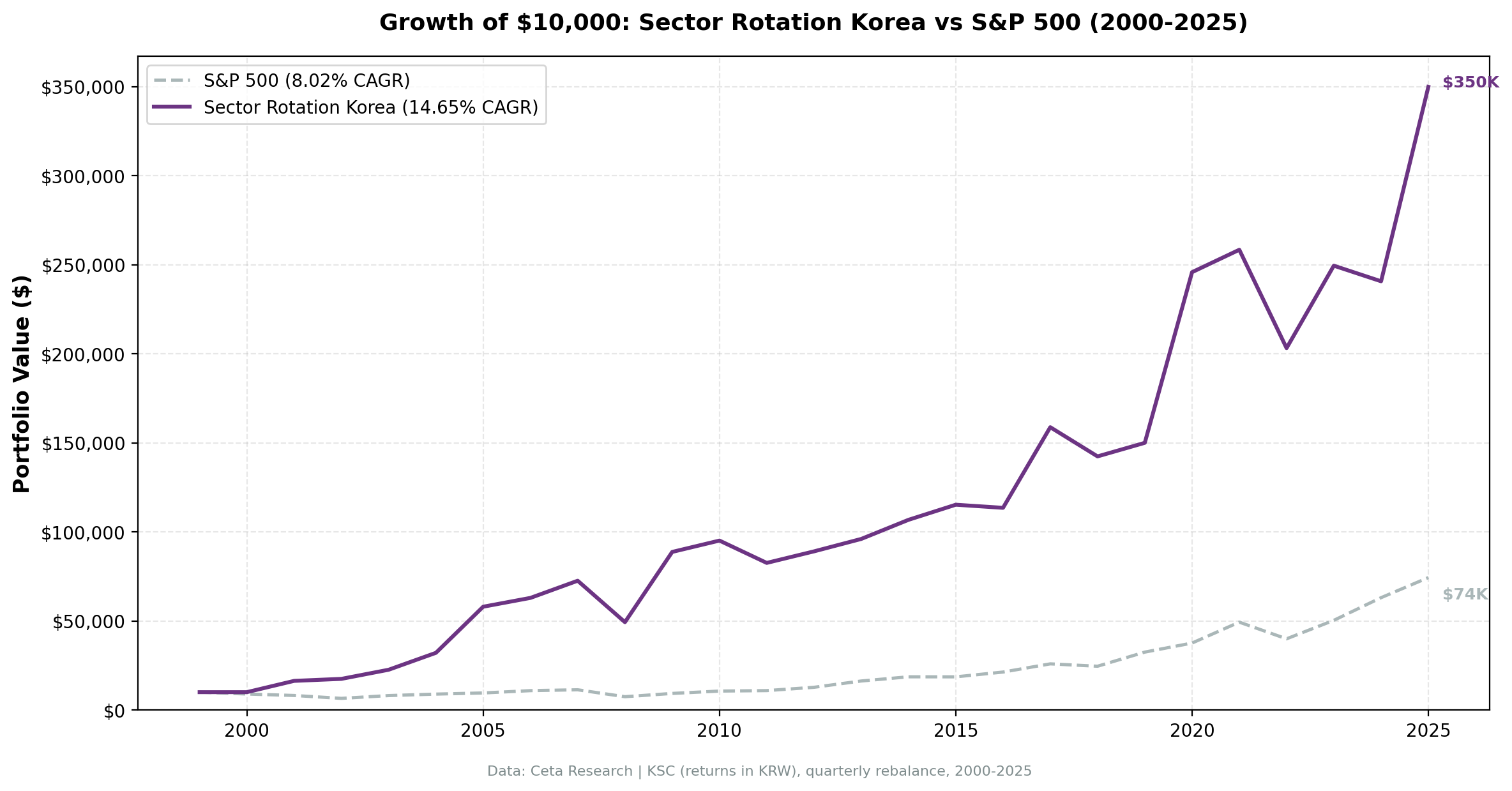
Korea's sector mean reversion is the standout result across every market we've tested. 14.65% CAGR in KRW, Sharpe of 0.466, max drawdown of -37.4%. When markets fell, this portfolio barely moved, down capture of 36.7%. When markets rose, it kept up. Over 26 years, that combination produced 3400% total return while beating SPY on risk-adjusted terms.
Contents
- Method
- What We Found
- Most Selected Sectors (104 quarters)
- Notable Years
- Full Annual Returns
- Backtest Methodology
- Limitations
- Takeaway
- Part of a Series
- References
Method
- Data source: Ceta Research (FMP financial data warehouse)
- Universe: KSC (Korea Stock Exchange), market cap > KRW 300B (~$220M USD)
- Period: 2000-2025 (26 years, 104 quarterly periods)
- Rebalancing: Quarterly (January, April, July, October)
- Signal: Buy all stocks in the bottom 2 sectors by 12-month trailing equal-weighted return
- Portfolio construction: Equal weight all qualifying stocks in selected sectors
- Benchmark: S&P 500 Total Return (SPY)
- Cash rule: Hold cash if fewer than 5 stocks qualify
- Currency note: Returns are in KRW (local currency). Benchmark is SPY in USD.
Historical financial data with 45-day lag to prevent look-ahead bias. Full methodology: backtests/METHODOLOGY.md
What We Found
Korea's result is unusual in systematic backtesting: a strategy that beats SPY on both total return and risk-adjusted basis, while also beating SPY's drawdown. SPY's Sharpe is 0.357 and max drawdown is -45.5%. Korea's Sharpe is 0.466 and max drawdown is -37.4%. That's a cleaner result than most strategies produce, higher return, lower volatility, smaller drawdown.
| Metric | Portfolio | S&P 500 |
|---|---|---|
| CAGR | 14.65% | 8.02% |
| Excess CAGR | +6.63% | — |
| Total Return | 3400% | — |
| Max Drawdown | -37.4% | -45.5% |
| Annualized Volatility | 24.99% | — |
| Sharpe Ratio | 0.466 | 0.297* |
| Win Rate (vs SPY) | 50.0% | — |
| Up Capture | 108.2% | — |
| Down Capture | 36.7% | — |
| Avg Stocks per Period | 49.9 | — |
| Cash Periods | 7 of 104 | — |
*SPY Sharpe in Korea comparison: 0.297
The down capture of 36.7% is the headline number. In years when SPY fell, this portfolio fell only 36.7% as much. Combined with 108.2% up capture, the strategy gained more when markets rose and lost far less when they fell. That's the asymmetry that powers the Sharpe to 0.466, comfortably above SPY.
The portfolio held an average of 49.9 stocks per quarter, manageable for institutional or serious individual investors. Cash periods were 7 of 104 quarters (7%), slightly more than India, suggesting Korea occasionally ran short of qualifying stocks.
Most Selected Sectors (104 quarters)
| Sector | Quarters Selected |
|---|---|
| Communication Services | 25 |
| Technology | 24 |
| Healthcare | 24 |
| Utilities | 23 |
| Financial Services | 22 |
| Energy | 21 |
Korea's sector composition is more balanced than India's. No single sector dominated, the top six sectors were all selected in 21-25 quarters. This reflects Korea's diversified industrial base: tech (Samsung, SK Hynix), telecom (KT, SKT), pharma (Samsung Biologics, Celltrion), and energy all cycle through periods of underperformance.
This balance is part of why Korea's risk profile looks different from India. With more sector diversity in the selection process, the portfolio wasn't persistently concentrated in two cyclical sectors.
Notable Years
2001: +63.33%, SPY -9.17%. The strategy dodged the dot-com fallout by selecting Financial Services and Consumer sectors, areas that had underperformed through the late-1990s tech boom. While US tech collapsed, Korea's non-tech sectors recovered. The excess return of +72.5% is the largest single-year gap in the Korea backtest.
2005: +80.70%, SPY +7.17%. Korea's tech and telecom sectors had been out of favor for several years post-dot-com. When the reversion came, it came hard. +73.53% excess in a year.
2008: -32.06%, SPY -34.31%. The strategy held up better than the US benchmark during the financial crisis. Korea's selected sectors fell 32.1% versus SPY's 34.3%, a +2.25% excess in the worst year of the backtest. The -37.4% max drawdown likely accumulated here and in the adjacent quarters.
2009: +80.00%, SPY +24.73%. Post-crisis recovery was strong. Korean industrials and financials that had been beaten down in 2008 snapped back. The strategy captured 80% return versus SPY's 24.7%.
2020: +63.88%, SPY +15.64%. COVID recovery was sharp for Korean tech and healthcare sectors that had been underperforming before the pandemic. The +48.24% excess in 2020 is the second-largest single-year outperformance.
2021: +5.12%, SPY +31.26%. The flip side of 2020. After the COVID-recovery sectors repriced, the strategy rotated into sectors that didn't perform. -26.1% excess in 2021 is the worst year in recent history.
2024: -3.51%, SPY +25.28%. Korea's market had a difficult 2024 driven by political uncertainty and weak export demand. The strategy lost -3.5% while SPY gained +25.3%. -28.8% excess, the worst single-year gap in the full backtest.
2025: +45.35%, SPY +17.88%. A sharp recovery. Sectors that were beaten down in 2024 reverted. The +27.5% excess is among the largest outperformance years.
Full Annual Returns
| Year | Portfolio | S&P 500 | Excess |
|---|---|---|---|
| 2000 | 0.00% (cash) | -10.50% | +10.50% |
| 2001 | +63.33% | -9.17% | +72.50% |
| 2002 | +6.88% | -19.92% | +26.80% |
| 2003 | +29.39% | +24.12% | +5.26% |
| 2004 | +42.06% | +10.24% | +31.83% |
| 2005 | +80.70% | +7.17% | +73.53% |
| 2006 | +8.54% | +13.65% | -5.10% |
| 2007 | +15.32% | +4.40% | +10.92% |
| 2008 | -32.06% | -34.31% | +2.25% |
| 2009 | +80.00% | +24.73% | +55.27% |
| 2010 | +7.18% | +14.31% | -7.12% |
| 2011 | -13.18% | +2.46% | -15.64% |
| 2012 | +7.84% | +17.09% | -9.25% |
| 2013 | +7.84% | +27.77% | -19.93% |
| 2014 | +11.18% | +14.50% | -3.32% |
| 2015 | +7.94% | -0.12% | +8.06% |
| 2016 | -1.51% | +14.45% | -15.97% |
| 2017 | +39.88% | +21.64% | +18.24% |
| 2018 | -10.32% | -5.15% | -5.17% |
| 2019 | +5.35% | +32.31% | -26.96% |
| 2020 | +63.88% | +15.64% | +48.24% |
| 2021 | +5.12% | +31.26% | -26.14% |
| 2022 | -21.37% | -18.99% | -2.38% |
| 2023 | +22.78% | +26.00% | -3.22% |
| 2024 | -3.51% | +25.28% | -28.79% |
| 2025 | +45.35% | +17.88% | +27.47% |
The win rate of 50.0% is an exact coinflip. But the distribution of wins and losses explains the +6.63% excess CAGR: the wins (+72.5%, +73.5%, +55.3%, +48.2%) are larger in magnitude than the losses (-26.96%, -26.14%, -28.79%). Korea's mean reversion created a payoff profile that favors large upside events over large downside events.
Backtest Methodology
| Parameter | Value |
|---|---|
| Signal | 12-month trailing equal-weighted sector return |
| Selection | Bottom 2 sectors each quarter |
| Universe | KSC, market cap > KRW 300B |
| Portfolio | Equal weight all qualifying stocks in selected sectors |
| Rebalancing | Quarterly (Jan, Apr, Jul, Oct) |
| Cash rule | Hold cash if < 5 qualifying stocks |
| Transaction costs | Size-tiered model |
| Data lag | 45 days (prevents look-ahead bias) |
| Period | 2000-2025 (104 quarterly periods) |
| Benchmark | S&P 500 Total Return (SPY) |
Limitations
Currency risk. Returns are in KRW. The S&P 500 benchmark is in USD. KRW has been volatile against USD over 26 years, with significant depreciation episodes (2008, 2022). A USD-based investor would experience different returns depending on when they converted. The comparison mixes currencies in a way that complicates direct interpretation.
50 stocks per period. Averaging 49.9 stocks per quarter is manageable but still requires meaningful trading infrastructure. Four rebalances per year on ~50 Korean stocks involves transaction costs, foreign exchange conversion, and Korea-specific market access considerations.
Sector concentration risk. Despite the balanced sector selection, buying the bottom 2 sectors means concentrated bets. In 2011-2013, the strategy consistently underperformed as the selected sectors didn't revert. Three consecutive years of underperformance (-15.6%, -9.3%, -19.9% excess) is a real test of conviction.
50.0% win rate. The coin-flip win rate means half the years you underperform SPY. The positive CAGR excess comes from asymmetric win/loss sizes, not from consistently picking right. In any given year, you have roughly even odds of beating or trailing the index.
Emerging market access. KSC-listed stocks require foreign investor registration and Korea-specific brokerage access. Short-selling restrictions, circuit breakers, and market hours differ from US markets. The backtest doesn't capture these operational frictions.
Takeaway
Korea's sector mean reversion is the cleanest result we've seen across 14 exchanges. The combination of 14.65% CAGR, 0.466 Sharpe, and -37.4% max drawdown is unusual. Most strategies that beat SPY on returns take on more risk to get there. Korea's version took on less.
The 36.7% down capture is what makes the math work. You can compound aggressively when the losses are contained. Losing 36.7% as much as the market in bad years while keeping 108.2% in good years is a favorable trade.
The balanced sector composition helps. Korea's market cycles through tech, telecom, healthcare, financials, and energy in its underperformance periods. That diversification in the signal keeps the portfolio from making the same concentrated bet quarter after quarter.
USD-based investors should adjust for currency. KRW exposure adds volatility that doesn't appear in the local-currency numbers.
Part of a Series
- US analysis →. The benchmark: consistent returns across 104 quarters
- India analysis →. Highest raw CAGR: 16.42%, +8.40% vs SPY, with -70.5% drawdown
- Global comparison →, 14 exchanges, the full picture
References
Moskowitz, T. J., & Grinblatt, M. (1999). Do industries explain momentum? Journal of Finance, 54(4), 1249-1290.
Part of a Series: US | Global | Global | US | UK | Thailand | Taiwan | Taiwan
Run It Yourself
Explore the data behind this analysis on Ceta Research. Query our financial data warehouse with SQL, build custom screens, and run your own backtests across 70,000+ stocks on 20 exchanges.
Data: Ceta Research, FMP financial data warehouse. Universe: KSC. Quarterly rebalance, equal weight, 2000-2025. Returns in KRW. Past performance doesn't guarantee future results.