Sector Mean Reversion on 13 Exchanges: Where Excess Return Is Actually Alpha
Same sector mean reversion strategy across 13 exchanges, each against its own local index. Taiwan +9.35%, Korea +8.74%, Sweden +7.40% excess CAGR. Germany is the only local failure at -2.61%. But India's +1.44% excess is a negative alpha once you adjust for beta, and so is most of the US result.

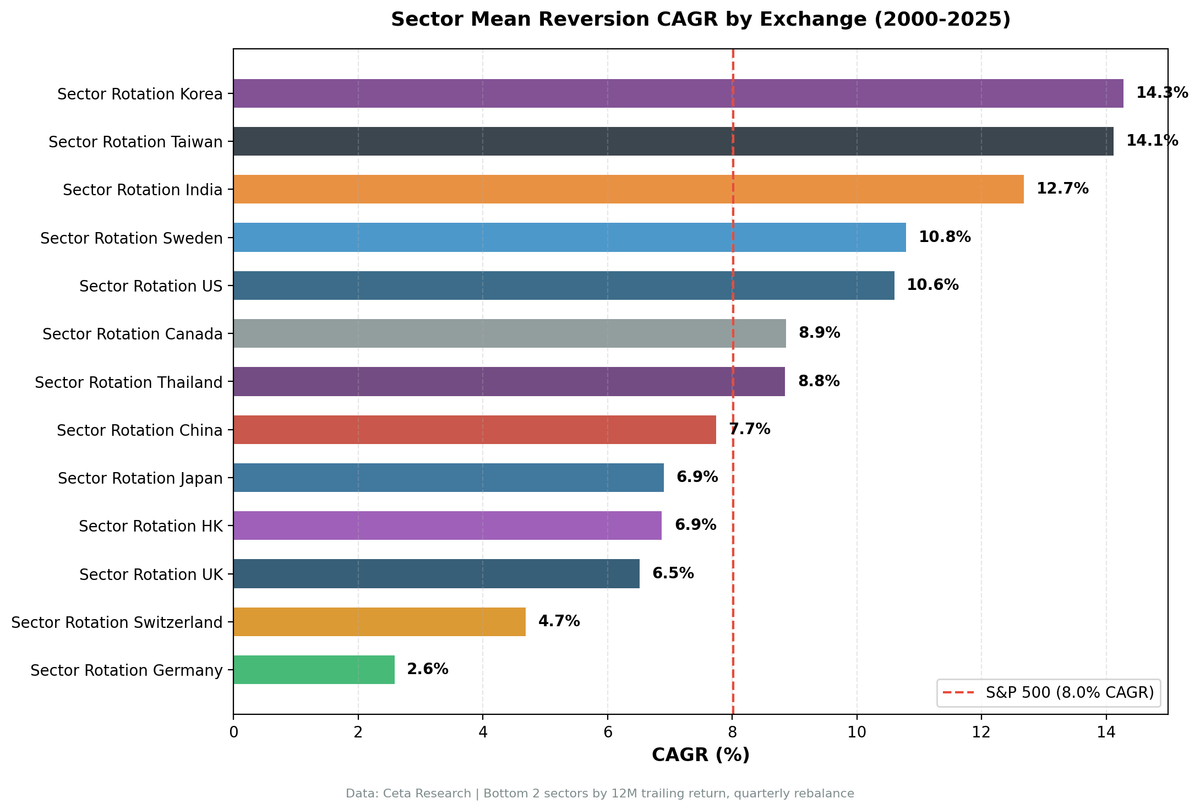
We ran the same sector mean reversion strategy on 13 exchanges from 2000 to 2025: at the start of each quarter, rank all sectors by their equal-weighted 12-month return and buy every qualifying stock in the bottom two. Quarterly rebalance, equal weight, 104 periods per market. The headline result isn't the alpha. It's the geography.
Contents
- Method
- Why this study covers 13 markets and not 14
- The Pattern Is Geographic
- Results: All 13 Exchanges
- Read the last two columns before the third one
- Emerging Markets: Why It Works
- Developed Markets: A Split Verdict
- Korea: The Best Result in the Study
- Taiwan: The Best Sharpe
- China: Real Alpha, Unusable Risk
- The Drawdown Picture
- Exchange Notes
- Backtest Methodology
- Limitations
- Takeaway
- See Individual Exchange Analysis
- References
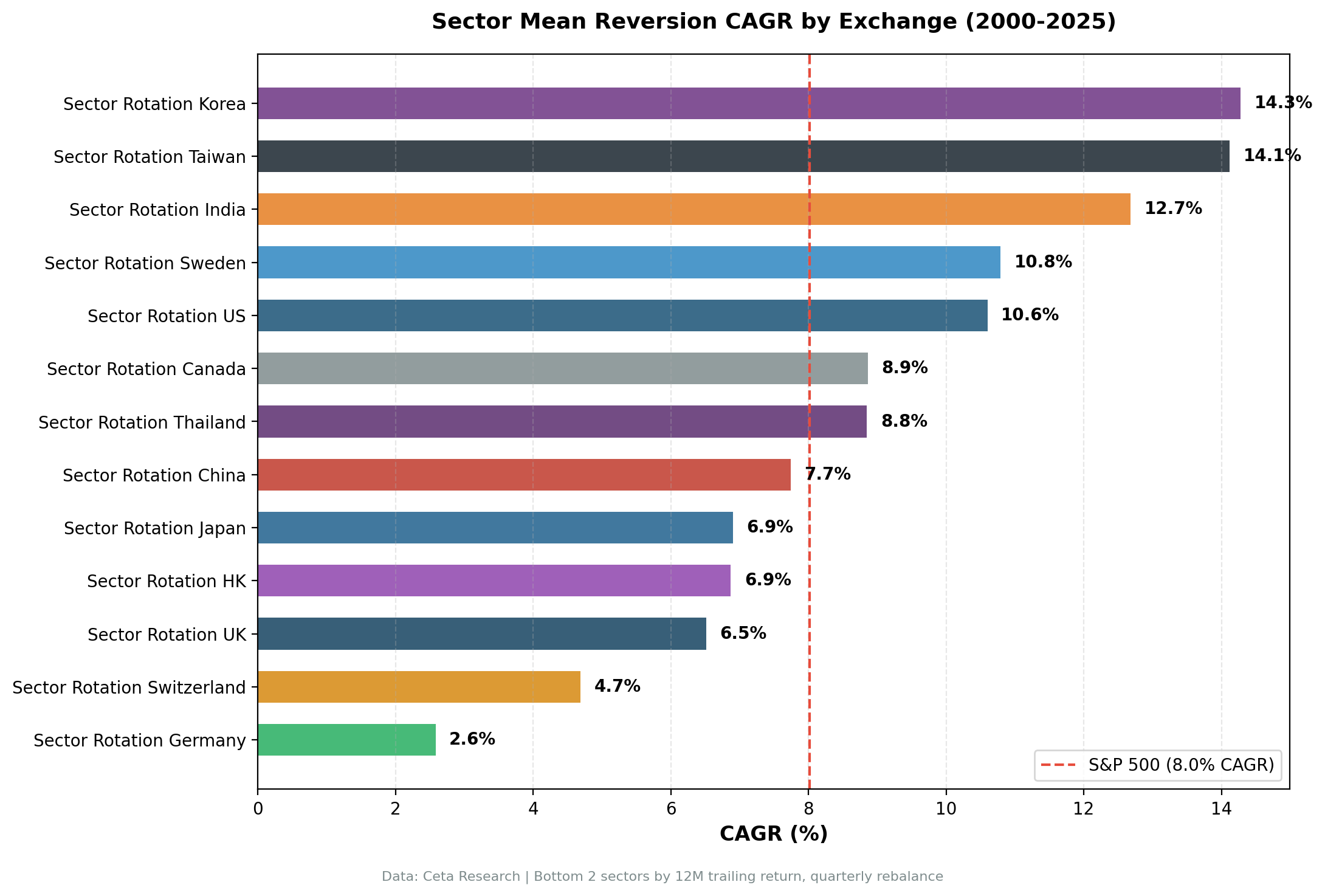
Measured against each country's own index, 12 of the 13 markets show positive excess return. Only 11 of those 12 keep the edge once you allow for the dividends those price indices leave out. Taiwan (+9.35% vs TAIEX), Korea (+8.74% vs KOSPI) and Sweden (+7.40% vs OMX30) lead. Germany is the only market where the strategy loses to its local benchmark, by -2.61% a year. Once that excess is adjusted for the market risk each portfolio carries, 11 of the 13 are left with positive alpha: India joins Germany on the wrong side of the line.
The raw CAGRs tell a different and less useful story, because they're in local currency against local inflation and local rates. Korea's 14.28% and Taiwan's 14.12% look like the top of the table. But India's 12.68% sits near the top too, and India's excess is the second-worst in the study, because the Sensex itself compounded at 11.24%. What a strategy beats matters more than what it returns.
Data: FMP financial data warehouse, 2000-2025. Updated August 2026.
Method
Data source: Ceta Research (FMP financial data warehouse) Universe: 13 exchanges, full exchange universe (not index-constrained), market cap > exchange-specific threshold Period: 2000-2025 (26 years, 104 quarterly periods per market) Rebalancing: Quarterly (January, April, July, October), equal weight all qualifying stocks in selected sectors Signal: Bottom 2 sectors by equal-weighted 12-month trailing return Execution: Entry at the next available close after the signal date Cash rule: Hold cash if fewer than 5 sectors qualify, or fewer than 10 stocks pass the filters Transaction costs: Size-tiered model, applied to every position Benchmark: each market against its own local index in its own currency. Returns and benchmark are always in the same currency, so every excess figure below is a like-for-like comparison.
Full methodology: backtests/METHODOLOGY.md
Why this study covers 13 markets and not 14
South Africa (JNB) was in earlier versions of this comparison and has been removed. The signal needs at least 5 sectors holding 5 or more stocks each before it will run. The JNB large-cap universe never reaches that bar before 2017, so 81 of the 104 quarters are forced to cash and the only investable stretch is 2018 to 2023. A 26-year claim on 23 quarters of data isn't one we're willing to publish. Singapore (SES), Australia (ASX) and Brazil (SAO) are excluded for the same class of reason: insufficient sector diversity in the first case, unusable split-adjusted prices in the other two.
These benchmarks leave dividends out. Portfolio returns here use dividend-adjusted prices, so they include dividends. Most of the indices we measure against do not. The FTSE 100, Hang Seng, KOSPI, Nikkei 225, OMX Stockholm 30, SET Index, SMI, SSE Composite, Sensex, TAIEX and TSX Composite are price indices, so excess return against them is overstated by roughly the local dividend yield, which has run between about 1.3% and 3.5% in these markets. Those comparisons are like for like: the S&P 500 figure runs through SPY, which is dividend-adjusted; the DAX is a performance index. Subtract the yield and only 11 of those 12 keep a positive edge. The ones that do not survive it are Switzerland. India survives by less than half a point, which is inside the noise.
The Pattern Is Geographic
The thesis, before the numbers: sector mean reversion works in markets where sector underperformance is temporary and sentiment-driven. It fails where sector underperformance reflects structural conditions that don't reverse on a quarterly timeline.
East Asian manufacturing economies have volatile, cyclical sector compositions. When Basic Materials or Financial Services underperform in Taiwan by 30-40% over 12 months, the reversion tends to be violent and fast, and it arrives without the portfolio having taken on extra market risk to wait for it. European markets built on pharmaceuticals, luxury goods and export industrials don't revert as sharply, because the beaten-down sector is often beaten down for a reason that lasts years.
Results: All 13 Exchanges
Sorted by excess CAGR against each market's own index, which is the number that answers "did this beat what a local investor could have bought instead?"
| Exchange | CAGR | Local Benchmark | Excess vs Local | Sharpe | Bench Sharpe | Max DD | Beta | Jensen Alpha | Avg Stocks |
|---|---|---|---|---|---|---|---|---|---|
| Taiwan (TAI+TWO) | 14.12% | TAIEX 4.76% | +9.35% | 0.485 | 0.154 | -49.54% | 0.872 | +9.84% | 100 |
| Korea (KSC) | 14.28% | KOSPI 5.55% | +8.74% | 0.434 | 0.107 | -35.09% | 0.918 | +8.95% | 51 |
| Sweden (STO) | 10.79% | OMX30 3.39% | +7.40% | 0.367 | 0.071 | -62.27% | 1.058 | +7.32% | 26 |
| Hong Kong (HKSE) | 6.87% | Hang Seng 1.61% | +5.26% | 0.148 | -0.065 | -49.60% | 1.043 | +5.32% | 69 |
| Thailand (SET) | 8.85% | SET Index 3.69% | +5.15% | 0.252 | 0.051 | -42.36% | 0.921 | +5.25% | 26 |
| UK (LSE) | 6.51% | FTSE 100 1.55% | +4.96% | 0.126 | -0.137 | -50.70% | 1.147 | +5.24% | 106 |
| Canada (TSX) | 8.86% | TSX Composite 5.26% | +3.61% | 0.257 | 0.178 | -48.55% | 1.188 | +3.09% | 65 |
| China (SHH+SHZ) | 7.74% | SSE Composite 4.24% | +3.50% | 0.151 | 0.062 | -74.82% | 1.029 | +3.45% | 262 |
| Japan (JPX) | 6.90% | Nikkei 225 3.93% | +2.97% | 0.333 | 0.182 | -50.39% | 0.783 | +3.80% | 100 |
| US (NYSE+NASDAQ+AMEX) | 10.60% | S&P 500 8.02% | +2.58% | 0.324 | 0.363 | -48.08% | 1.304 | +0.75% | 569 |
| Switzerland (SIX) | 4.69% | SMI 2.31% | +2.38% | 0.199 | 0.127 | -59.22% | 1.118 | +2.16% | 33 |
| India (NSE) | 12.68% | Sensex 11.24% | +1.44% | 0.163 | 0.200 | -69.67% | 1.348 | -0.21% | 68 |
| Germany (XETRA) | 2.58% | DAX 5.19% | -2.61% | 0.026 | 0.144 | -67.33% | 0.840 | -2.10% | 68 |
All returns in local currency against a local-currency benchmark. Most local indices are price-only (FTSE 100, Hang Seng, TAIEX, SMI, DAX and others exclude dividends), which understates the benchmark and therefore overstates the excess. The S&P 500 comparison is the exception: SPY is total return, which is one reason the US excess looks smaller than the rest.
Read the last two columns before the third one
Excess CAGR flatters any strategy that takes more risk than its benchmark, and several of these do. Two markets change character once you adjust:
India posts +1.44% excess and a negative Jensen alpha of -0.21%, because it runs a beta of 1.348. A 1.35x position in a Sensex tracker would have produced the same shape without the work. India is not a market where this signal works; it's a market where the index did well and the strategy levered it.
The US posts +2.58% excess and only +0.75% alpha, on a beta of 1.304. Most of the American result is compensation for risk, not skill.
Contrast that with Korea (beta 0.918, alpha +8.95%), Taiwan (beta 0.872, alpha +9.84%) and Japan (beta 0.783, alpha +3.80%). All three carry LESS market risk than their index and still beat it. That's the profile you actually want, and it's concentrated in East Asia.
Emerging Markets: Why It Works
The top three by local alpha are Taiwan, Korea and Sweden. Two are East Asian manufacturing economies; the third is a small European market with an unusually cyclical sector mix.
Taiwan (TAI+TWO): 14.12% CAGR, +9.35% vs TAIEX, Sharpe 0.485. The best risk-adjusted result in the study, and the best down capture at 52.88%. More below.
Korea (KSC): 14.28% CAGR, +8.74% vs KOSPI, Sharpe 0.434. The highest raw CAGR of the 13, and the widest drawdown gap over a local index in the study: -35.09% against the KOSPI's -52.73%. More below.
Sweden (STO): 10.79% CAGR, +7.40% vs OMX30, Sharpe 0.367. Sweden's inclusion makes sense once you look at the OMX30, which grew at 3.39% annually and drew down -66.13% at its worst. The STO universe is heavily weighted toward cyclical industrials and basic materials, and Basic Materials alone was selected in 40 of 104 quarters, the second-heaviest single-sector tilt in the study behind Japan's Utilities at 41. 2009 (+84.85% against +38.89%) tells the story. The portfolio averages only 26 stocks, so single names matter more here than anywhere except Thailand.
What these markets share: sector underperformance is mostly cyclical, not structural. When a sector falls 30-40% over 12 months in Taiwan or Korea, it's usually because the economic cycle turned against it, not because the industry is in secular decline. The 12-month lookback catches exactly that kind of dislocation and positions for the recovery.
India is the counter-example, and it's instructive. India has the third-highest raw CAGR (12.68%) and the second-worst excess (+1.44%, negative after beta). The Indian market went up a lot; the strategy went up slightly more while carrying 60% more volatility (37.90% vs 23.72%) and a -69.67% drawdown against the index's -51.34%. Emerging-market cyclicality on its own doesn't generate the premium. The sector dispersion has to mean-revert, and in India it mostly just amplified.
Developed Markets: A Split Verdict
UK (LSE): 6.51% CAGR, +4.96% vs FTSE 100. The FTSE 100 has returned 1.55% annually as a price index over 26 years, with a negative Sharpe. Beating it by 4.96 points a year is real for a UK-benchmarked investor. Two caveats matter. The FTSE 100 excludes dividends, and UK yields have run 3-4% historically, so a total-return benchmark would eat most of that excess. And at 6.51% the strategy now trails SPY's 8.02%, so the global investor's answer is different from the local one.
Japan (JPX): 6.90% CAGR, +2.97% vs Nikkei 225, Sharpe 0.333. Japan is the quiet good result. A beta of 0.783, an alpha of +3.80%, down capture of 66.82%, and a max drawdown of -50.39% against the Nikkei's -61.06%. Less risk than the index and more return. Utilities dominated selection at 41 of 104 quarters, a structural consequence of the post-Fukushima shutdown cycle.
Hong Kong (HKSE): 6.87% CAGR, +5.26% vs Hang Seng. The Hang Seng returned 1.61% annually with a negative Sharpe, so the bar is low, but the strategy cleared it with a beta of 1.043 and an alpha of +5.32%. Down capture of 74.46% is genuinely protective.
Switzerland (SIX): 4.69% CAGR, +2.38% vs SMI. Modest local alpha on a low absolute return. The SMI returned 2.31%. Worth noting that this figure uses companies LISTED on SIX, which includes foreign secondary lines. Restricting to Swiss-domiciled companies raises the result to 6.34% CAGR and +4.02% excess, so the published number is the conservative one.
Germany (XETRA): 2.58% CAGR, -2.61% vs DAX. The only failure, and not a marginal one. The DAX delivered 5.19%. The strategy returned 2.58% at essentially identical volatility (22.21% vs 22.13%) and a deeper drawdown (-67.33% vs -65.15%). Same risk, half the return. XETRA's sector composition is export-dependent industrials and chemicals; when those fall, it's usually because export conditions worsened structurally, not because sentiment briefly overcorrected. Consumer Defensive was selected in 31 of 104 quarters, the strategy repeatedly finding "cheap" defensives that stayed cheap.
Korea: The Best Result in the Study
Korea produced 14.28% CAGR against the KOSPI's 5.55%, an excess of +8.74%, with a max drawdown of -35.09% against the KOSPI's own -52.73%. Sharpe 0.434 against the index's 0.107.
Six of the 13 markets beat their index on return, risk-adjusted return and drawdown at once (Korea, Taiwan, Japan, Thailand, Sweden and Hong Kong). What sets Korea apart is the size of the drawdown gap: 17.6 points shallower than the KOSPI, the widest margin in the study, and it comes with the highest CAGR of the 13.
The mechanism is the capture asymmetry: 115.58% up, 64.38% down. Korean sectors that are already beaten down don't fall as hard in further market declines as sectors that are still expensive. The portfolio is defensively positioned by construction, then participates fully in the recovery.
The beta of 0.918 is what separates Korea from India and the US. Korea earns +8.95% Jensen alpha while carrying slightly less market risk than the index. That's not leverage. That's the signal working.
2008 shows it directly: the strategy returned -30.81% while the KOSPI fell -37.55%, then +64.04% in 2009 against the index's +46.55%.
The honest counterweight is 2025. The KOSPI returned +79.65% and the strategy returned +42.35%, a -37.30% gap and the worst single year in Korea's record. Concentrated index leadership is this strategy's structural blind spot, and 2025 was an extreme case of it.
Taiwan: The Best Sharpe
Taiwan has the highest Sharpe in the study (0.485) and the best down capture (52.88%), meaning the strategy absorbed a little over half of the TAIEX's down moves. Its max drawdown of -49.54% is well inside the index's own -65.25%.
TAI+TWO selection is dominated by Basic Materials (36 of 104 quarters), Financial Services (34) and Real Estate (33). In bull markets driven by global growth, tech and semiconductors lead and sit at the top of the 12-month ranking, so the strategy doesn't hold them. It holds what fell.
2002 is the cleanest single year: +64.19% while the TAIEX fell -19.20%, an 83-point gap. 2009 was +130.44% against +74.70%.
The recent record is the counterweight, and it's the same story as Korea's. 2024 (-28.36% excess) and 2025 (-23.87% excess) were both years when the TAIEX surged on TSMC-driven semiconductor momentum while a contrarian tilt was wrong by construction.
China: Real Alpha, Unusable Risk
China (SHH+SHZ) beats the SSE Composite by +3.50% with an alpha of +3.45% on a beta near 1. The signal works.
Nothing else about it does. Volatility is 34.67%, second only to India's 37.90%. The max drawdown is -74.82%, the deepest in the study. The annual series swings from +166.50% in 2007 to -57.81% in 2008 to +140.14% in 2009. With 262 average holdings this is the second-largest universe after the US, so the volatility isn't a small-sample artifact. It's the market.
Included as a data point, not a recommendation.
The Drawdown Picture
Down capture against each market's own benchmark, sorted by how protective the strategy was:
| Exchange | Down Capture vs Local | Strategy Max DD | Benchmark Max DD |
|---|---|---|---|
| Taiwan (TAI+TWO) | 52.88% | -49.54% | -65.25% |
| Korea (KSC) | 64.38% | -35.09% | -52.73% |
| Japan (JPX) | 66.82% | -50.39% | -61.06% |
| Thailand (SET) | 70.85% | -42.36% | -48.10% |
| Hong Kong (HKSE) | 74.46% | -49.60% | -50.50% |
| Germany (XETRA) | 78.24% | -67.33% | -65.15% |
| Sweden (STO) | 82.23% | -62.27% | -66.13% |
| Switzerland (SIX) | 96.80% | -59.22% | -47.38% |
| China (SHH+SHZ) | 98.81% | -74.82% | -67.10% |
| Canada (TSX) | 101.22% | -48.55% | -41.58% |
| UK (LSE) | 106.02% | -50.70% | -43.69% |
| US (NYSE+NASDAQ+AMEX) | 114.58% | -48.08% | -43.86% |
| India (NSE) | 127.88% | -69.67% | -51.34% |
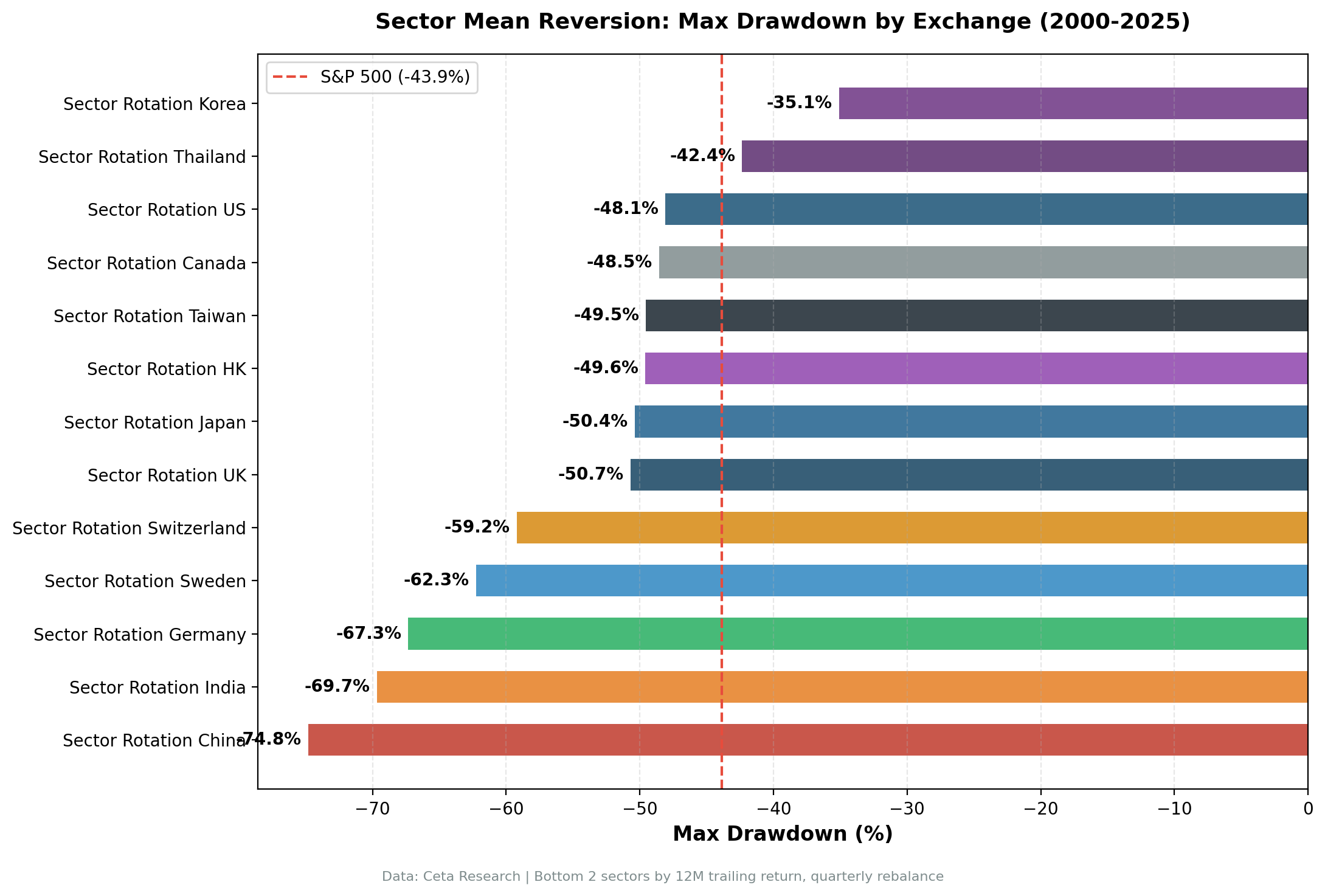
The table splits cleanly. In the five East Asian and Southeast Asian markets the strategy is genuinely defensive: it captures 53-75% of the local index's downside and finishes with a shallower worst drawdown than the index itself. In the US, the UK, Canada and India it captures 100-128% of the downside and draws down deeper than the benchmark.
India's 127.88% is the extreme. The strategy amplifies the local market's crashes and its 13% raw CAGR is bought with a -69.67% peak-to-trough loss against the Sensex's -51.34%.
Korea is the extreme in the other direction: -35.09% against an index that fell -52.73%. That's 17 points of drawdown protection alongside the study's highest CAGR.
Exchange Notes
South Africa (JNB): removed from the study. Earlier versions of this comparison carried a South Africa row showing 11.72% CAGR and +3.69% excess. That row does not survive scrutiny. The signal needs 5 sectors of 5 or more stocks each before it runs, and the JNB large-cap universe never reaches that bar before 2017. Re-run correctly, 81 of 104 quarters are cash and the only investable stretch is 2018 to 2023. The old row also reported returns for 2004 and 2005, years in which the universe could not have produced a portfolio at all. We've removed South Africa rather than publish a 26-year claim built on 23 quarters.
China (SHH+SHZ): included as a data point. Real local alpha, and volatility and drawdown that make consistent execution implausible. See above.
Australia (ASX), Brazil (SAO), Singapore (SES): excluded. ASX and SAO carry split-adjustment errors in FMP's adjusted close series severe enough to corrupt returns. SES doesn't have the sector diversity to run the signal, at 61% cash periods.
Backtest Methodology
| Parameter | Choice |
|---|---|
| Signal | Bottom 2 sectors by equal-weighted 12-month trailing return |
| Portfolio | All qualifying stocks in selected sectors, equal weight |
| Rebalancing | Quarterly (January, April, July, October) |
| Execution | Next available close after the signal date |
| Cash rule | Hold cash if < 5 sectors qualify or < 10 stocks pass filters |
| Transaction costs | Size-tiered model, applied to every position |
| Minimum market cap | Exchange-specific threshold, local currency |
| Sector classification | FMP sector tags |
| Period | 2000-2025 (26 years, 104 quarters per market) |
| Benchmark | Each market's own local index, in its own currency |
| Data source | Ceta Research (FMP financial data warehouse) |
Full backtest code (Python): github.com/ceta-research/backtests
Limitations
Most local indices exclude dividends. The FTSE 100, Hang Seng, TAIEX, SMI, DAX, KOSPI and SSE Composite used here are price indices. Local dividend yields of 2-4% would come off every excess figure in the table if total-return versions were available. The S&P 500 comparison uses SPY, which is total return, and that asymmetry is a real reason the US excess looks smaller than the rest. Read the excess column as an upper bound outside the US.
Excess is not alpha. Eight of these markets run a beta above 1.0 against their own index. India (+1.44% excess, -0.21% alpha) and the US (+2.58% excess, +0.75% alpha) are cases where nearly all of the headline gap is compensation for extra risk. The Jensen alpha column is the more honest read.
Currency. Returns are in local currency, and so are the benchmarks, which makes each row internally consistent. It also means the rows aren't comparable to each other in wealth terms. An investor running the India strategy from outside India earns INR returns and then converts.
Small universes. Sweden averages 26 holdings and Thailand 26. At that size, individual company outcomes drive annual results and the sector thesis is diluted by idiosyncratic risk.
Survivorship bias. Exchange membership uses current profiles, not historical. Delisted companies, including failures, aren't tracked. This skews results upward across all markets, more so where delisting rates are higher.
Closed-end funds sit inside one sector. FMP files funds and ETFs under Financial Services. On US large caps that sector is 79.5% funds (3,378 of 4,248 symbols) and 59% of the whole universe by count, so when Financial Services is selected the portfolio is mostly funds. Screening logic was left unchanged so published numbers match the stated rule; excluding funds and ETFs raises the US result to 11.72% CAGR and 0.365 Sharpe.
Listed is not domiciled. Outside the US, an exchange universe includes foreign companies' secondary listings. We measured this on the two European markets where it bites hardest. Germany moves from -2.61% to -2.38% excess (conclusion unchanged) and Switzerland from +2.38% to +4.02% (published figure is the conservative one). Neither flips sign.
Data vintage moves results. Re-running these backtests months apart moves published excess figures by up to 2.6 percentage points, because FMP revises coverage and corrects history. Treat any excess under about 2 points as indistinguishable from zero. That specifically covers India (+1.44%).
Structural change risk. The strategy assumes sector underperformance is cyclical. When it's structural, it buys into continued decline. Energy globally after 2014, and German industrials throughout, are the clearest examples.
Takeaway
Sector mean reversion beat the local index in 12 of 13 markets. After the dividend adjustment, 11 of those 12 hold. Germany is the exception, and it fails decisively rather than narrowly.
The more useful split is by risk-adjusted alpha, and it's geographic. Taiwan (+9.84%), Korea (+8.95%), Sweden (+7.32%), Hong Kong (+5.32%), Thailand (+5.25%), UK (+5.24%) and Japan (+3.80%) all produce real alpha, and Taiwan, Korea and Japan produce it while carrying LESS market risk than their own index. That's the combination worth having.
At the other end, India's +1.44% excess is negative once you adjust for its 1.348 beta, and the US +2.58% shrinks to +0.75%. Both markets look like winners on the excess column and neither is delivering much beyond leveraged index exposure.
Where the strategy works, it works for a specific reason: sectors dislocate on sentiment and cycle, then revert. East Asian manufacturing economies do that. Germany, whose sector weakness tends to be export-driven and structural, doesn't.
If you were allocating to this signal on the 26-year evidence, the case is Taiwan, Korea and Japan. The case against is that all three had their worst relative years in 2024 and 2025, when index leadership concentrated in exactly the sectors a contrarian rule is built to avoid.
See Individual Exchange Analysis
- Korea (KSC): 14.28% CAGR, +8.74% vs KOSPI, Sharpe 0.434, max drawdown -35.09%
- Taiwan (TAI + TWO): 14.12% CAGR, +9.35% vs TAIEX, Sharpe 0.485
- India (NSE): 12.68% CAGR, +1.44% vs Sensex, alpha -0.21%
- Sweden (STO): 10.79% CAGR, +7.40% vs OMX30, Sharpe 0.367
- US (NYSE + NASDAQ + AMEX): 10.60% CAGR, +2.58% vs S&P 500, alpha +0.75%
- Canada (TSX): 8.86% CAGR, +3.61% vs TSX Composite
- Thailand (SET): 8.85% CAGR, +5.15% vs SET Index
- Japan (JPX): 6.90% CAGR, +2.97% vs Nikkei 225, beta 0.783
- Hong Kong (HKSE): 6.87% CAGR, +5.26% vs Hang Seng
- UK (LSE): 6.51% CAGR, +4.96% vs FTSE 100
- Switzerland (SIX): 4.69% CAGR, +2.38% vs SMI
- Germany (XETRA): 2.58% CAGR, -2.61% vs DAX, the only local failure
References
- Moskowitz, T. & Grinblatt, M. (1999). "Do Industries Explain Momentum?" Journal of Finance, 54(4), 1249-1290.
Data: Ceta Research, FMP financial data warehouse. 13 exchanges, quarterly rebalance, equal weight, 2000-2025. Returns and benchmarks in local currency. Past performance does not guarantee future results. Not investment advice.