Compounding Equity Screen Canada: Closest to Benchmark, Fails in 2008

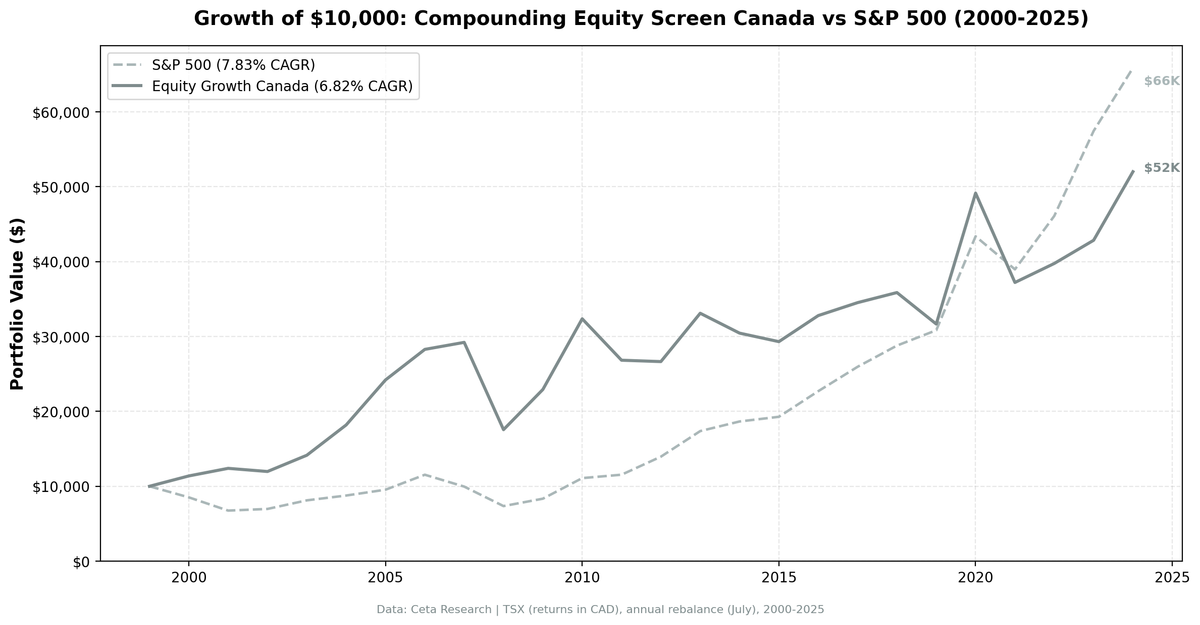
We backtested the Compounding Equity Screen on TSX stocks from 2000 to 2025. The portfolio returned 6.82% annually vs 7.83% for the S&P 500. That -1.01% annual gap is the smallest shortfall of any market tested. Canada came closest to matching the benchmark across all 14 exchanges in our global comparison.
Contents
- Method
- Signal and Filters
- Results
- The First Decade: Strong Signal
- The 2008 Problem
- Post-2008 Pattern
- Full Annual Returns
- The Screen
- Limitations
- Takeaway
The story has two distinct halves. The first decade was excellent. 2000-2007 showed the equity compounding signal working exactly as expected: strong outperformance during the dot-com bust, continued advantage through the mid-2000s commodity boom. Then 2008 arrived and hit TSX equity compounders hard: -39.9% in a single year, the full max drawdown in one period.
Method
- Data source: Ceta Research (FMP financial data warehouse)
- Universe: Toronto Stock Exchange (TSX), market cap > CAD 500M
- Period: 2000-2025 (25 annual rebalance periods, 0 cash)
- Rebalancing: Annual (July), equal weight top 30 by highest equity CAGR
- Benchmark: S&P 500 Total Return (SPY), returns in CAD
- Cash rule: Hold cash if fewer than 10 stocks qualify
- Transaction costs: Size-tiered model adapted for TSX costs
Financial data uses a 45-day lag from the rebalance date for point-in-time correctness. Full methodology: backtests/METHODOLOGY.md
Signal and Filters
| Criterion | Metric | Threshold | Why |
|---|---|---|---|
| Value creation | Shareholders' equity CAGR (5yr) | > 10% | Core compounding signal |
| Quality overlay | Return on Equity (TTM) | > 8% | Growth from operations |
| Quality overlay | Operating Profit Margin (TTM) | > 8% | Pricing power confirmed |
| Liquidity | Market Cap | > CAD 500M | Investable universe |
Results
| Metric | Portfolio | S&P 500 |
|---|---|---|
| CAGR | 6.82% | 7.83% |
| Total Return | 420% | 559% |
| Max Drawdown | -39.9% | -36.3% |
| Volatility | 21.0% | 16.2% |
| Sharpe Ratio | 0.206 | 0.329 |
| Down Capture | 44.6% | -- |
| Up Capture | 83.3% | -- |
| Win Rate (vs SPY) | 40% | -- |
| Cash Periods | 0/25 | -- |
| Avg Stocks | 24.1 | -- |
$10,000 invested in July 2000 grew to $52,000. The same $10,000 in SPY grew to $65,900.
The First Decade: Strong Signal
Canada 2000-2007 showed what equity compounding can do in a resource-heavy market during the right macro environment.
Dot-Com Crash (2000-2001):
| Year | Portfolio | S&P 500 | Excess |
|---|---|---|---|
| 2000 | +13.8% | -14.8% | +28.6% |
| 2001 | +8.9% | -20.8% | +29.7% |
Companies that had been compounding equity for five years on the TSX in 2000 were largely energy producers, financial services, and industrials. No speculative tech exposure. While the dot-com bubble burst, these businesses continued growing book value.
Commodity Boom (2004-2007):
| Year | Portfolio | S&P 500 | Excess |
|---|---|---|---|
| 2004 | +28.6% | +7.9% | +20.7% |
| 2005 | +33.1% | +8.9% | +24.2% |
| 2007 | +3.3% | -13.7% | +17.0% |
Canadian equity compounders rode the commodity supercycle. Energy companies and materials producers had been compounding equity at 10%+ through the 2000s as oil and commodity prices rose. The signal captured this cycle at its best.
The 2008 Problem
The same commodity concentration that drove outperformance through 2007 created the 2008 collapse:
| Year | Portfolio | S&P 500 | Excess |
|---|---|---|---|
| 2008 | -39.9% | -26.1% | -13.8% |
When commodity prices collapsed in H2 2008, TSX equity compounders took a full hit. The companies that had been growing book value most rapidly through the commodity boom were now the most exposed to the price reversal. A -39.9% single-year return is the full max drawdown, it happened in one period.
The signal did its job: it selected companies with 5 years of strong equity growth and high ROE/OPM. But the ROE and margin thresholds were calibrated to the commodity cycle peak. When the cycle turned, those thresholds couldn't filter out the coming deterioration fast enough with annual rebalancing.
Post-2008 Pattern
The portfolio recovered and tracked SPY reasonably well through the 2010s:
| Year | Portfolio | S&P 500 | Excess |
|---|---|---|---|
| 2009 | +30.6% | +13.4% | +17.1% |
| 2010 | +41.2% | +32.9% | +8.2% |
| 2013 | +24.2% | +24.5% | -0.3% |
| 2020 | +55.2% | +40.7% | +14.5% |
| 2024 | +21.4% | +14.7% | +6.7% |
Notably, 2020 showed +55.2% vs +40.7% for SPY. Canadian equity compounders participated strongly in the post-COVID recovery. And 2024 showed a solid +6.7% excess. The recent data suggests the signal is working again in a post-commodity-cycle environment.
Weak recent periods:
| Year | Portfolio | S&P 500 | Excess |
|---|---|---|---|
| 2011 | -17.1% | +4.1% | -21.2% |
| 2012 | -0.7% | +20.9% | -21.5% |
| 2019 | -11.7% | +7.1% | -18.9% |
| 2021 | -24.3% | -10.2% | -14.1% |
2021 stands out: -24.3% while SPY itself fell -10.2% (July 2021 to July 2022 includes the rate hike period). Canadian equity compounders were hit harder than the benchmark during the rate-rise environment, suggesting meaningful interest-rate sensitivity, likely from financial sector concentration.
Full Annual Returns
| Year | Portfolio | S&P 500 | Excess |
|---|---|---|---|
| 2000 | +13.8% | -14.8% | +28.6% |
| 2001 | +8.9% | -20.8% | +29.7% |
| 2002 | -3.4% | +3.3% | -6.7% |
| 2003 | +18.1% | +16.4% | +1.7% |
| 2004 | +28.6% | +7.9% | +20.7% |
| 2005 | +33.1% | +8.9% | +24.2% |
| 2006 | +16.9% | +21.0% | -4.1% |
| 2007 | +3.3% | -13.7% | +17.0% |
| 2008 | -39.9% | -26.1% | -13.8% |
| 2009 | +30.6% | +13.4% | +17.1% |
| 2010 | +41.2% | +32.9% | +8.2% |
| 2011 | -17.1% | +4.1% | -21.2% |
| 2012 | -0.7% | +20.9% | -21.5% |
| 2013 | +24.2% | +24.5% | -0.3% |
| 2014 | -8.0% | +7.4% | -15.4% |
| 2015 | -3.7% | +3.4% | -7.1% |
| 2016 | +11.9% | +17.7% | -5.9% |
| 2017 | +5.3% | +14.3% | -9.1% |
| 2018 | +3.9% | +10.9% | -7.0% |
| 2019 | -11.7% | +7.1% | -18.9% |
| 2020 | +55.2% | +40.7% | +14.5% |
| 2021 | -24.3% | -10.2% | -14.1% |
| 2022 | +6.8% | +18.3% | -11.5% |
| 2023 | +7.8% | +24.6% | -16.8% |
| 2024 | +21.4% | +14.7% | +6.7% |
The Screen
Run this screen live on Ceta Research →
-- (Same SQL as UK screen but filtered to TSX and CAD 500M market cap)
 AND k.marketCap > 500000000
 AND p.exchange = 'TSX'
Limitations
Commodity cycle concentration. TSX equity compounders during commodity booms skew heavily toward energy and materials. The 5-year equity CAGR signal will select these companies at peak earnings, creating concentration right before cycle reversals. Annual rebalancing can't react fast enough.
CAD/USD effects. Returns are in CAD. The Canadian dollar tracked USD closely until 2008, then diverged. Currency effects add meaningful volatility for non-CAD investors.
High drawdown. -39.9% max drawdown is worse than SPY's -36.3%. For a strategy premised on quality and compounding, this is a disappointing crisis result.
Takeaway
Canada delivered 6.82% CAGR, the closest shortfall to SPY (-1.01%) of any exchange in the 14-market test. The strategy worked well in the first decade (2000-2007), capturing the quality advantage during the dot-com bust and commodity boom. The 2008 collapse was severe and set the overall record back.
Recent years show some revival: 2020 and 2024 were strong. The signal functions on TSX in principle, but the commodity-heavy market structure creates cyclical boom-bust distortions that the annual rebalancing can't escape. If you run this screen in Canada, watch for commodity cycle exposure in the qualifying list.
Part of a Series: US | UK | India | Screen Global | Germany
Run It Yourself
Explore the data behind this analysis on Ceta Research. Query our financial data warehouse with SQL, build custom screens, and run your own backtests across 70,000+ stocks on 20 exchanges.
Data: Ceta Research (FMP financial data warehouse), 2000-2025. Universe: Toronto Stock Exchange (TSX). Returns in CAD. Full methodology: METHODOLOGY.md. Past performance doesn't guarantee future results. This is educational content, not investment advice.