Sector Momentum in Canada: +10.23% Annual Excess, the Dataset's

Canada delivered the third-best excess return in our 14-exchange sector momentum study. +10.23% annually over 26 years, behind only India and Korea. Nobody writes about Canadian sector momentum. They should.
Contents
- The Strategy
- What We Found
- Why Canada Works
- When It Worked and When It Didn't
- Full Annual Returns
- Limitations
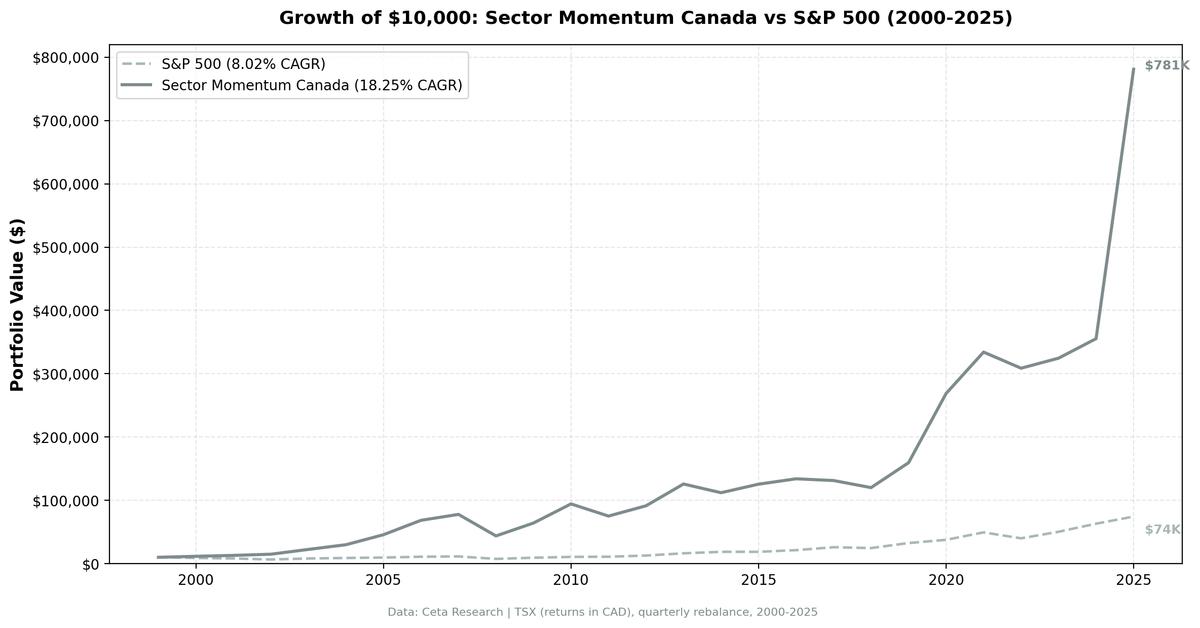
The TSX grew from $10,000 to $781,030 CAD over the same period that SPY grew to $74,347 USD. That's a 78x portfolio vs a 7x benchmark, driven by a mechanical strategy that simply held the two strongest sectors each quarter. Canada's commodity-heavy market created exactly the conditions where sector momentum thrives: multi-year trending cycles in Basic Materials and Energy that the strategy captured almost perfectly.
The Strategy
The Toronto Stock Exchange is structurally different from US markets. Energy and Basic Materials are the dominant economic forces. When commodities run, they run hard and they run long. When they crash, they crash sharply. A strategy designed to capture sector momentum will behave very differently in Canada than in markets where Technology or Healthcare dominate.
The mechanics:
| Parameter | Value |
|---|---|
| Universe | TSX (Toronto Stock Exchange) |
| Signal | Top 2 sectors by trailing 12-month equal-weighted return |
| Selection | All qualifying stocks in those sectors |
| Rebalancing | Quarterly |
| Period | 2000-2025 (26 years, 104 quarters) |
| Cash periods | 3 of 104 (3%) |
| Avg stocks held | 70.7 |
| Benchmark | S&P 500 Total Return (SPY, USD) |
| Data source | Ceta Research (FMP financial data warehouse) |
Returns are in CAD. SPY is a USD benchmark used for cross-exchange comparison. Full methodology: backtests/METHODOLOGY.md
What We Found
The headline metrics are strong across the board:
| Metric | Portfolio | S&P 500 (USD) |
|---|---|---|
| CAGR (2000-2025) | 18.25% | 8.02% |
| Excess CAGR | +10.23% | — |
| Max drawdown | -50.21% | -36.27% |
| Sharpe ratio | 0.612 | — |
| Sortino ratio | 1.203 | — |
| Calmar ratio | 0.363 | — |
| Beta | 0.987 | 1.0 |
| Alpha | 10.3% | — |
| Up capture | 133.94% | 100% |
| Down capture | 51.35% | 100% |
| Win rate vs SPY | 54.81% | — |
| $10K → | $781,030 CAD | $74,347 USD |
The Sharpe of 0.612 is the highest in the dataset. Canada's commodity cycles are volatile but structured. The strategy's quarterly rebalancing captures the trend phases and rotates before the worst of the collapses. The result is better risk-adjusted return than most markets in the study.
The down capture of 51.35% means the portfolio captured roughly half the S&P 500's downside on average. That's not exceptional protection, but it's meaningful. When SPY fell, Canada's sector rotation didn't fall as hard.
Why Canada Works
The sector frequency table tells the real story:
| Sector | Quarters in Top 2 |
|---|---|
| Basic Materials | 39 |
| Energy | 37 |
| Technology | 36 |
| Consumer Cyclical | 24 |
| Consumer Defensive | 14 |
| Healthcare | 14 |
| Industrials | 14 |
| Real Estate | 13 |
| Communication Services | 9 |
| Utilities | 7 |
| Financial Services | 1 |
Basic Materials occupied the top-two positions for 39 of 104 quarters. Energy for 37. Together, these two sectors were in the top two for more than half of all quarterly rebalances. Canada's sector momentum strategy is, structurally, a commodity supercycle capture strategy.
That's not a design flaw. It's the market. Canada's TSX is commodity-weighted and always has been. A momentum strategy that ignores that reality would be fighting the market's actual structure.
Financial Services appeared just once. That's notable given how dominant Canadian banks are by market cap. This tells you that Canadian banks moved steadily and consistently rather than producing top-tier momentum signals. The TSX's commodity sectors delivered the momentum. The banks delivered the stability but not the signal.
When It Worked and When It Didn't
The dotcom bust years: Canada won three straight (2000-2002)
The early 2000s define this strategy's character. While the S&P 500 fell through a brutal tech bear market, Canadian Materials and Energy were entering a commodity supercycle:
| Year | Portfolio | SPY | Excess |
|---|---|---|---|
| 2000 | +15.27% | -10.5% | +25.8% |
| 2001 | +12.49% | -9.17% | +21.7% |
| 2002 | +14.61% | -19.92% | +34.5% |
Three consecutive positive years while the S&P 500 posted three consecutive losses. The strategy wasn't in tech. It was in the sectors that actually had momentum: Materials and Energy. Those industries didn't care about the Nasdaq collapse. Commodity demand from China's industrialization was just beginning. Canada's sector structure was perfectly positioned.
The commodity supercycle peak (2003-2007)
| Year | Portfolio | SPY | Excess |
|---|---|---|---|
| 2003 | +50.97% | +24.12% | +26.8% |
| 2004 | +33.04% | +10.24% | +22.8% |
| 2005 | +52.94% | +7.17% | +45.8% |
| 2006 | +49.81% | +13.65% | +36.2% |
| 2007 | +13.67% | +4.40% | +9.3% |
Five straight years of outperformance, including 2005 (+52.94%) and 2006 (+49.81%). China's demand for iron ore, copper, oil, and potash drove Canadian sector momentum for half a decade. The quarterly rebalancing kept the portfolio in the leading commodity sectors throughout.
2008: Commodity crash
Canada wasn't protected when global demand collapsed:
| Year | Portfolio | SPY | Excess |
|---|---|---|---|
| 2008 | -43.75% | -34.31% | -9.4% |
| 2009 | +46.66% | +24.73% | +21.9% |
| 2010 | +47.05% | +14.31% | +32.7% |
-43.75% in 2008. When commodity prices crashed alongside global equities, the strategy's Materials and Energy holdings fell hard. This is the honest cost of the commodity momentum approach. The strategy didn't anticipate the collapse. The recovery in 2009 and 2010 was equally sharp, adding back the losses and then some.
2014: Oil price collapse
| Year | Portfolio | SPY | Excess |
|---|---|---|---|
| 2014 | -10.93% | +14.50% | -25.4% |
| 2015 | +12.03% | -0.12% | +12.2% |
2014 was a rough year caused by a specific macro event: crude oil prices collapsed from $100+ to below $60. Canadian Energy holdings got crushed. The excess return gap of -25.4% against SPY was the worst single-year relative performance in the 26-year study. One sector. One commodity collapse. That's the concentrated risk of this market structure.
2020: Post-COVID commodity surge
| Year | Portfolio | SPY | Excess |
|---|---|---|---|
| 2020 | +68.60% | +15.64% | +53.0% |
| 2021 | +24.36% | +31.26% | -6.9% |
+68.60% in 2020. The commodity recovery after the COVID crash was violent and fast. The strategy captured the surge in Materials and Energy as supply chains rewired and stimulus-driven demand hit commodity prices.
2025: The extraordinary outlier
2025 produced the most remarkable single-year result in the full dataset:
| Year | Portfolio | SPY | Excess |
|---|---|---|---|
| 2025 | +119.75% | +17.88% | +101.9% |
+119.75% isn't a typo. Canadian Energy and Materials surged in 2025 with a force not seen since the supercycle peak. The strategy was positioned in the right sectors and captured the full move. That single year added enormous terminal value to the 26-year compound.
Full Annual Returns
| Year | Portfolio (CAD) | SPY (USD) | Excess |
|---|---|---|---|
| 2000 | +15.27% | -10.5% | +25.8% |
| 2001 | +12.49% | -9.17% | +21.7% |
| 2002 | +14.61% | -19.92% | +34.5% |
| 2003 | +50.97% | +24.12% | +26.8% |
| 2004 | +33.04% | +10.24% | +22.8% |
| 2005 | +52.94% | +7.17% | +45.8% |
| 2006 | +49.81% | +13.65% | +36.2% |
| 2007 | +13.67% | +4.40% | +9.3% |
| 2008 | -43.75% | -34.31% | -9.4% |
| 2009 | +46.66% | +24.73% | +21.9% |
| 2010 | +47.05% | +14.31% | +32.7% |
| 2011 | -20.38% | +2.46% | -22.8% |
| 2012 | +21.64% | +17.09% | +4.5% |
| 2013 | +37.68% | +27.77% | +9.9% |
| 2014 | -10.93% | +14.50% | -25.4% |
| 2015 | +12.03% | -0.12% | +12.2% |
| 2016 | +6.77% | +14.45% | -7.7% |
| 2017 | -2.04% | +21.64% | -23.7% |
| 2018 | -8.53% | -5.15% | -3.4% |
| 2019 | +32.76% | +32.31% | +0.5% |
| 2020 | +68.60% | +15.64% | +53.0% |
| 2021 | +24.36% | +31.26% | -6.9% |
| 2022 | -7.62% | -18.99% | +11.4% |
| 2023 | +5.14% | +26.00% | -20.9% |
| 2024 | +9.50% | +25.28% | -15.8% |
| 2025 | +119.75% | +17.88% | +101.9% |
Limitations
Commodity concentration. The strategy is effectively a commodity supercycle timing strategy in Canada. Basic Materials and Energy dominate the top-two positions. Investors taking large concentrated positions in those sectors carry single-commodity risk that diversification doesn't address.
Currency mismatch. Returns are in CAD. USD-based investors face additional CAD/USD exchange rate exposure. The comparison to SPY (USD) is illustrative. CAD tends to track oil prices, which means currency moves can amplify or dampen returns for USD investors relative to the CAD figures shown.
Oil price dependency. Two of the worst years (2008, 2014) were driven primarily by oil price collapses. The strategy has no oil price signal. It holds energy momentum positions and then rotates out after the quarterly rebalance shows the sector has lost momentum. By then, some of the loss has already occurred.
2025 terminal weight. The +119.75% return in 2025 has an outsized effect on the 26-year CAGR. Remove it, and the CAGR and excess figures are meaningfully lower. A single extraordinary year at the end of a long backtest inflates the compound.
Thin universe. Avg 70.7 stocks per quarter is thinner than most markets in the study. In periods where the strategy holds only Materials or Energy, the portfolio may be concentrated in 20-30 names. Smaller Canadian names carry real liquidity constraints that would reduce live execution returns.
Data coverage. FMP's TSX coverage from 2000 may not fully represent the early-period universe. Results before 2003 should be read with some caution regarding data completeness.
Part of a Series: Global | US | Korea | Japan | India | Germany
Run It Yourself
Explore the data behind this analysis on Ceta Research. Query our financial data warehouse with SQL, build custom screens, and run your own backtests across 70,000+ stocks on 20 exchanges.
Data: Ceta Research (FMP financial data warehouse). Universe: TSX (Canada). Period: 2000-2025 (26 years), quarterly rebalance, returns in CAD. Past performance doesn't guarantee future results. This is educational content, not investment advice.
Part of the Sector Momentum Rotation series. US flagship blog