KOSPI's 52-Week High Screen: 11.4% CAGR, 39% Down Capture

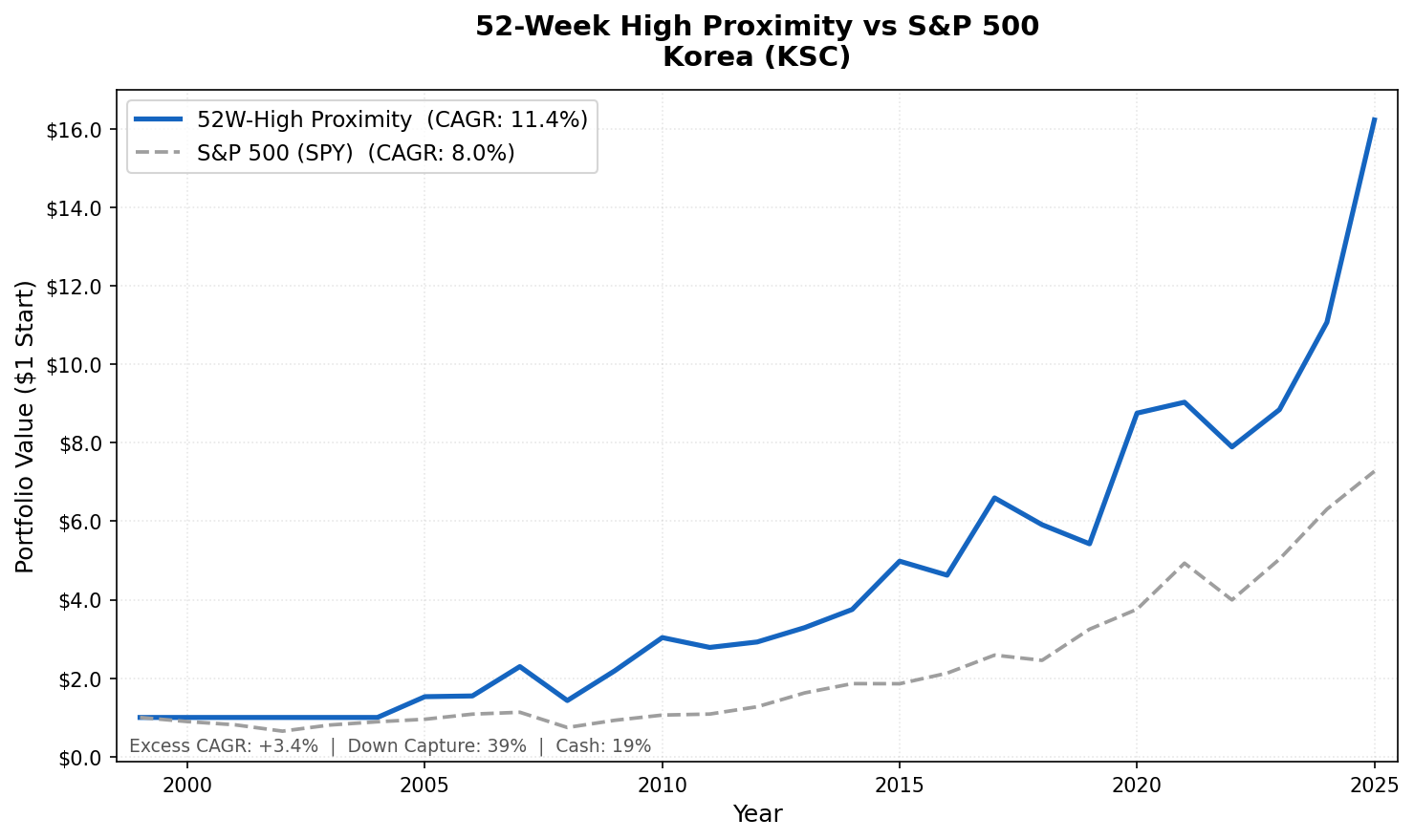
We ran the 52-week high proximity strategy on Korean stocks (KSC) from 2000 to 2025. The result: 11.43% annualized, +3.42% above the S&P 500, 39.1% down capture. A $1 investment grew to $15.23. The strategy held cash for roughly a fifth of the 25 years, and those cash periods lined up well with Korea's worst market environments.
Contents
- Method
- What is the 52-Week High Proximity Strategy?
- What We Found
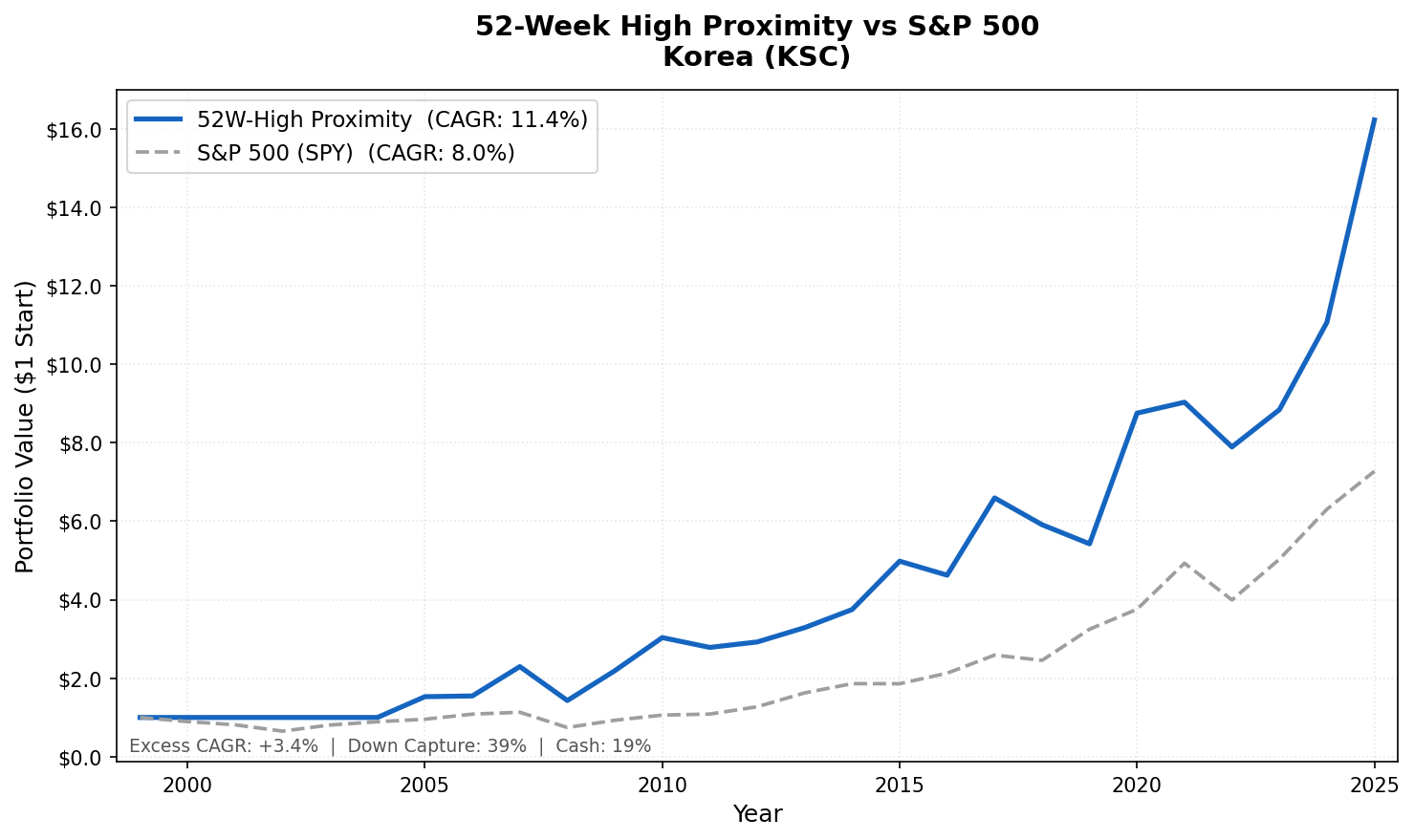
- 11.43% CAGR. 39.1% down capture. $15.23 from $1.
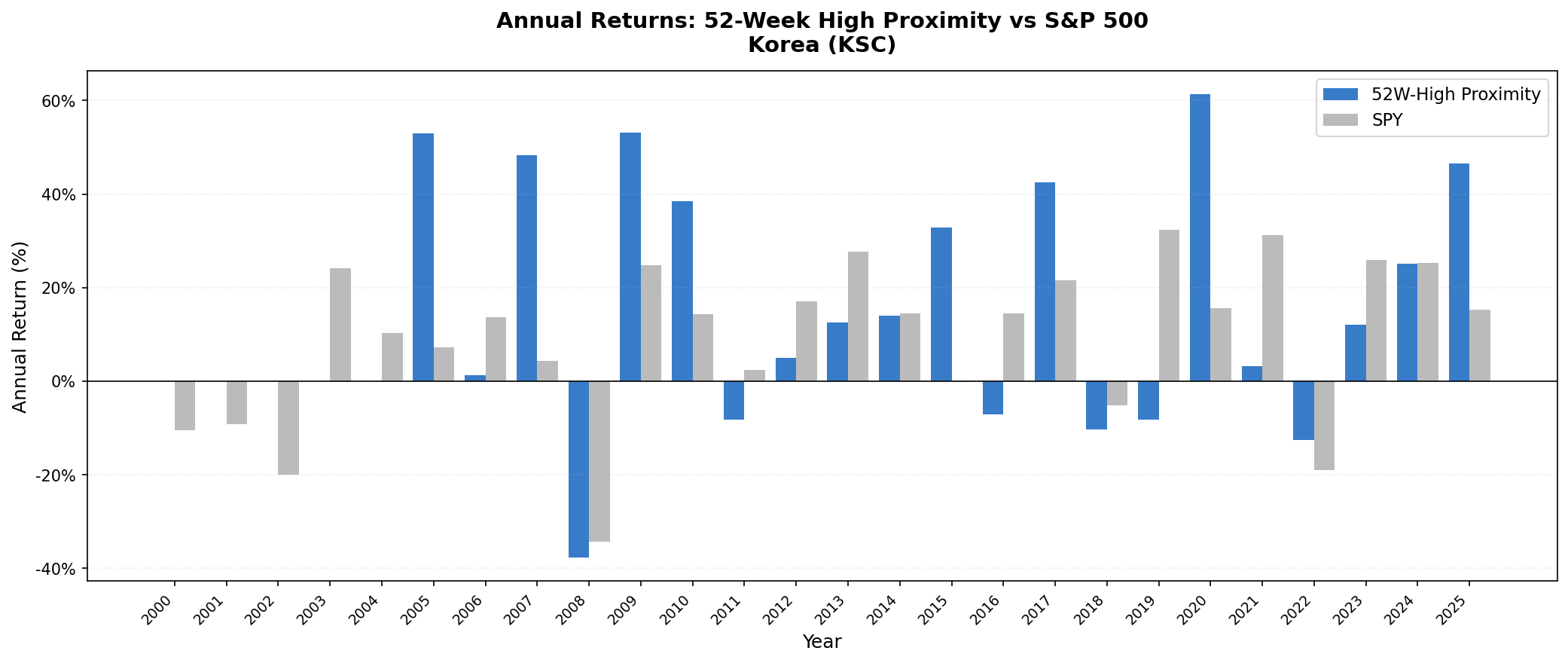
- Year-by-Year Returns
- 2000–2004: five years of cash
- 2005: the KOSPI breakout year
- 2008: slightly worse than SPY but faster recovery
- 2020: the standout upside year at +61.4%
- 2022 and 2025: the downside protection proof
- Why Anchoring Works in Korea
- Limitations
- Run This Screen Yourself
- Part of a Series
- References
Korea's equity story is about downside discipline. The KOSPI is dominated by retail investors (over 60% of daily volume from individual accounts), which makes anchoring effects visible and persistent. The signal finds that. It doesn't always deliver big up years, but it absorbs a fraction of the crashes.
Method
- Data source: Ceta Research (FMP financial data warehouse)
- Universe: KSC (Korea Stock Exchange), market cap > ₩500B
- Period: 2000–2025 (25 years, 103 quarterly periods)
- Rebalancing: Quarterly (January, April, July, October), equal weight
- Benchmark: S&P 500 Total Return (SPY, in USD, cross-currency comparison)
- Returns: Calculated in KRW; SPY in USD for reference
- Cash rule: Hold cash if fewer than 10 stocks qualify
The signal is the proximity ratio: current price divided by the 52-week high (rolling 252 trading days). Stocks are ranked by proximity ratio and the top 30 are held each quarter.
Note on benchmarking: Korea returns are in KRW. SPY is in USD. The comparison shows how the strategy performed against the global equity benchmark, not a currency-adjusted return.
What is the 52-Week High Proximity Strategy?
George and Hwang (2004) showed that stocks trading near their 52-week high outperform stocks far from it. The mechanism is anchoring bias. Investors treat the 52-week high as a psychological ceiling. When a stock approaches it, selling pressure builds from investors who expect resistance. That pressure keeps the price below fundamental value temporarily. When news or earnings push the stock past the anchor, the discount corrects sharply.
Proximity ratio = adjClose / MAX(high over 252 trading days)
A ratio of 1.0 means the stock is at its 52-week high. We select the top 30 stocks by this ratio, closest to their annual peak, and hold them equal weight for one quarter.
What We Found
11.43% CAGR. 39.1% down capture. $15.23 from $1.
| Metric | 52-Week High Korea | S&P 500 |
|---|---|---|
| CAGR | 11.43% | 8.01% |
| Excess Return | +3.42% | — |
| Total Return | $15.23 per $1 | $7.30 per $1 |
| Max Drawdown | -37.9% | -45.53% |
| Sharpe Ratio | 0.418 | 0.354 |
| Up Capture | 88.08% | — |
| Down Capture | 39.1% | — |
| Cash Periods | 19% of quarters | — |
| Avg Stocks (invested) | 28.7 | — |
| Win Rate | 50.5% | — |
The 39.1% down capture is the standout. When US markets fell, this portfolio absorbed less than 40% of the decline. Combined with a max drawdown of just -37.9% (versus SPY's -45.53%), the strategy shows genuine downside management over a 25-year period that included two global crashes and multiple Korea-specific corrections.
The trade-off is up capture. At 88.08%, the strategy captures slightly less of up markets than down. This is the natural consequence of a signal that exits to cash when fewer stocks are near their highs, bear markets reduce the qualifying universe, but so do slow sideways markets where nothing is near an annual peak.
The win rate of 50.5% is exactly market-like. The edge doesn't come from being right more often. It comes from asymmetry: the wins are larger than the losses when they happen.
Year-by-Year Returns
| Year | Korea Strategy | S&P 500 | Excess |
|---|---|---|---|
| 2000 | 0.0% (cash) | -10.5% | n/a |
| 2001 | 0.0% (cash) | -9.2% | n/a |
| 2002 | 0.0% (cash) | -19.9% | n/a |
| 2003 | 0.0% (cash) | +24.1% | n/a |
| 2004 | 0.0% (cash) | +10.2% | n/a |
| 2005 | +53.0% | +7.2% | +45.8% |
| 2006 | +1.2% | +13.7% | -12.5% |
| 2007 | +48.3% | +4.4% | +43.9% |
| 2008 | -37.7% | -34.3% | -3.4% |
| 2009 | +53.1% | +24.7% | +28.4% |
| 2010 | +38.6% | +14.3% | +24.3% |
| 2011 | -8.2% | +2.5% | -10.7% |
| 2012 | +5.0% | +17.1% | -12.1% |
| 2013 | +12.5% | +27.8% | -15.3% |
| 2014 | +14.0% | +14.5% | -0.5% |
| 2015 | +32.8% | -0.1% | +32.9% |
| 2016 | -7.2% | +14.4% | -21.6% |
| 2017 | +42.6% | +21.6% | +21.0% |
| 2018 | -10.4% | -5.2% | -5.2% |
| 2019 | -8.2% | +32.3% | -40.5% |
| 2020 | +61.4% | +15.6% | +45.8% |
| 2021 | +3.2% | +31.3% | -28.1% |
| 2022 | -12.6% | -19.0% | +6.4% |
| 2023 | +12.0% | +26.0% | -14.0% |
| 2024 | +25.2% | +25.3% | -0.1% |
| 2025 | +46.6% | +15.3% | +31.3% |
2000–2004: five years of cash
The KOSPI didn't have enough stocks near their 52-week highs during these years for the signal to fire. Korea was recovering from the 1997–1998 Asian financial crisis. Corporate restructuring was ongoing. The market had low conviction periods where most stocks were well below annual peaks.
Five years of cash meant missing the 2003 US recovery (+24.1%). But it also meant avoiding the 2001 and 2002 US losses. On balance, the cash periods from 2000–2004 preserved the portfolio for the 2005 entry at a clean base.
2005: the KOSPI breakout year
When the signal fired in 2005, it found exactly what it was designed to capture. +53.0% in a single year, against SPY's 7.2%. Korea's mid-cap industrial and technology companies were approaching annual highs on improving fundamentals. The proximity screen positioned in them before the breakout extended.
2008: slightly worse than SPY but faster recovery
2008 was -37.7% for the strategy, versus -34.3% for SPY. The KOSPI fell hard in the global crisis. Korea's export-heavy economy is cyclically sensitive. The 3.4 percentage point underperformance is the honest weakness: concentrated cyclical stocks in an open economy are vulnerable when global trade seizes.
But 2009 returned +53.1%. The recovery was faster than the drawdown, and by 2010 (+38.6%) the portfolio had rebuilt substantially.
2020: the standout upside year at +61.4%
2020 was the strongest single-year result. COVID crashed markets in March, but Korea's equity market recovered with unusual speed. The KOSPI was driven partly by retail investor participation (Korean retail investors became very active during the COVID period) and partly by Korea's early economic recovery relative to Western markets.
The proximity signal captured the strongest-recovering stocks within that environment. +61.4% against SPY's 15.6%.
2022 and 2025: the downside protection proof
2022 shows the signal working as designed during a genuine bear market. US rates rose sharply, SPY fell 19.0%, and the Korea strategy fell only 12.6%, absorbing 66% of the decline. Some of Korea's domestic-oriented sectors held up better than US equities in that environment.
2025 is the other standout: +46.6% when SPY returned 15.3%. A 31.3 percentage point outperformance in a recent year. Korean semiconductor and technology stocks in 2025 showed strong relative strength after underperformance in 2023–2024, and the proximity signal was positioned there before the move.
Why Anchoring Works in Korea
Korea's equity market has one of the highest retail participation rates globally. Individual investors account for over 60% of daily KOSPI volume. Retail investors are particularly susceptible to anchoring, they watch 52-week highs and all-time highs as reference points for "expensive" and "cheap."
This creates predictable behavior around annual highs. Retail selling pressure builds as stocks approach the 52-week high level. The proximity signal positions the portfolio precisely in those stocks. When the anchor breaks to the upside, the retail sellers are proven wrong, and the repricing is sharp.
The 19% cash periods (roughly one in five quarters) reflect an important feature of the signal. When Korean markets are trending lower, fewer stocks are near their highs. The screen naturally reduces exposure. This isn't a deliberate market-timing mechanism, it's the signal being selective about what qualifies. The effect is a portfolio that's inherently less invested in bad environments.
Limitations
Currency risk. Returns are in KRW. KRW/USD fluctuations affect the cross-currency comparison. Korean investors wouldn't face this, but international investors should account for it.
Cash periods miss up markets. The five cash years from 2000–2004 missed the 2003 SPY recovery (+24.1%). In periods where the broader market rallies but individual stocks aren't near highs, the strategy sits out. This is protection in bad environments but a drag in uneven recoveries.
Max drawdown of 37.9% in 2008. Still a large single-event loss. The downside protection is relative, not absolute.
Liquidity. Mid-cap Korean stocks have thinner order books outside the top-tier names. Real execution costs for larger positions could exceed the modeled transaction costs.
Survivorship bias. Companies that delisted or failed during the 25-year period aren't fully tracked. Drawdowns are likely understated somewhat.
Run This Screen Yourself
Current 52-week high proximity screen (Korean stocks):
SELECT
    s.symbol,
    p.companyName,
    p.sector,
    ROUND(s.adjClose / MAX(s.high) OVER (
        PARTITION BY s.symbol
        ORDER BY s.date
        ROWS BETWEEN 251 PRECEDING AND CURRENT ROW
    ), 4) AS proximity_ratio,
    ROUND(p.mktCap / 1e9, 2) AS mktcap_bn_krw
FROM stock_eod s
JOIN profile p ON s.symbol = p.symbol
WHERE p.exchange IN ('KSC')
  AND p.mktCap > 500000000000
  AND s.date = (SELECT MAX(date) FROM stock_eod)
QUALIFY ROW_NUMBER() OVER (PARTITION BY s.symbol ORDER BY s.date DESC) = 1
ORDER BY proximity_ratio DESC
LIMIT 30
Run this screen on Ceta Research
The full backtest code (Python + DuckDB) is on GitHub.
Part of a Series
This post is part of our 52-week high proximity global exchange comparison:
- India (BSE + NSE): 26.7% CAGR, 23% Down Capture
- Thailand (SET): Anchoring Works in Emerging Markets Too
- Japan (JPX): Steady Alpha in a Flat Market
- Global Comparison: 52-Week High Proximity Across Exchanges
References
- George, T. & Hwang, C. (2004). "The 52-Week High and Momentum Investing." Journal of Finance, 59(5), 2145–2176.
- Jegadeesh, N. & Titman, S. (1993). "Returns to Buying Winners and Selling Losers: Implications for Stock Market Efficiency." Journal of Finance, 48(1), 65–91.
- Kaniel, R., Saar, G. & Titman, S. (2008). "Individual Investor Trading and Stock Returns." Journal of Finance, 63(1), 273–310. (Retail investor behavior and market impact)
Part of a Series: Global | US | Thailand | Japan | India
Run It Yourself
Explore the data behind this analysis on Ceta Research. Query our financial data warehouse with SQL, build custom screens, and run your own backtests across 70,000+ stocks on 20 exchanges.
Data: Ceta Research (FMP financial data warehouse). Universe: KSC, market cap > ₩500B. Quarterly rebalance, equal weight, transaction costs included, 2000–2025. Returns in KRW.