Yield Gap Sweden: Strong Alpha with a 64% Win Rate (2000-2025)

Contents
Sweden doesn't come to mind first when thinking about value investing. But among the markets we tested, Stockholm delivered the third-highest excess return in our 20-exchange study, with a 64% annual win rate against SPY and a return profile that compounded well across multiple market cycles.
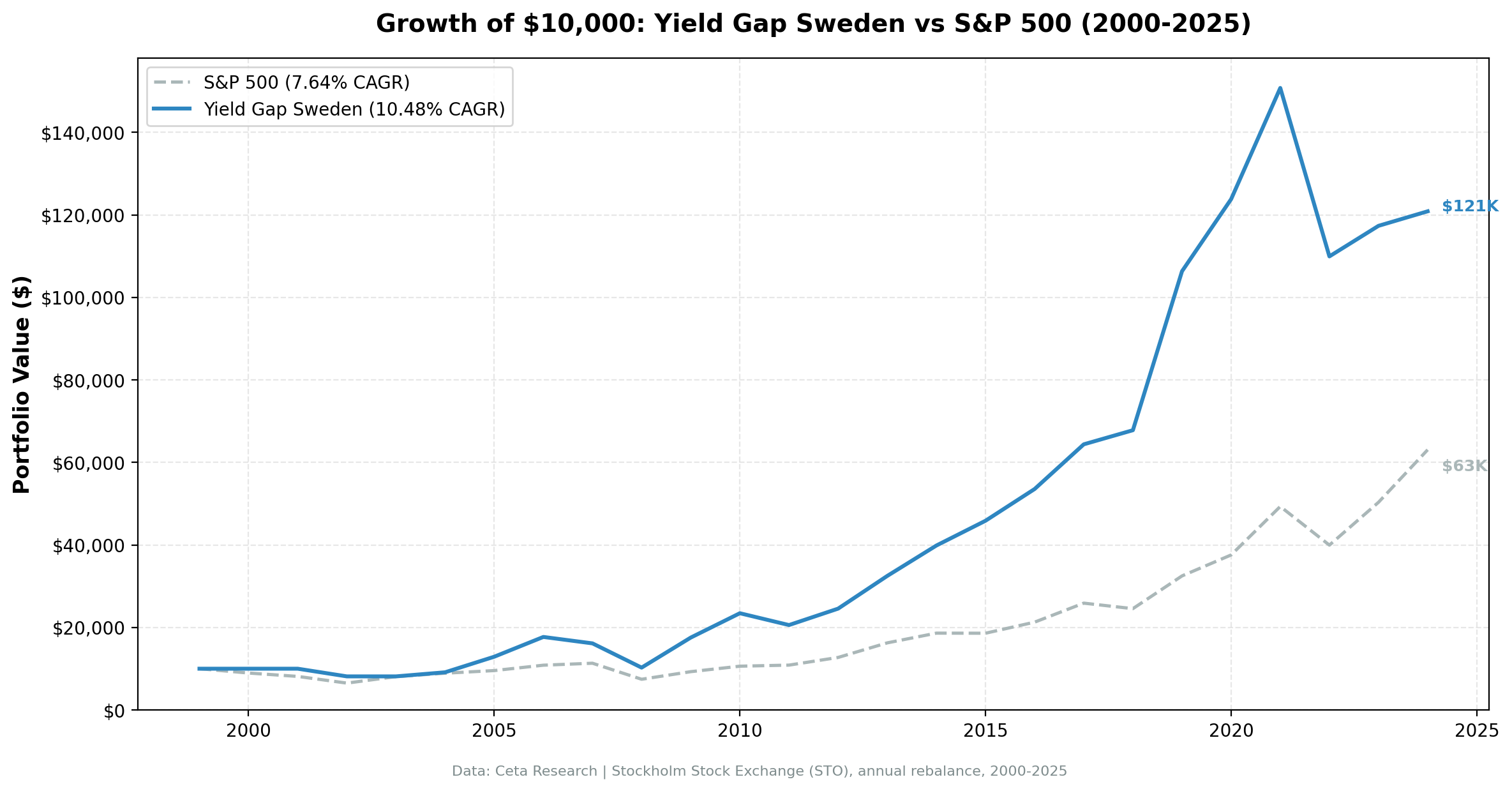
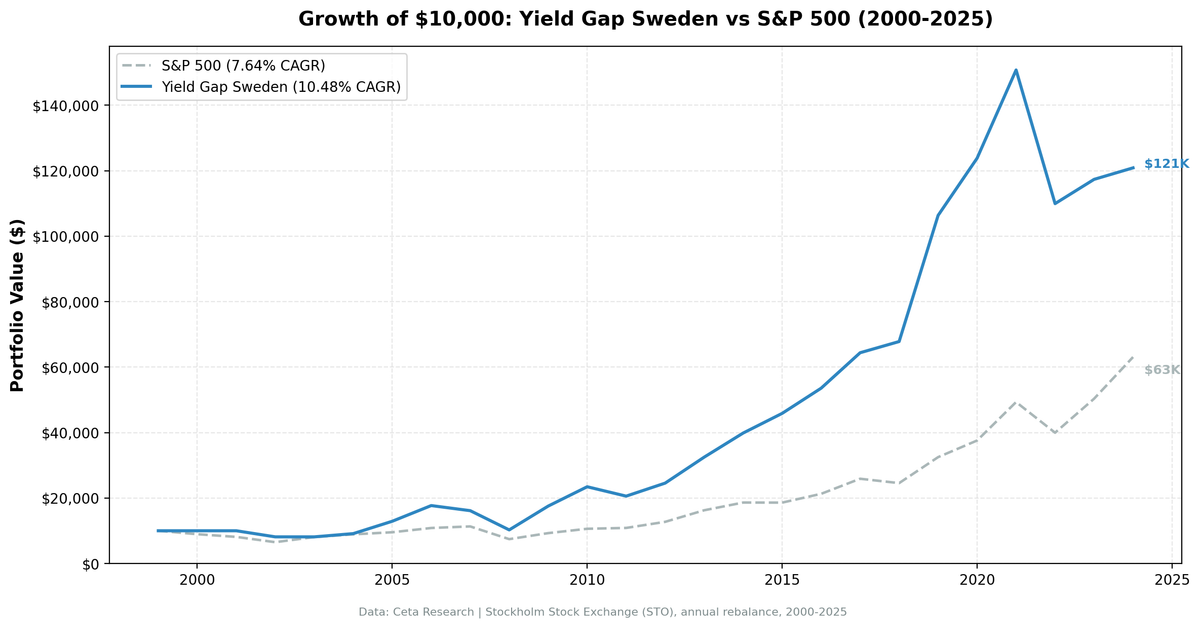
A $10,000 investment grew to $120,863 using this strategy. SPY grew to $63,066 over the same period.
The Strategy
Sweden's risk-free rate over this period averaged roughly 2%, putting the effective threshold at 6% earnings yield (the 6% absolute floor applies, since rfr+3% = 5% is below the floor). PE ratios below ~16.7x.
Signal: - Earnings yield > 6% (PE < ~16.7x) - Earnings yield < 50% - ROE > 8% - D/E < 2.0
Portfolio construction: Top 30 by highest earnings yield, equal weight, annual January rebalance. Cash if fewer than 10 stocks qualify. Three years at the start of the backtest (2000, 2001, 2003) saw fewer than 10 qualifying stocks, the portfolio held cash for those years, which explains some of the early-period performance differences.
Methodology
- Universe: Stockholm Stock Exchange (STO)
- Market cap filter: SEK 2B+ at each rebalance date
- Data period: January 2000 through December 2025 (25 annual periods, 12% cash years, 3 of 25)
- Rebalancing: Annual (January)
- Point-in-time data: FY filings with 45-day filing lag
- Transaction costs: Size-tiered model
- Benchmark: SPY
- Data source: Ceta Research FMP financial data warehouse
Full methodology at github.com/ceta-research/backtests/blob/main/METHODOLOGY.md.
Results
| Metric | Yield Gap Sweden | SPY |
|---|---|---|
| CAGR | 10.48% | 7.64% |
| Total return (25yr) | 1,108.6% | 530.7% |
| Max drawdown | -42.00% | -45.50% |
| Sharpe ratio | 0.344 | — |
| Down capture vs SPY | 62.9% | — |
| Win rate vs SPY | 64.0% | — |
| Cash periods | 3 of 25 years (12%) | — |
| Avg stocks (invested) | 26.5 | — |
The 64% win rate is the highest in our study (tied with India). In 14 of 22 invested years, the portfolio beat SPY. That level of consistency matters: most of the excess return wasn't generated in a single lucky stretch, it came from repeated small wins across decades.
The 62.9% down-capture also means the strategy absorbed less downside in bear years on average, compounding the advantage.
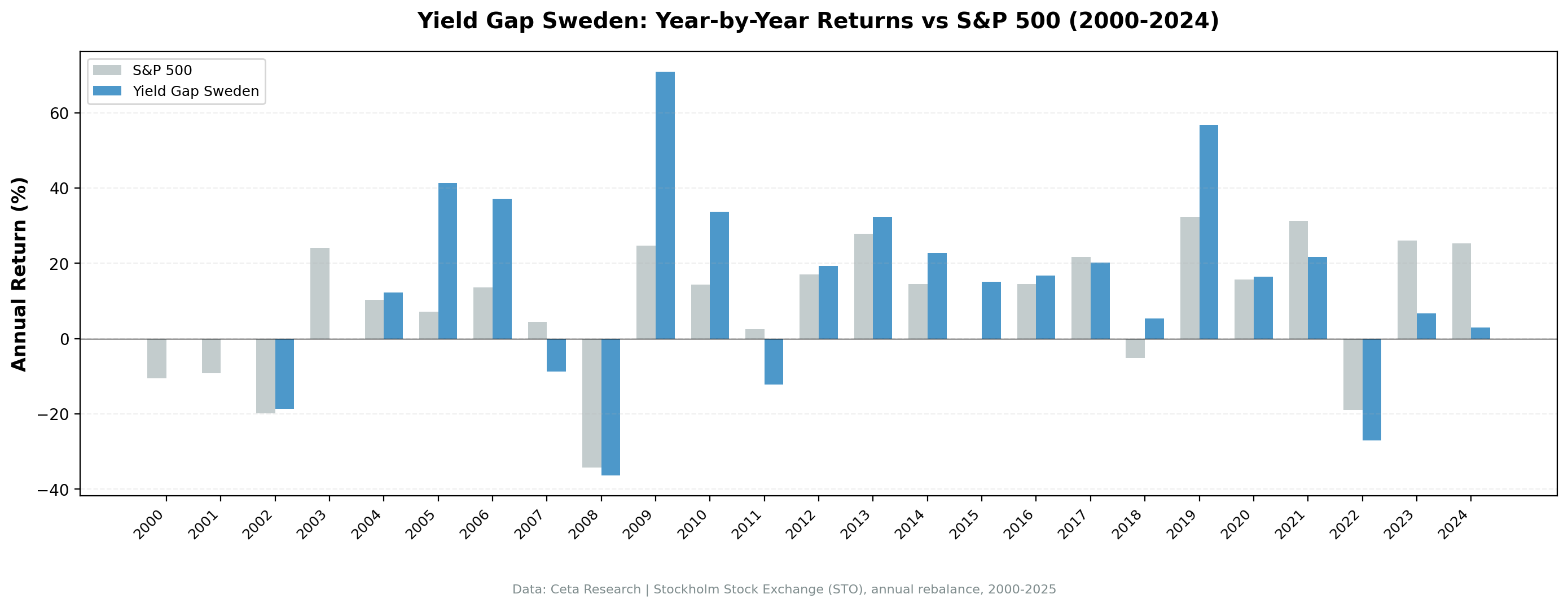
Annual returns:
| Year | Portfolio | SPY | Excess |
|---|---|---|---|
| 2000 | 0.00% (cash) | -10.50% | +10.50% |
| 2001 | 0.00% (cash) | -9.17% | +9.17% |
| 2002 | -18.62% | -19.92% | +1.30% |
| 2003 | 0.00% (cash) | +24.12% | -24.12% |
| 2004 | +12.20% | +10.24% | +1.96% |
| 2005 | +41.31% | +7.17% | +34.14% |
| 2006 | +37.15% | +13.65% | +23.50% |
| 2007 | -8.81% | +4.40% | -13.21% |
| 2008 | -36.40% | -34.31% | -2.09% |
| 2009 | +70.91% | +24.73% | +46.18% |
| 2010 | +33.66% | +14.31% | +19.35% |
| 2011 | -12.22% | +2.46% | -14.68% |
| 2012 | +19.34% | +17.09% | +2.25% |
| 2013 | +32.27% | +27.77% | +4.50% |
| 2014 | +22.68% | +14.50% | +8.18% |
| 2015 | +15.07% | -0.12% | +15.19% |
| 2016 | +16.78% | +14.45% | +2.33% |
| 2017 | +20.22% | +21.64% | -1.42% |
| 2018 | +5.31% | -5.15% | +10.46% |
| 2019 | +56.83% | +32.31% | +24.52% |
| 2020 | +16.44% | +15.64% | +0.80% |
| 2021 | +21.76% | +31.26% | -9.50% |
| 2022 | -27.08% | -18.99% | -8.09% |
| 2023 | +6.74% | +26.00% | -19.26% |
| 2024 | +3.00% | +25.28% | -22.28% |
Note: 2000, 2001, and 2003 show 0% returns, the portfolio held cash in those years because fewer than 10 stocks met the EY > 6% / ROE > 8% / D/E < 2 criteria. The STO universe took a few years to yield enough qualifying stocks.
What Drove the Returns
2005-2006 and 2009-2010 were transformative. Swedish industrials and consumer companies were genuinely cheap in the mid-2000s relative to earnings. The portfolio returned +41.31% in 2005 and +37.15% in 2006, capturing a broad re-rating of Scandinavian value stocks. The 2009 bounce of +70.91% then added another enormous compounding step.
2019 stands out. +56.83% vs +32.31% SPY (+24.52% excess). Sweden had a large population of high-earnings-yield industrial and specialty companies that rerated sharply that year. No single event explains it, it was a broad Swedish mid-cap value recovery.
2018 showed defensive quality. +5.31% vs -5.15% SPY (+10.46% excess). While US markets fell on Fed tightening fears and trade war noise, Swedish quality value stocks held up, many with lower US exposure and simpler business models.
2022-2024 has been difficult. Three consecutive years of underperformance relative to SPY, with 2023 and 2024 particularly painful as SPY rallied on AI and mega-cap narratives. This is the same issue as every value screen globally: a market dominated by a few high-multiple compounders is a bad environment for any PE-floor strategy.
The cash years cost some early compounding. Holding cash in 2003 (when SPY returned +24.12%) was the worst cash-year outcome, a 24-point miss. But 2000 (cash, avoided -10.50%) and 2001 (cash, avoided -9.17%) offset that. Net, the cash years were roughly neutral to the long-run return.
Part of a Series: Global | US | UK | India | Canada
Run It Yourself
Full backtest:
git clone https://github.com/ceta-research/backtests.git
cd backtests
pip install -r requirements.txt
python3 yield-gap/backtest.py --preset sweden --output results.json --verbose
Limitations
Currency risk: Returns in SEK. SEK/USD has been volatile, particularly during the 2022-2023 period when SEK weakened substantially against USD. USD-based investors would have experienced lower returns.
Cash years create uncertainty: Three early years of cash holding mean the 25-year track record includes periods where the strategy simply wasn't active. The actual invested-period CAGR is higher than the headline number, but so is the realized sequence risk.
Small universe: STO has a smaller number of large-cap companies than US or UK markets. In some years, the portfolio held 20-25 stocks at maximum, sector concentration is higher than in more liquid markets.
Sweden's economy is global: Swedish large-cap companies (engineering, industrials, financial) have heavy international revenue exposure. Returns are partly driven by global industrial cycle dynamics, not just Swedish domestic conditions.
Run It Yourself
Explore the data behind this analysis on Ceta Research. Query our financial data warehouse with SQL, build custom screens, and run your own backtests across 70,000+ stocks on 20 exchanges.
Data: Ceta Research (FMP financial data warehouse), January 2000 through December 2025. Full methodology: github.com/ceta-research/backtests/blob/main/METHODOLOGY.md.
Academic references: Campbell, J.Y. & Vuolteenaho, T. (2004). "Bad Beta, Good Beta." American Economic Review, 94(5). Damodaran, A. (2012). "Equity Risk Premiums (ERP): Determinants, Estimation and Implications." Stern School of Business.