Analyst Upgrades on UK: Sustained Drift and a Strong Cluster Effect

Analyst Upgrades on UK Stocks: Sustained Drift and a Strong Cluster Effect
We measured 9,059 individual analyst upgrades on LSE-listed UK stocks from 2012 to 2025. Upgrades produce immediate price impact and the drift sustains through three months. The cluster effect, multiple independent firms upgrading within 30 days, produces 4x the drift of single-analyst events.
Contents
- Method
- What We Found
- Sustained drift through three months
- Cluster effect: 4x the drift at T+21
- Downgrades deepen over the quarter
- The Data
- Limitations
- Takeaway
Method
- Data source: Ceta Research (FMP stock_grade table, individual analyst grade changes)
- Universe: LSE (London Stock Exchange), market cap above £300M GBP
- Period: 2012–2025 (14 years, 17,839 events including downgrades)
- Study type: Event study. Each event measured independently.
- Benchmark: EWU (iShares MSCI United Kingdom ETF)
- Windows: T+1, T+5, T+21, T+63 trading days after the event
- Abnormal return: Stock return minus EWU return at each window
What We Found
Sustained drift through three months
| Window | Upgrade CAR | t-stat | Downgrade CAR | t-stat |
|---|---|---|---|---|
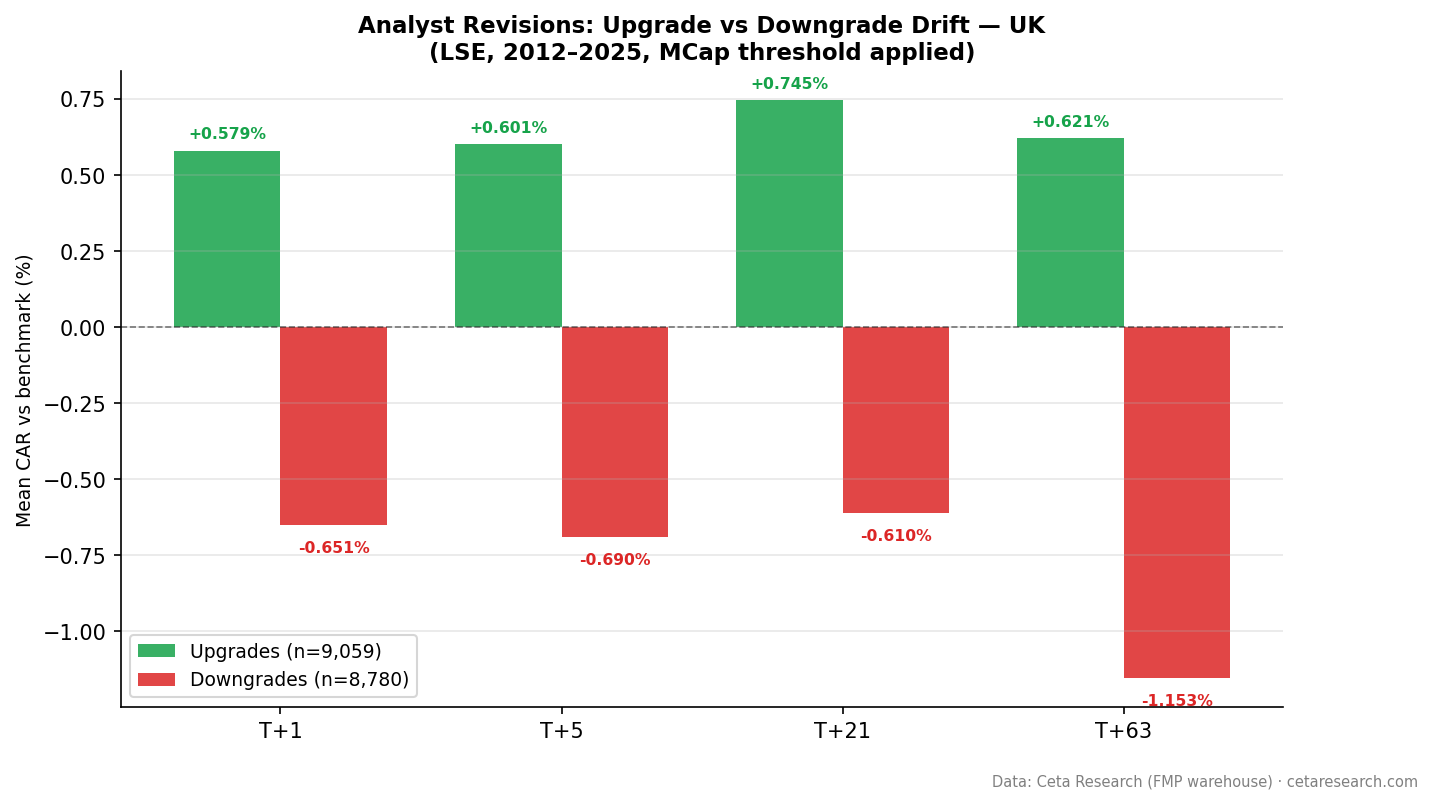
| T+1 | +0.579% | 19.4 | -0.651% | -19.3 |
| T+5 | +0.601% | 10.8 | -0.690% | -11.0 |
| T+21 | +0.745% | 7.1 | -0.610% | -5.3 |
| T+63 | +0.621% | 3.2 | -1.153% | -5.8 |
n=9,059 upgrades, n=8,780 downgrades. Winsorized mean. All windows significant at p<0.05.
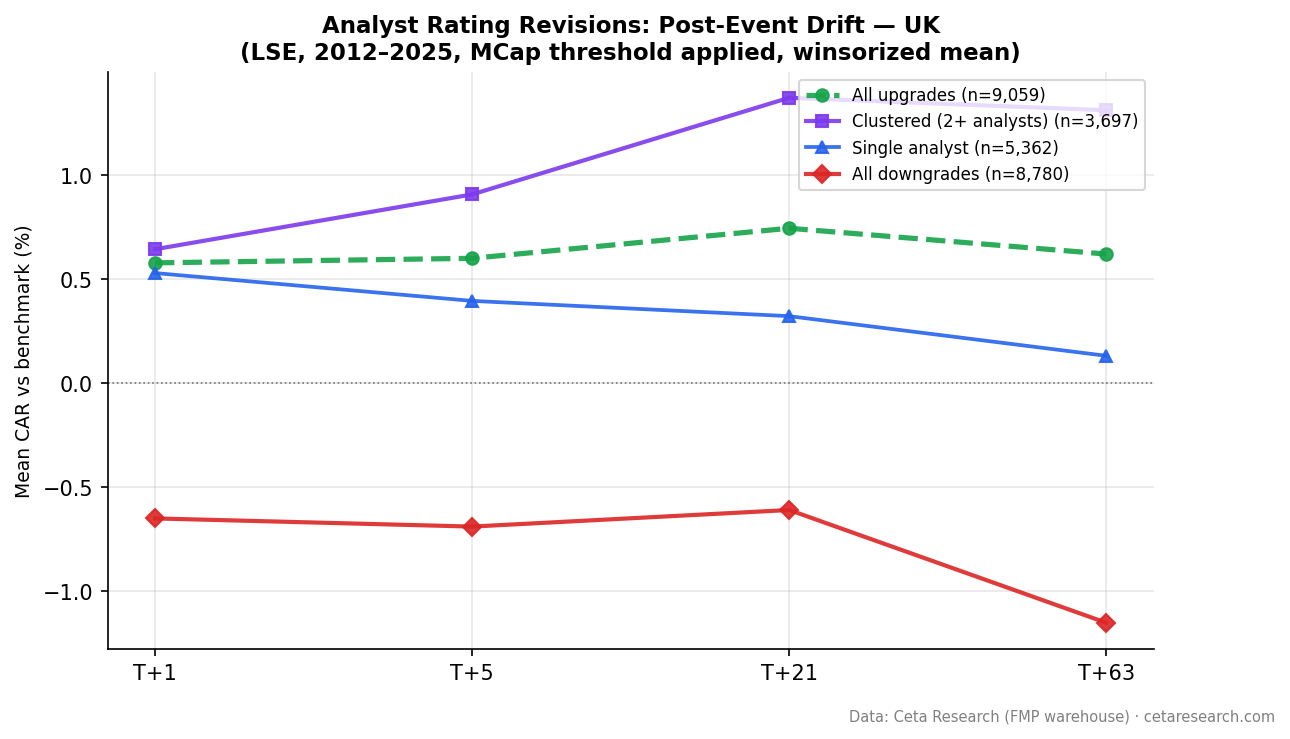
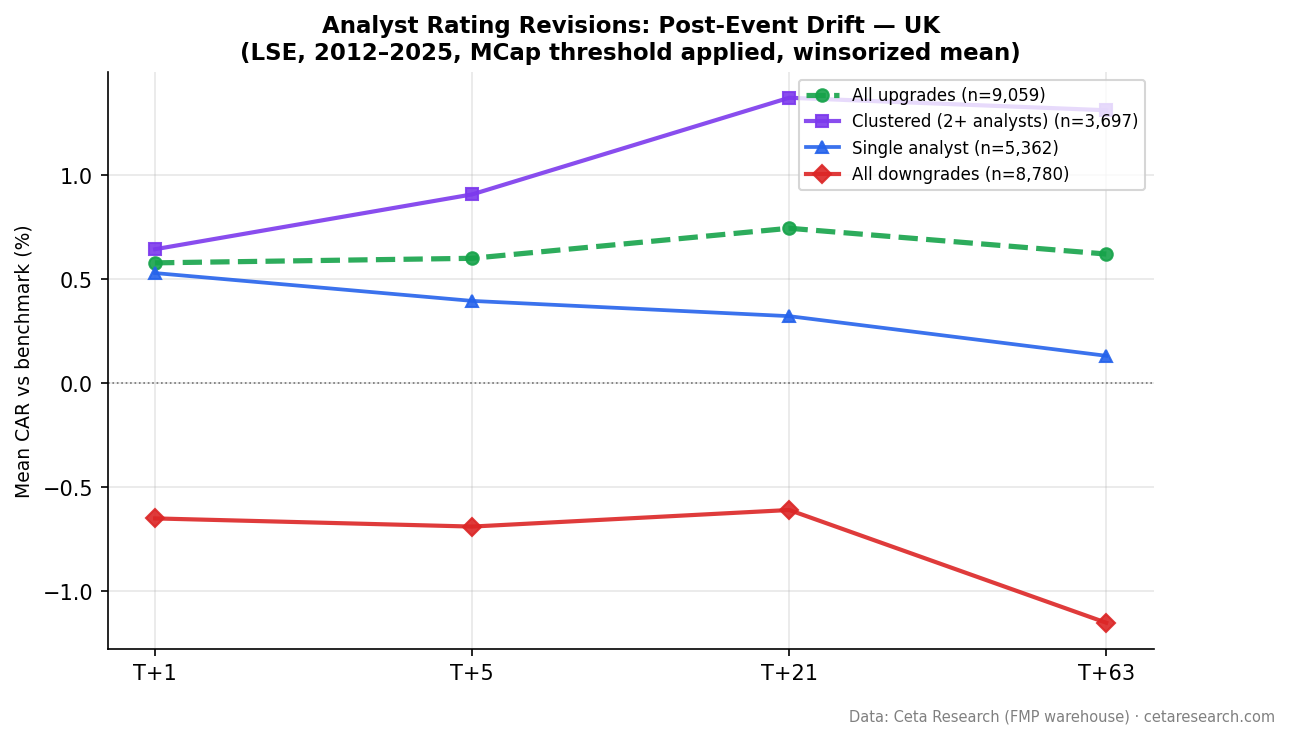
The UK profile is different from both the US and Germany. In the US, upgrade drift peaks at T+5 and gradually fades. In Germany, it keeps accelerating through T+63. In the UK, it rises through T+21 and then plateaus, +0.58% on day one, +0.75% at one month, +0.62% at three months. Sustained but not accelerating.
Cluster effect: 4x the drift at T+21
| Category | n | T+1 | T+21 | T+63 |
|---|---|---|---|---|
| Clustered (2+ analysts) | 3,697 | +0.644% | +1.373% | +1.313% |
| Single analyst | 5,362 | +0.530% | +0.322% | +0.132% (ns) |
Single-analyst upgrades fade to +0.13% at three months (not statistically significant). Clustered upgrades hold at +1.31%, significant at every window.
The cluster split is useful practically: when a UK stock sees upgrades from multiple firms within 30 days, the one-month expected drift is 4x higher than a single-analyst event. Single upgrades on LSE produce short-term moves that fade quickly.
Downgrades deepen over the quarter
UK downgrades start at -0.65% on day one and deepen to -1.15% at three months. All windows are statistically significant. The pattern mirrors the US, downgrades on UK stocks carry information that gets priced in gradually.
The Data
Limitations
EWU as benchmark. EWU holds primarily large-cap UK stocks. Mid-cap LSE companies may have different market exposure, which means EWG may not fully capture their systematic risk. Abnormal returns could include residual factor exposures.
Currency effects. UK stocks are denominated in GBP; EWU converts to USD. For a UK investor, the benchmark would be a direct UK index. The currency layer adds noise.
Event timing. UK analyst reports are often released pre-market. T+1 returns capture the first full trading day after revision, but some of the return may already be in the price within hours of release.
Coverage concentration. FMP's stock_grade data for LSE is concentrated in large- and mid-cap stocks. Very small LSE companies are under-represented, which means results apply primarily to the institutionally covered universe.
Takeaway
UK analyst upgrades produce real, sustained price impact. The average upgrade runs +0.58% above EWU on day one and +0.75% at one month, with the signal holding through the full 63 trading days.
The cluster effect separates actionable from background noise: multiple independent firms upgrading within 30 days produces +1.37% at one month vs +0.32% for single-analyst upgrades. Single upgrades on LSE fade quickly and are statistically insignificant by three months.
Downgrades carry more weight than upgrades, they deepen from -0.65% to -1.15% over the quarter.
Part of a Series: S Global Comparison Event Study | Global | US | S Germany Xetra Event Study | US
Run It Yourself
Explore the data behind this analysis on Ceta Research. Query our financial data warehouse with SQL, build custom screens, and run your own backtests across 70,000+ stocks on 20 exchanges.
Data: FMP warehouse via Ceta Research, 2012–2025. LSE stocks, market cap >£300M. Benchmark: EWU.
Backtest code on GitHub. Live screen: python3 analyst-revision/screen.py --preset uk