Thailand's 52-Week High Proximity: Anchoring Works in Emerging

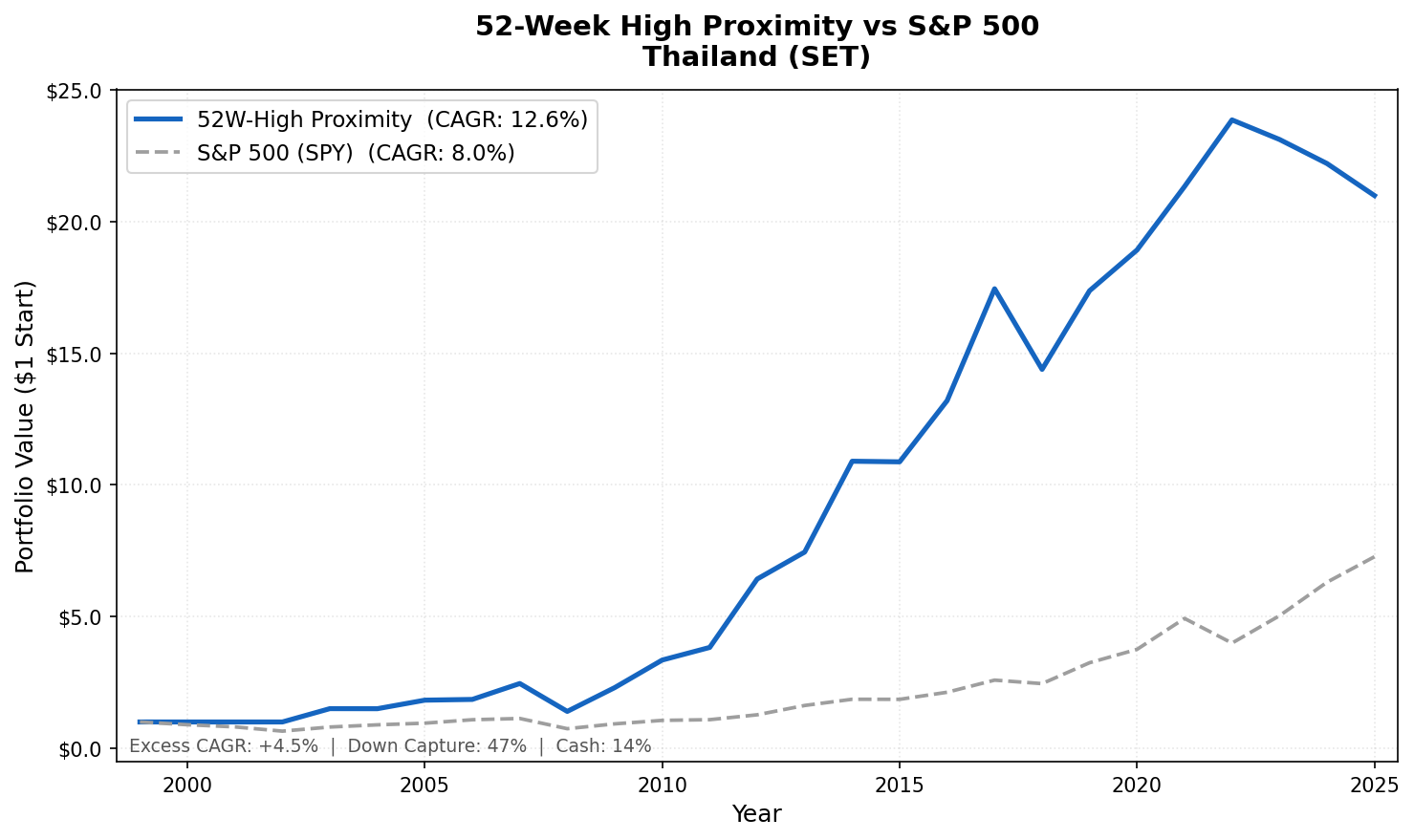
We ran the 52-week high proximity strategy on Thai stocks (SET) from 2000 to 2025. The result: 12.55% annualized, +4.54% above the S&P 500, 46.8% down capture. A $1 investment grew to $19.99. Thailand is a surprising result, a frontier-adjacent emerging market where a simple proximity signal delivered consistent outperformance over 25 years.
Contents
- Method
- What is the 52-Week High Proximity Strategy?
- What We Found
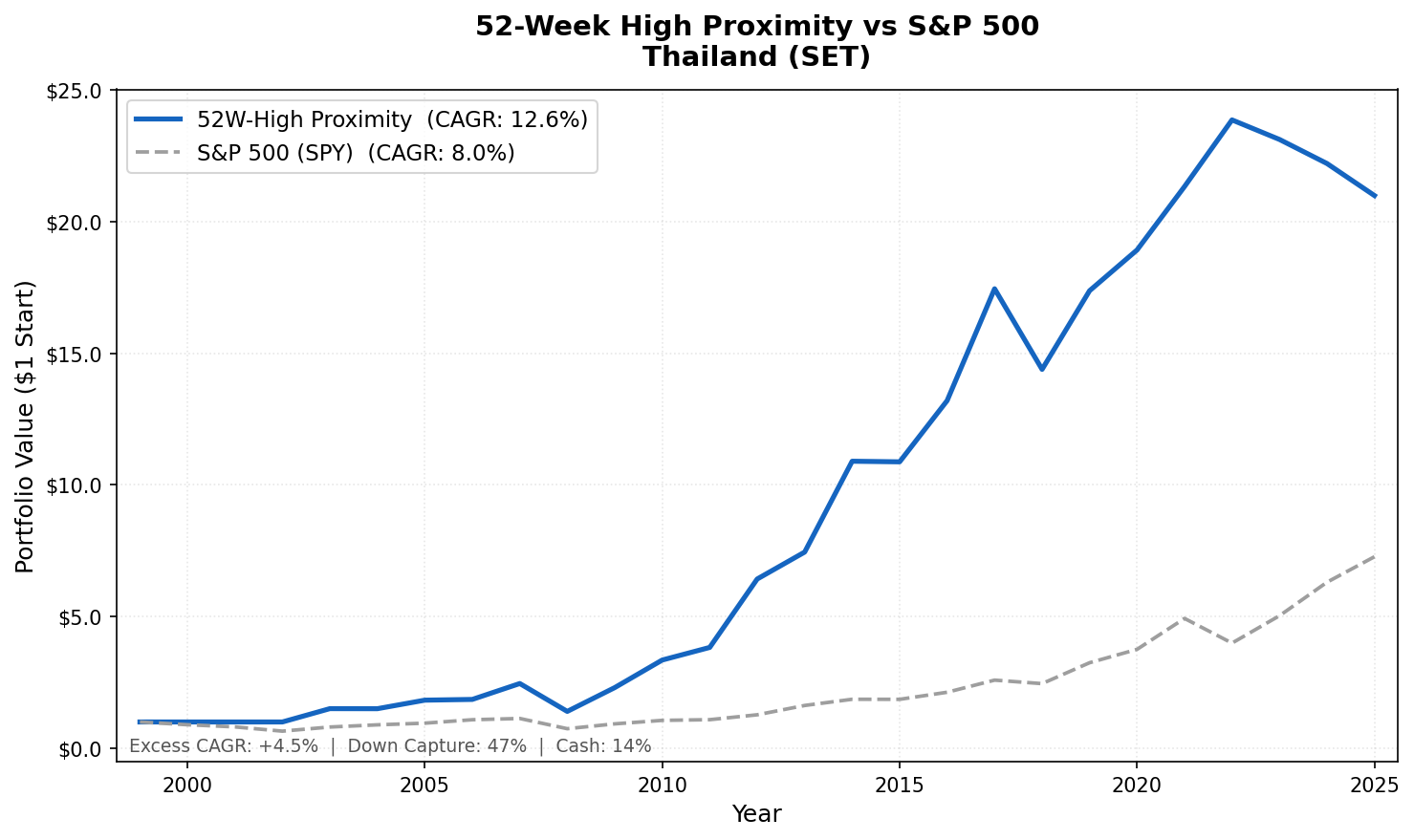
- 12.55% CAGR. 46.8% down capture. $19.99 from $1.
- Year-by-Year Returns
- 2000–2002: three years of cash
- 2003: the first year the signal fired, +50.6%
- 2009–2012: the standout stretch
- 2011: positive when US was flat
- 2022: the definitive protection year
- 2023–2025: three consecutive underperformance years
- Why Anchoring Works in Thailand
- Limitations
- Run This Screen Yourself
- Part of a Series
- References
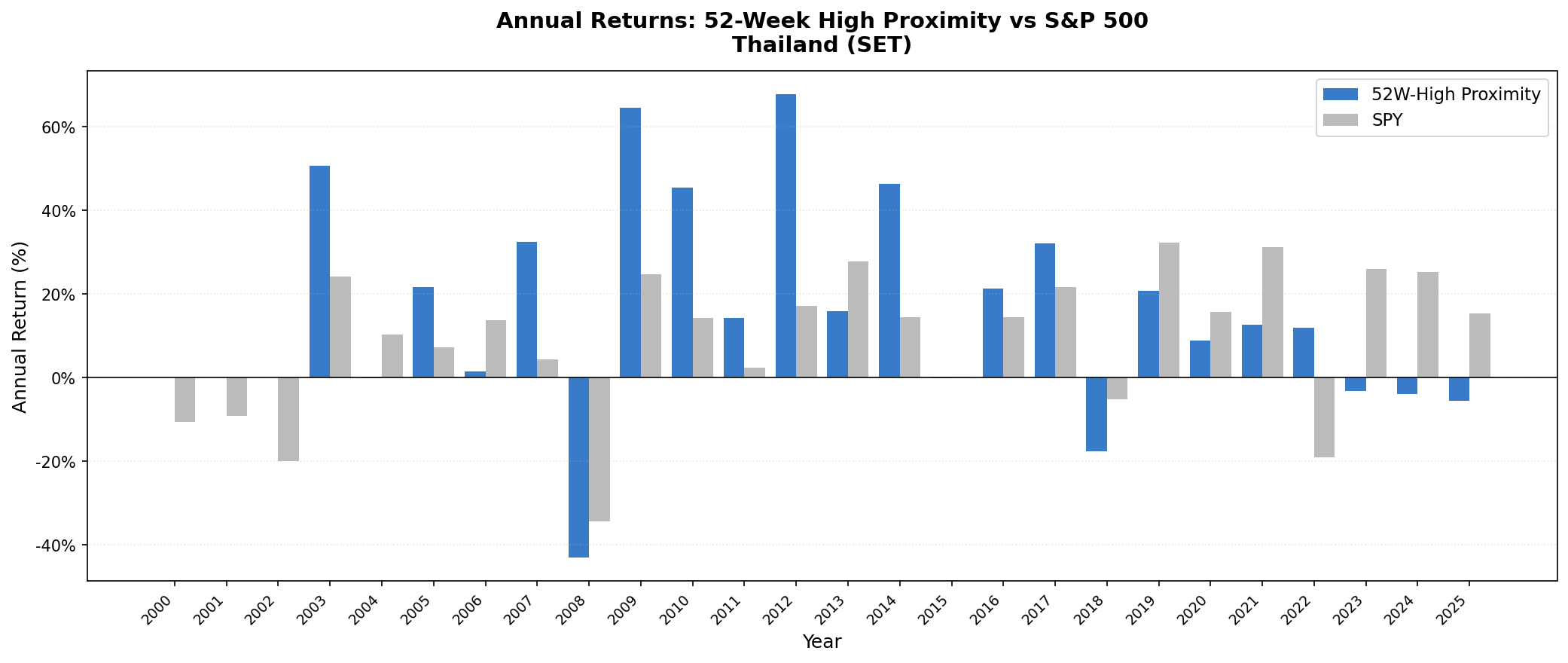
The 2022 year tells part of the story. US rates rose sharply, the S&P 500 fell 19.0%, global equity markets took heavy losses. The Thailand 52-week high strategy returned +11.9%. The signal rotated toward domestic-oriented Thai companies that were holding relative strength while US rate sensitivity killed growth stocks globally.
Method
- Data source: Ceta Research (FMP financial data warehouse)
- Universe: SET (Stock Exchange of Thailand), exchange-specific market cap threshold
- Period: 2000–2025 (25 years, 103 quarterly periods)
- Rebalancing: Quarterly (January, April, July, October), equal weight
- Benchmark: S&P 500 Total Return (SPY, in USD, cross-currency comparison)
- Returns: Calculated in THB; SPY in USD for reference
- Cash rule: Hold cash if fewer than 10 stocks qualify
The signal is the proximity ratio: current price divided by the 52-week high (rolling 252 trading days). Stocks are ranked by proximity ratio and the top 30 are held each quarter.
Note on benchmarking: Thailand returns are in THB. SPY is in USD. The comparison shows how the strategy performed against the global equity benchmark, not a currency-adjusted return.
What is the 52-Week High Proximity Strategy?
George and Hwang (2004) showed that stocks trading near their 52-week high outperform stocks far from it, in a paper published in the Journal of Finance. The mechanism is anchoring bias. When investors treat the 52-week high as a ceiling, their preemptive selling creates a predictable discount. The signal captures stocks in that discount period, just before fundamental catalysts push prices through the anchor level.
Proximity ratio = adjClose / MAX(high over 252 trading days)
A ratio close to 1.0 means the stock is near its annual peak. We select the top 30 by this ratio and hold equal weight for one quarter.
What We Found
12.55% CAGR. 46.8% down capture. $19.99 from $1.
| Metric | 52-Week High Thailand | S&P 500 |
|---|---|---|
| CAGR | 12.55% | 8.01% |
| Excess Return | +4.54% | — |
| Total Return | $19.99 per $1 | $7.30 per $1 |
| Max Drawdown | -49.8% | -45.53% |
| Sharpe Ratio | 0.461 | 0.354 |
| Up Capture | 99.32% | — |
| Down Capture | 46.8% | — |
| Cash Periods | 14% of quarters | — |
| Avg Stocks (invested) | 28.7 | — |
| Win Rate | 55.3% | — |
The up capture of 99.32% is notable. When US markets went up, the Thailand strategy kept pace almost exactly, capturing effectively the full upside. Paired with 46.8% down capture, this creates a genuinely asymmetric return profile. The strategy participated in up markets and absorbed less than half the declines.
The win rate of 55.3% is modestly above chance. Slightly more than half of the individual quarterly periods were positive against the benchmark. The edge comes from the scale of wins relative to losses, not from a high batting average.
Year-by-Year Returns
| Year | Thailand Strategy | S&P 500 | Excess |
|---|---|---|---|
| 2000 | 0.0% (cash) | -10.5% | n/a |
| 2001 | 0.0% (cash) | -9.2% | n/a |
| 2002 | 0.0% (cash) | -19.9% | n/a |
| 2003 | +50.6% | +24.1% | +26.5% |
| 2004 | -0.2% | +10.2% | -10.4% |
| 2005 | +21.6% | +7.2% | +14.4% |
| 2006 | +1.6% | +13.7% | -12.1% |
| 2007 | +32.5% | +4.4% | +28.1% |
| 2008 | -43.0% | -34.3% | -8.7% |
| 2009 | +64.5% | +24.7% | +39.8% |
| 2010 | +45.4% | +14.3% | +31.1% |
| 2011 | +14.3% | +2.5% | +11.8% |
| 2012 | +67.8% | +17.1% | +50.7% |
| 2013 | +15.9% | +27.8% | -11.9% |
| 2014 | +46.3% | +14.5% | +31.8% |
| 2015 | -0.2% | -0.1% | -0.1% |
| 2016 | +21.4% | +14.4% | +7.0% |
| 2017 | +32.2% | +21.6% | +10.6% |
| 2018 | -17.5% | -5.2% | -12.3% |
| 2019 | +20.8% | +32.3% | -11.5% |
| 2020 | +8.9% | +15.6% | -6.7% |
| 2021 | +12.7% | +31.3% | -18.6% |
| 2022 | +11.9% | -19.0% | +30.9% |
| 2023 | -3.1% | +26.0% | -29.1% |
| 2024 | -4.0% | +25.3% | -29.3% |
| 2025 | -5.5% | +15.3% | -20.8% |
2000–2002: three years of cash
Thailand's stock market was still recovering from the 1997 Asian financial crisis. The SET had low depth and few companies showing the relative strength the proximity signal requires. Three years of cash meant missing both the SPY losses (2001: -9.2%, 2002: -19.9%) and the modest recovery. The starting base for the invested period was clean.
2003: the first year the signal fired, +50.6%
When Thailand's market recovered from the post-crisis trough, it did so with force. +50.6% in 2003, against SPY's +24.1%. The SET's domestically-oriented companies, consumer, property, and banking, were among the strongest in Asia that year. The proximity signal found them early.
2009–2012: the standout stretch
Four years of strong outperformance define the middle period. 2009: +64.5%. 2010: +45.4%. 2011: +14.3%. 2012: +67.8%. These four years averaged over 48% annually while SPY averaged around 15%.
Thailand's economy was genuinely expanding during this period. Rising domestic consumption, infrastructure investment, and a growing tourism sector pushed corporate earnings. The SET was less correlated to US rate cycles or tech valuations. The proximity signal found companies at the leading edge of that domestic growth story.
2011: positive when US was flat
2011 was a difficult global year. The S&P 500 returned just +2.5%, and many markets fell. Thailand returned +14.3% on the strategy. Thailand's domestic consumption story was intact and insulated from the European debt crisis that dominated global sentiment.
2022: the definitive protection year
2022 is the clearest demonstration of the signal's downside protection in a high-stress environment. The Federal Reserve raised rates from near zero to over 4%. US growth stocks crashed. SPY fell 19.0%. The Thailand 52-week high strategy returned +11.9%.
The 30.9 percentage point excess return in 2022 happened because Thailand's equity market has different rate sensitivity than US equities. Thai companies near their 52-week highs in 2022 were domestic-oriented businesses, consumer staples, utilities, and financials that benefited from rising local rates. The proximity filter naturally positioned in exactly that subset.
2023–2025: three consecutive underperformance years
The strategy underperformed SPY by roughly 20–29 percentage points each year from 2023 to 2025. Thailand's economy faced headwinds, weak Chinese tourism recovery, manufacturing competitiveness pressure, political uncertainty. The SET struggled to generate the upward momentum that the proximity signal looks for. Fewer stocks near annual highs means fewer qualifying positions and more muted returns.
This is an honest weakness in any single-exchange strategy. Domestic economic cycles can last several years and create extended periods where the signal fires in a flat or declining market.
Why Anchoring Works in Thailand
Thailand's SET has high retail participation, consistent with other Southeast Asian markets. Retail investors anchor to visible price levels, 52-week highs, round numbers, all-time highs, as reference points for buy and sell decisions.
The SET also has meaningful price continuity. Thai stocks don't gap wildly on earnings the way US stocks do. Price approaches to annual highs tend to be gradual, which creates a longer window for the proximity signal to position ahead of breakouts.
The 14% cash periods reflect moderate selectivity. Thailand isn't so illiquid or distressed that the signal rarely fires (like some frontier markets), but it doesn't have deep enough liquidity for the signal to always find 30 qualifying stocks. The cash periods provide natural drawdown protection.
Limitations
Currency risk. Returns are in THB. THB/USD fluctuations affect cross-currency comparisons. The THB is a managed float with periodic depreciation pressure.
Max drawdown of 49.8%. 2008 saw -43.0% in a single year. The protection is relative, the strategy absorbed less than SPY's decline, but the absolute loss was still severe in a global crisis.
2023–2025 underperformance. Three consecutive years of large underperformance show that the strategy isn't immune to prolonged domestic headwinds. Investors relying on it as a SET-exposure vehicle would have experienced significant opportunity cost against global benchmarks.
Liquidity constraints. Thailand's mid-cap segment is thinner than India or Korea. Position sizing matters. Transaction costs may be higher in practice than modeled.
Survivorship bias. Companies that delisted or failed during the 25-year period aren't fully tracked through failure. Historical drawdowns are likely somewhat understated.
Run This Screen Yourself
Current 52-week high proximity screen (Thai stocks):
SELECT
 s.symbol,
 p.companyName,
 p.sector,
 ROUND(s.adjClose / MAX(s.high) OVER (
 PARTITION BY s.symbol
 ORDER BY s.date
 ROWS BETWEEN 251 PRECEDING AND CURRENT ROW
 ), 4) AS proximity_ratio,
 ROUND(p.mktCap / 1e9, 2) AS mktcap_bn_thb
FROM stock_eod s
JOIN profile p ON s.symbol = p.symbol
WHERE p.exchange IN ('SET')
 AND s.date = (SELECT MAX(date) FROM stock_eod)
QUALIFY ROW_NUMBER() OVER (PARTITION BY s.symbol ORDER BY s.date DESC) = 1
ORDER BY proximity_ratio DESC
LIMIT 30
Run this screen on Ceta Research
The full backtest code (Python + DuckDB) is on GitHub.
Part of a Series
This post is part of our 52-week high proximity global exchange comparison:
- India (BSE + NSE): 26.7% CAGR, 23% Down Capture
- Korea (KSC): 11.4% CAGR, 39% Down Capture
- Japan (JPX): Steady Alpha in a Flat Market
- Global Comparison: 52-Week High Proximity Across Exchanges
References
- George, T. & Hwang, C. (2004). "The 52-Week High and Momentum Investing." Journal of Finance, 59(5), 2145–2176.
- Jegadeesh, N. & Titman, S. (1993). "Returns to Buying Winners and Selling Losers: Implications for Stock Market Efficiency." Journal of Finance, 48(1), 65–91.
- Rouwenhorst, K. (1999). "Local Return Factors and Turnover in Emerging Stock Markets." Journal of Finance, 54(4), 1439–1464.
Part of a Series: Global | US | Korea | Japan | India
Run It Yourself
Explore the data behind this analysis on Ceta Research. Query our financial data warehouse with SQL, build custom screens, and run your own backtests across 70,000+ stocks on 20 exchanges.
Data: Ceta Research (FMP financial data warehouse). Universe: SET. Quarterly rebalance, equal weight, transaction costs included, 2000–2025. Returns in THB.