Japan's 52-Week High Proximity: Steady Alpha in a Flat Market

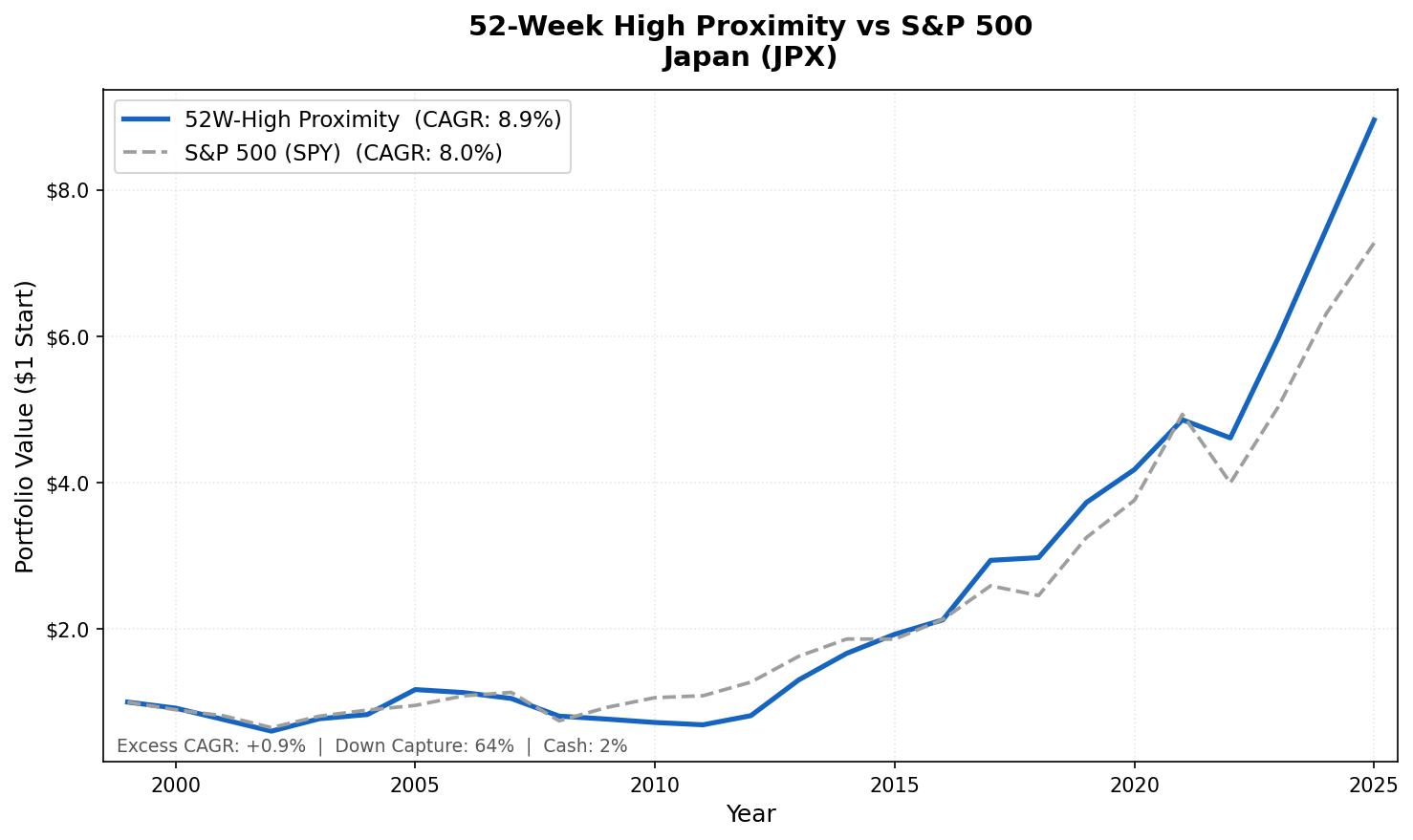
We ran the 52-week high proximity strategy on Japanese stocks (JPX) from 2000 to 2025. The result: 8.89% annualized, +0.88% above the S&P 500, Sharpe of 0.548. A $1 investment grew to $7.96. The S&P 500 returned $7.30 over the same period.
Contents
- Method
- What is the 52-Week High Proximity Strategy?
- What We Found
- 8.89% CAGR. 0.548 Sharpe. 63.5% down capture.
- Year-by-Year Returns
- The "lost decade" context (2000–2012)
- 2008: the crisis year shows clear protection
- 2013: Abenomics and the biggest year at +60.1%
- 2022 protection: -5.1% vs SPY -19.0%
- 2025: +20.0%, outperforming as the yen repatriates
- Why Japan Is the Risk-Adjusted Story
- Limitations
- Run This Screen Yourself
- Part of a Series
- References
The Japan result isn't the biggest alpha generator in this strategy's global comparison. India delivers +18.72% excess. Even Korea and Thailand offer +3-4%. Japan's +0.88% looks modest. But look at how it was achieved: Sharpe of 0.548 versus SPY's 0.354, 63.5% down capture, -23.0% in the 2008 crash versus SPY's -34.3%, and -5.1% in 2022 when SPY fell 19.0%.
Japan is the risk-adjusted story. In a market that went sideways for a decade, the proximity signal found the winners within the malaise, and avoided most of the worst drawdowns in the process.
Method
- Data source: Ceta Research (FMP financial data warehouse)
- Universe: JPX (Japan Exchange Group), market cap > ¥100B
- Period: 2000–2025 (25 years, 103 quarterly periods)
- Rebalancing: Quarterly (January, April, July, October), equal weight
- Benchmark: S&P 500 Total Return (SPY, in USD, cross-currency comparison)
- Returns: Calculated in JPY; SPY in USD for reference
- Cash rule: Hold cash if fewer than 10 stocks qualify
The signal is the proximity ratio: current price divided by the 52-week high (rolling 252 trading days). Stocks are ranked by proximity ratio and the top 30 are held each quarter. Japan has only 2% cash periods, the JPX universe is large enough and liquid enough that 30 qualifying stocks are almost always available.
Note on benchmarking: Japan returns are in JPY. SPY is in USD. The comparison shows how the strategy performed against the global equity benchmark, not a currency-adjusted return.
What is the 52-Week High Proximity Strategy?
George and Hwang (2004) showed that stocks trading near their 52-week high outperform stocks far from it. The Journal of Finance paper established the pattern across US stocks, but the mechanism, anchoring bias, should be universal. Investors anchor to the 52-week high as a mental ceiling and sell preemptively near that level. This creates a temporary discount. When fundamentals push the stock through the anchor, the discount corrects.
Proximity ratio = adjClose / MAX(high over 252 trading days)
We select the top 30 stocks by this ratio, closest to their annual peak, and hold them equal weight for one quarter.
What We Found
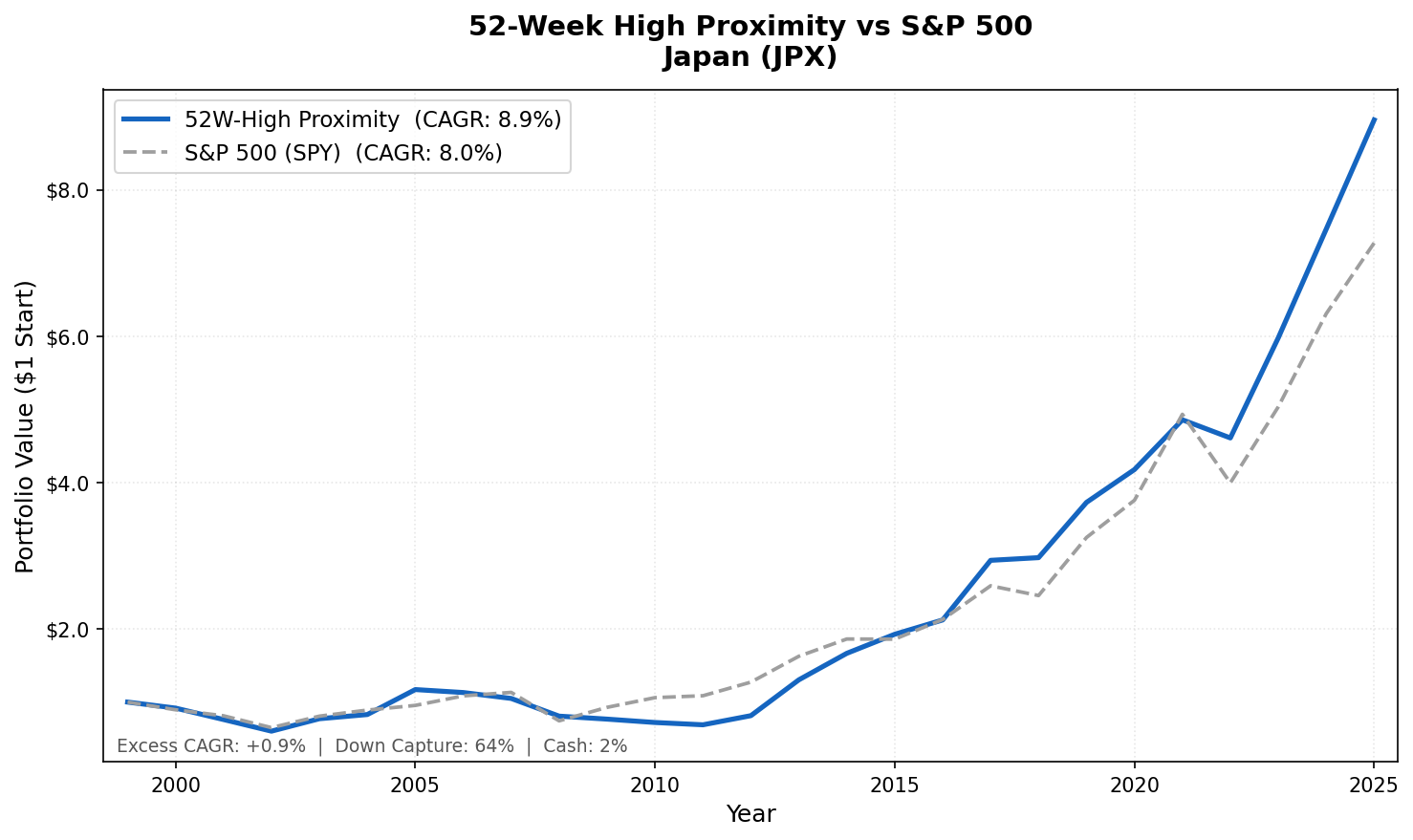
8.89% CAGR. 0.548 Sharpe. 63.5% down capture.
| Metric | 52-Week High Japan | S&P 500 |
|---|---|---|
| CAGR | 8.89% | 8.01% |
| Excess Return | +0.88% | — |
| Total Return | $7.96 per $1 | $7.30 per $1 |
| Max Drawdown | -43.0% | -45.53% |
| Sharpe Ratio | 0.548 | 0.354 |
| Sortino Ratio | 0.995 | — |
| Calmar Ratio | 0.207 | — |
| Up Capture | 84.71% | — |
| Down Capture | 63.5% | — |
| Cash Periods | 2% of quarters | — |
| Avg Stocks (invested) | 29.2 | — |
| Win Rate | 48.5% | — |
The Sharpe of 0.548 versus SPY's 0.354 is the key number. The strategy earns more return per unit of risk than the global benchmark, in a market that underperformed globally for much of the 25-year period.
The win rate of 48.5% is below 50%. Japan is the only exchange in this comparison where the strategy wins less than half the time quarterly. But the edge persists because the strategy loses less when it loses than it wins when it wins. That asymmetry, not frequency of wins, is where the alpha comes from.
The 63.5% down capture means the strategy absorbs roughly two-thirds of US market declines. That's weaker protection than India (23.4%) or Korea (39.1%), but Japan's market structure is different. With 2% cash periods, the portfolio is almost always fully invested. The protection comes not from going to cash but from holding the subset of stocks within Japan that maintain relative strength during global selloffs.
Year-by-Year Returns
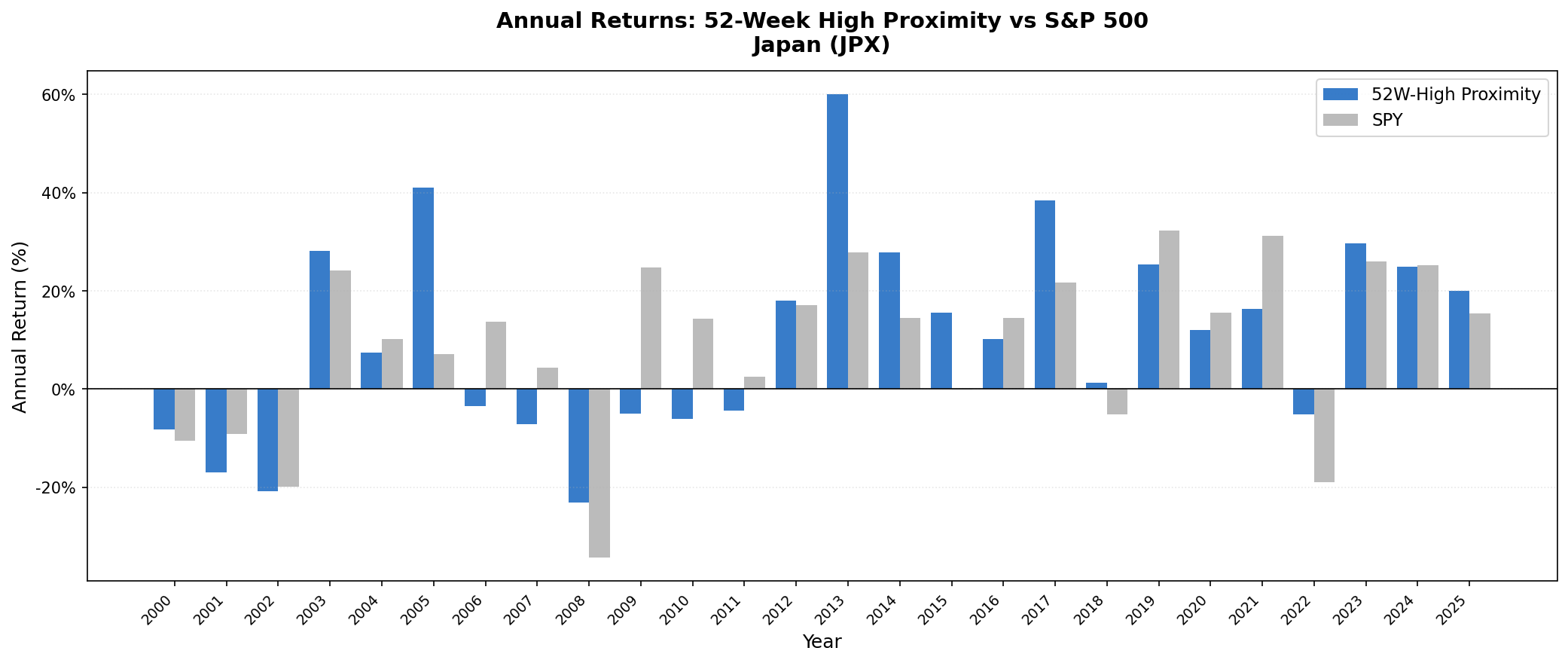
| Year | Japan Strategy | S&P 500 | Excess |
|---|---|---|---|
| 2000 | -8.2% | -10.5% | +2.3% |
| 2001 | -17.0% | -9.2% | -7.8% |
| 2002 | -20.9% | -19.9% | -1.0% |
| 2003 | +28.2% | +24.1% | +4.1% |
| 2004 | +7.4% | +10.2% | -2.8% |
| 2005 | +41.1% | +7.2% | +33.9% |
| 2006 | -3.5% | +13.7% | -17.2% |
| 2007 | -7.1% | +4.4% | -11.5% |
| 2008 | -23.0% | -34.3% | +11.3% |
| 2009 | -5.0% | +24.7% | -29.7% |
| 2010 | -6.0% | +14.3% | -20.3% |
| 2011 | -4.4% | +2.5% | -6.9% |
| 2012 | +18.1% | +17.1% | +1.0% |
| 2013 | +60.1% | +27.8% | +32.3% |
| 2014 | +27.8% | +14.5% | +13.3% |
| 2015 | +15.6% | -0.1% | +15.7% |
| 2016 | +10.2% | +14.4% | -4.2% |
| 2017 | +38.4% | +21.6% | +16.8% |
| 2018 | +1.2% | -5.2% | +6.4% |
| 2019 | +25.4% | +32.3% | -6.9% |
| 2020 | +12.0% | +15.6% | -3.6% |
| 2021 | +16.3% | +31.3% | -15.0% |
| 2022 | -5.1% | -19.0% | +13.9% |
| 2023 | +29.7% | +26.0% | +3.7% |
| 2024 | +24.9% | +25.3% | -0.4% |
| 2025 | +20.0% | +15.3% | +4.7% |
The "lost decade" context (2000–2012)
Japan's equity market is often described as a cautionary tale: the Nikkei peaked in December 1989 at nearly 39,000 and spent 30 years recovering. During our backtest period, the Japanese economy grew at near-zero or negative GDP rates for most of the 2000s.
In that environment, 2000 (-8.2%), 2001 (-17.0%), and 2002 (-20.9%) look like failures. But compare to SPY: -10.5%, -9.2%, -19.9%. The Japan strategy lost roughly in line with or slightly worse than the US benchmark, not because Japan was easy, but because the proximity signal in a declining market still found the relative winners within the universe.
2009 and 2010 are the notable misses. SPY recovered +24.7% and +14.3% respectively. Japan's market was slower to recover post-2008, and the proximity signal, which fires best in a trending-up market, found fewer strong setups. The strategy was -5.0% and -6.0% in those two years. These are the years when the 63.5% down capture looks less helpful: the strategy absorbed the downside but also missed some of the global upside.
2008: the crisis year shows clear protection
2008 is the clearest test. The global financial crisis hit Japan in two ways: the Nikkei fell, and the yen strengthened sharply (which hurt exporters). The S&P 500 fell 34.3%. The Japan 52-week high strategy fell 23.0%, 11.3 percentage points better.
The reason: the proximity filter kept the portfolio in domestic-oriented Japanese companies that were closer to their annual highs at the start of 2008. Export-heavy industrials and financials had already broken down from their peaks before the year began. The signal naturally de-selected them.
2013: Abenomics and the biggest year at +60.1%
Prime Minister Abe's reflationary policy, massive fiscal stimulus, aggressive monetary easing, structural reform, launched in late 2012 and generated one of Japan's strongest equity market years in decades. The Nikkei rose roughly 57% in 2013.
The 52-week high proximity strategy returned +60.1%. The signal was already positioned in Japan's strongest companies when the Abenomics rally accelerated. The proximity filter had selected the stocks that maintained relative strength through the market's bottom in 2012, those same stocks were the first to break out as the policy shift took hold.
2022 protection: -5.1% vs SPY -19.0%
2022 shows the same pattern as other markets in this series. US rate hikes drove a global selloff. But Japan's central bank maintained ultra-loose policy, the Bank of Japan held rates near zero and continued yield curve control through 2022. Japanese equities were less sensitive to the global rate shock.
The proximity signal found the subset of Japanese stocks holding relative strength within that environment, domestically-oriented companies, banks that benefited from steepening yield expectations, and exporters benefiting from a weakening yen. The result: -5.1% while SPY fell 19.0%.
2025: +20.0%, outperforming as the yen repatriates
2025's +20.0% against SPY's +15.3% reflects Japan's ongoing normalization. The Bank of Japan began rate hikes in 2024. Japanese institutional capital, long invested abroad in higher-yielding assets, began repatriating. Domestic equity markets benefited. The proximity signal captured the leading edge of that reallocation.
Why Japan Is the Risk-Adjusted Story
Japan's flat market over most of the 2000s is the reason the risk-adjusted numbers are interesting. In a structurally weak market, the average stock does poorly. The proximity signal doesn't find the average stock, it finds the stocks showing relative strength within that weak environment.
Those stocks tend to be:
- Companies with strong domestic earnings insulated from export headwinds and currency pressure
- Companies where institutional ownership has been buying (pushing price toward annual highs)
- Companies that have already survived a downturn and are early in a recovery cycle
Japan's equity market has high institutional participation from domestic insurance companies, pension funds, and the Government Pension Investment Fund (GPIF). When these large buyers accumulate a position, the stock naturally rises toward its annual high. The proximity signal captures these institutionally-driven moves before the full repricing.
The near-zero cash periods (2%) reflect Japan's market depth. The JPX universe has thousands of qualifying companies above the ¥100B market cap threshold. Even in weak markets, 30 companies are near their 52-week highs. The protection mechanism operates through stock selection rather than cash migration.
Limitations
Modest excess return. +0.88% annualized is small. Currency fluctuation, estimation error in transaction costs, or differences in index construction could explain all of it. Japan isn't a strong alpha generator for this strategy, it's a risk-adjusted generator.
JPY currency risk. Returns are in JPY. The yen has been volatile against the USD over this period, strengthening sharply in 2008, weakening from 2012–2022, then strengthening again. International investors absorb that volatility on top of the equity returns.
63.5% down capture is incomplete protection. In a severe global event, the Japan strategy still absorbs most of the decline through stock losses rather than cash. The protection is meaningful but not the strategy's strongest feature at the Japan level.
Max drawdown of 43.0%. Slightly better than SPY's 45.53% but still a large peak-to-trough loss. A 2007-entry investor would have experienced a painful 2008.
Survivorship bias. Japanese companies that delisted during the 25-year period aren't fully tracked. Japan has had notable corporate failures and takeovers. This likely understates historical drawdowns.
Run This Screen Yourself
Current 52-week high proximity screen (Japanese stocks):
SELECT
 s.symbol,
 p.companyName,
 p.sector,
 ROUND(s.adjClose / MAX(s.high) OVER (
 PARTITION BY s.symbol
 ORDER BY s.date
 ROWS BETWEEN 251 PRECEDING AND CURRENT ROW
 ), 4) AS proximity_ratio,
 ROUND(p.mktCap / 1e9, 2) AS mktcap_bn_jpy
FROM stock_eod s
JOIN profile p ON s.symbol = p.symbol
WHERE p.exchange IN ('JPX')
 AND p.mktCap > 100000000000
 AND s.date = (SELECT MAX(date) FROM stock_eod)
QUALIFY ROW_NUMBER() OVER (PARTITION BY s.symbol ORDER BY s.date DESC) = 1
ORDER BY proximity_ratio DESC
LIMIT 30
Run this screen on Ceta Research
The full backtest code (Python + DuckDB) is on GitHub.
Part of a Series
This post is part of our 52-week high proximity global exchange comparison:
- India (BSE + NSE): 26.7% CAGR, 23% Down Capture
- Korea (KSC): 11.4% CAGR, 39% Down Capture
- Thailand (SET): Anchoring Works in Emerging Markets Too
- Global Comparison: 52-Week High Proximity Across Exchanges
References
- George, T. & Hwang, C. (2004). "The 52-Week High and Momentum Investing." Journal of Finance, 59(5), 2145–2176.
- Jegadeesh, N. & Titman, S. (1993). "Returns to Buying Winners and Selling Losers: Implications for Stock Market Efficiency." Journal of Finance, 48(1), 65–91.
- Daniel, K., Hirshleifer, D. & Subrahmanyam, A. (1998). "Investor Psychology and Security Market Under- and Overreactions." Journal of Finance, 53(6), 1839–1885.
Part of a Series: Global | US | Thailand | Korea | India
Run It Yourself
Explore the data behind this analysis on Ceta Research. Query our financial data warehouse with SQL, build custom screens, and run your own backtests across 70,000+ stocks on 20 exchanges.
Data: Ceta Research (FMP financial data warehouse). Universe: JPX, market cap > ¥100B. Quarterly rebalance, equal weight, transaction costs included, 2000–2025. Returns in JPY.