The UK Analyst Upgrade Drift Was Mostly American Companies
We reported +1.09% upgrade drift against the FTSE 100 on LSE stocks. Then we checked the universe: 85.7% of the events are US-domiciled companies and only 6.2% are British. For UK companies the one-month drift is 0.008%, which is zero. This is the correction.

Correction, August 2026. This post used to report that UK analyst upgrades produce +1.09% above the FTSE 100 at three months. The number was computed correctly, but the universe wasn't what the headline implied: 85.7% of the analyst events on our LSE screen belong to US-domiciled companies, and only 6.2% to UK companies. The post below is the corrected version, with the original numbers kept visible.ContentsWhat we originally reportedWhat the universe actually containsSplit by domicile, the upgrade signal mostly disappearsWhy the FTSE 100 was the wrong benchmark either wayWhat survivesMethodLimitationsTakeaway
We measured 17,207 analyst rating changes on LSE-listed stocks and reported sustained upgrade drift against the FTSE 100. Then we checked who was in the universe. Six out of every seven events were revisions of American companies trading a London line. The UK-domiciled events tell a different and much weaker story.
Data: FMP financial data warehouse, 2012–2025. Updated August 2026.
What we originally reported
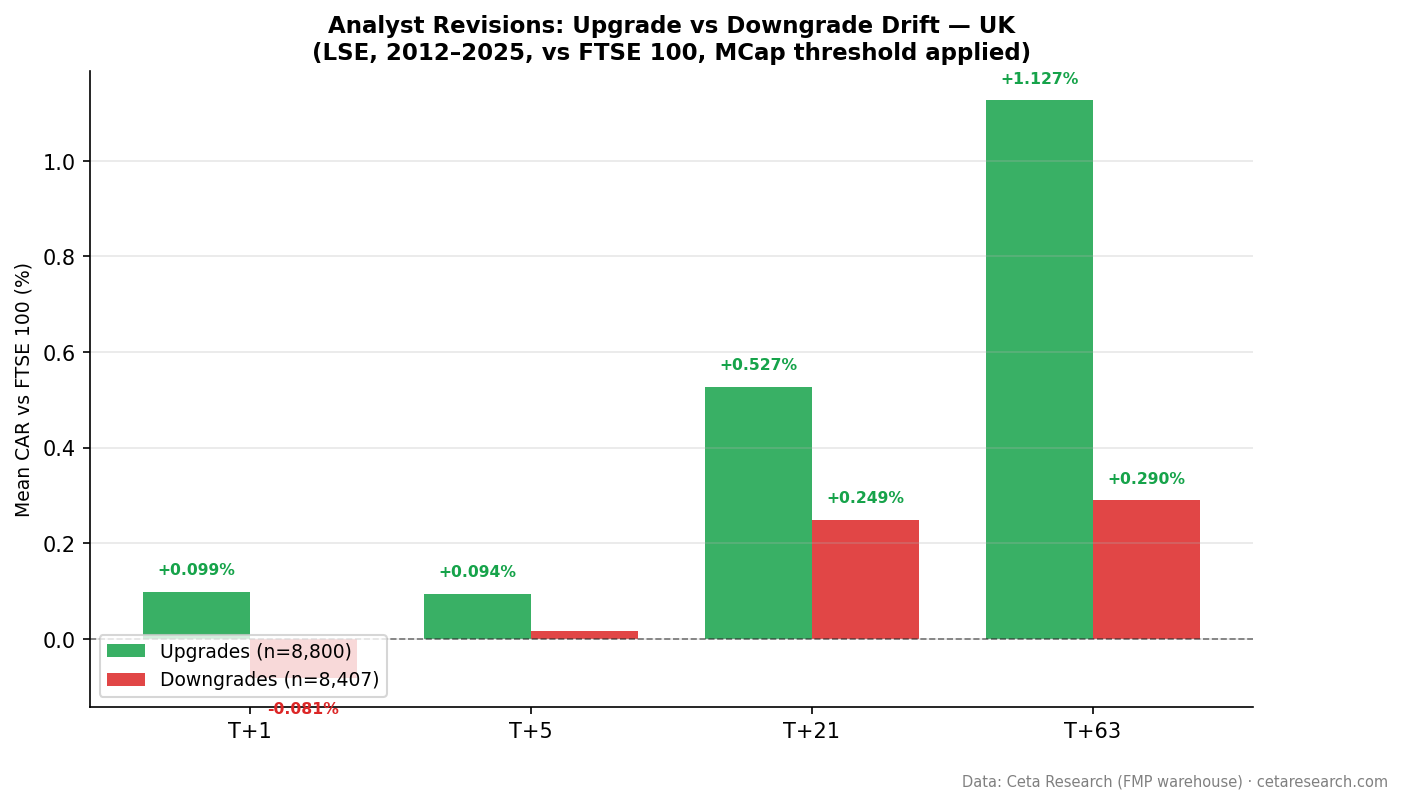
Screening every company listed on the LSE and scoring each revision against the FTSE 100:
| Window | Upgrade CAR | t-stat | Downgrade CAR | t-stat |
|---|---|---|---|---|
| T+1 | +0.099% | 4.2 | -0.081% | -3.0 |
| T+5 | +0.094% | 1.9 (ns) | +0.016% | 0.3 (ns) |
| T+21 | +0.527% | 5.2 | +0.249% | 2.2 |
| T+63 | +1.127% | 6.0 | +0.290% | 1.5 (ns) |
n=8,800 upgrades, n=8,407 downgrades. Winsorized mean, next-day-close entry.
These are rerun figures on current data, not the numbers exactly as first published. The three-month drift we published was +1.09%; the same screen today returns +1.127%. The data moved a little. The error didn't.
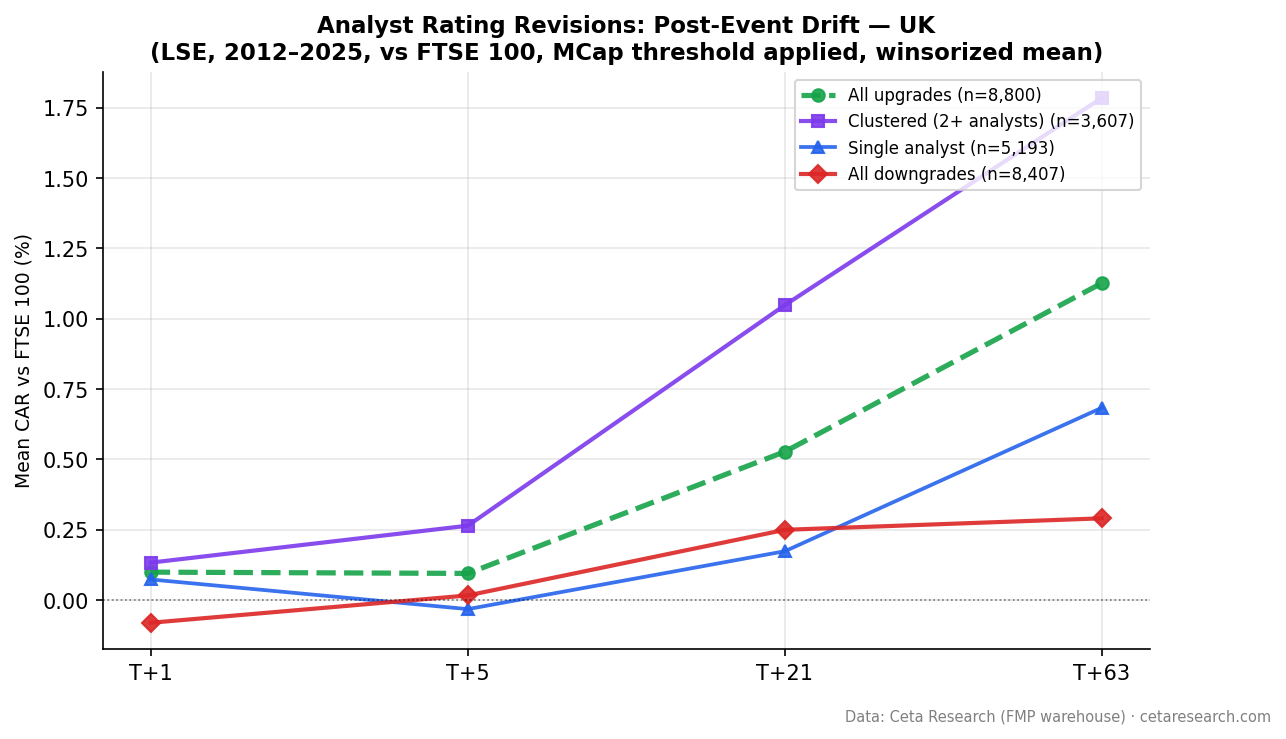
The upgrade column looks strong and grows with the horizon. The downgrade column is the warning. By T+21, downgraded stocks are beating the FTSE 100 by +0.25% with a t-statistic of 2.2. Significant, and pointing the wrong way.
Upgrades and downgrades can't both be good news. When they both beat the index, the index is the problem.
What the universe actually contains
Joining each event to the company's domicile in FMP's profile table:
| Group | Share of events | Events |
|---|---|---|
| Domiciled in the UK | 6.2% | 1,062 |
| Domiciled in the US | 85.7% | 14,748 |
| Other foreign | 8.1% | 1,397 |
The London Stock Exchange in this dataset is mostly a venue for foreign lines, and FMP's analyst grade coverage concentrates hard on the US names among them. Measuring those against the FTSE 100 compares US companies to a UK large-cap index dominated by energy, banks, miners and staples. Over 2012 to 2025 that comparison favours the US names in essentially any window.
Split by domicile, the upgrade signal mostly disappears
| Group | Upgrade T+21 | Upgrade T+63 | Downgrade T+21 | Downgrade T+63 |
|---|---|---|---|---|
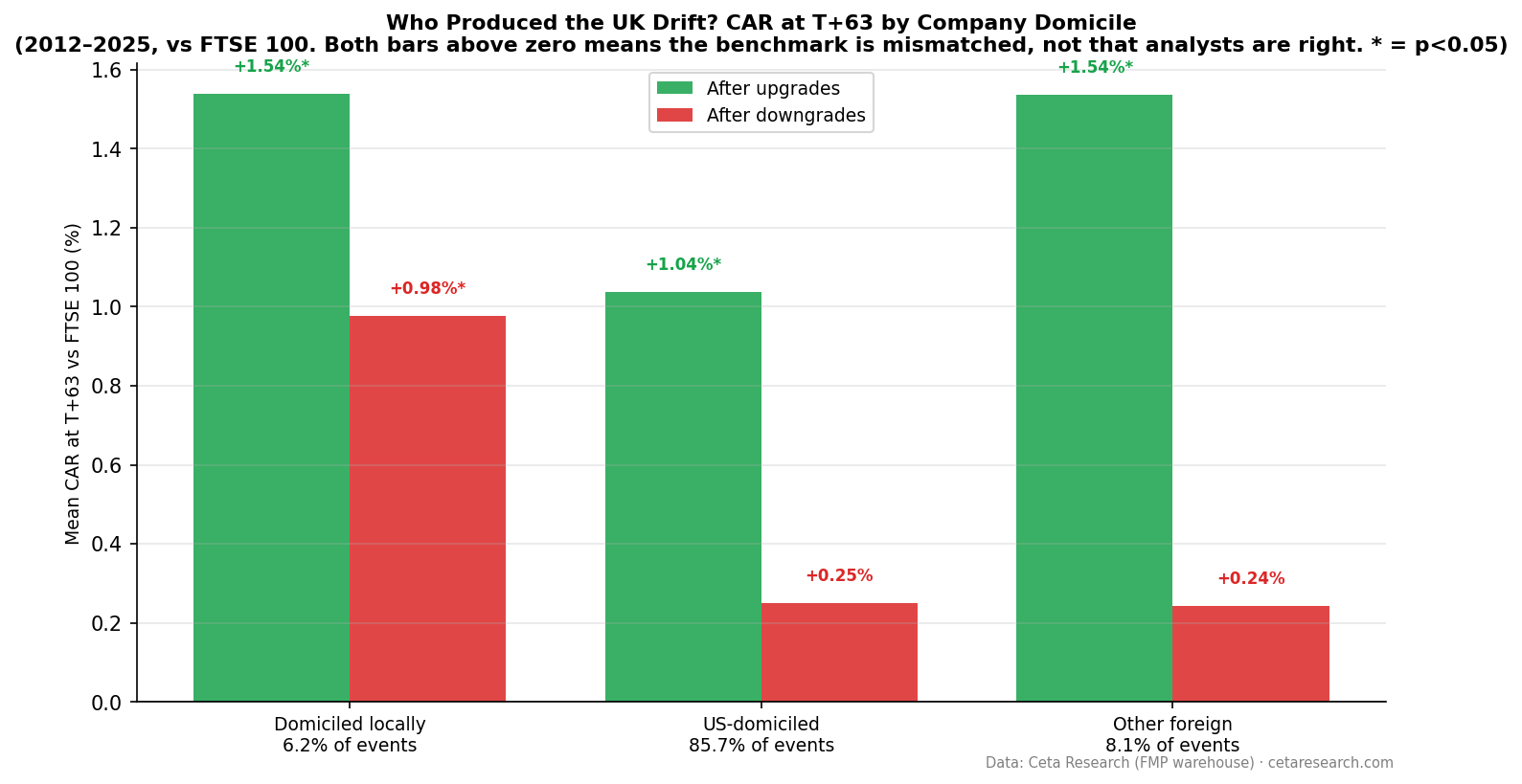
| US-domiciled (85.7%) | +0.565%** | +1.038%** | +0.254%** | +0.250% (ns) |
| Other foreign (8.1%) | +0.635% (ns) | +1.538%** | -0.054% (ns) | +0.243% (ns) |
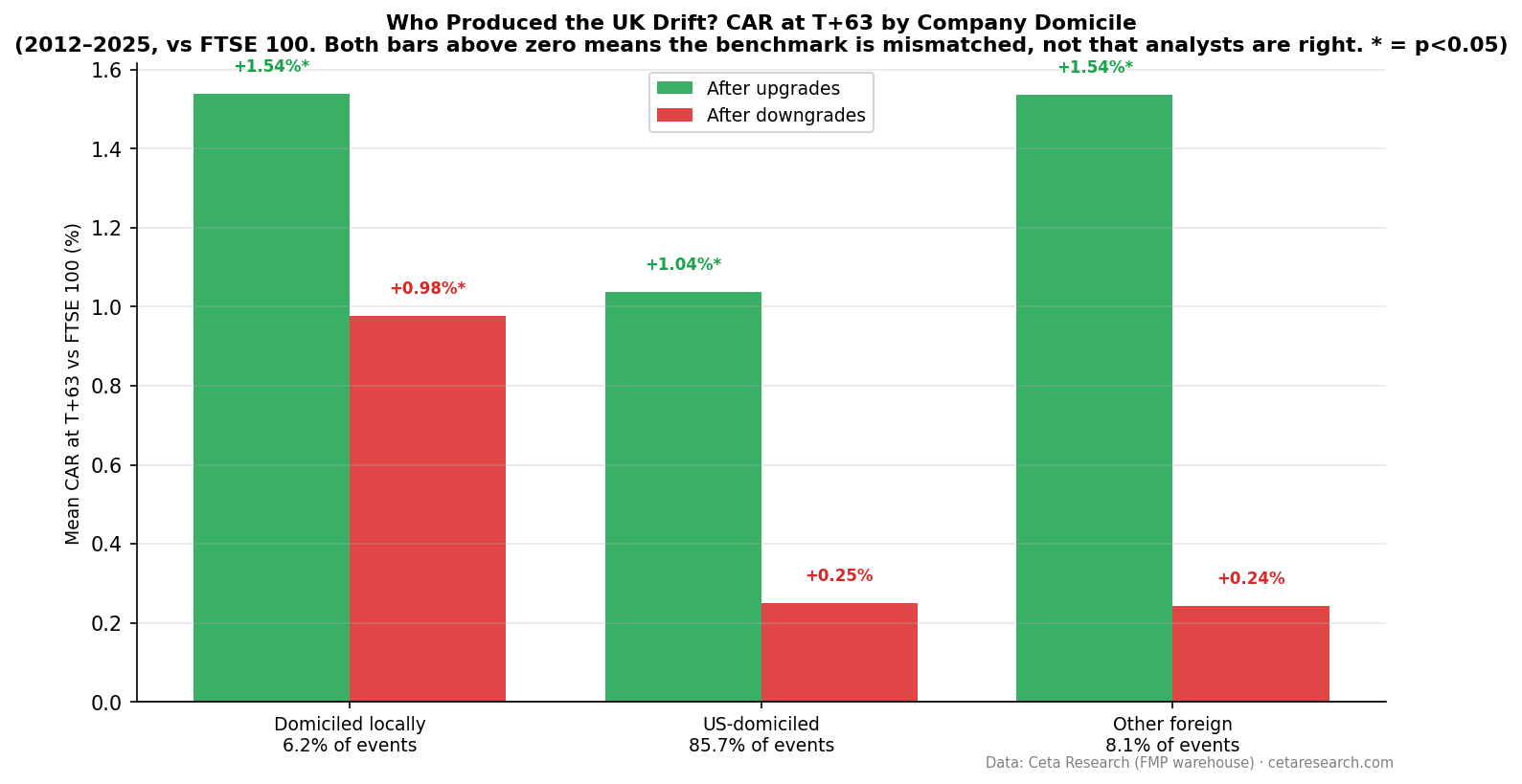
| UK-domiciled (6.2%) | +0.008% (ns) | +1.539%** | +0.616%** | +0.977%** |
** = significant at p<0.05. ns = not significant.
The headline one-month drift is entirely foreign. UK companies produce +0.008% at T+21, which is zero with a t-statistic of 0.03. The +0.53% we published for one month came from the US block.
At three months UK companies do show +1.54% (t=3.3), and unlike Germany the sample isn't trivially small: 570 upgrade events across the period. We're not claiming that as a finding. It sits alongside a downgrade result of +0.98% (t=2.1) on the same universe, so UK stocks beat the FTSE 100 after upgrades and after downgrades. That's the same pattern that flagged the foreign block, and the most likely reading is that mid-cap LSE companies outperform a large-cap index over a quarter regardless of analyst activity.
Why the FTSE 100 was the wrong benchmark either way
The FTSE 100 covers 100 large-cap UK companies. Almost nothing in this event universe is a FTSE 100 constituent. Foreign listings aren't in it, and the UK-domiciled names that generate analyst events skew mid-cap.
That means the abnormal return was picking up a size and sector spread on top of the domicile mismatch. A UK study done properly would need a broader domestic benchmark, the FTSE All-Share or a mid-cap index, and a domestic universe. We have the second of those and not the first.
What survives
The direction test is the durable lesson. Run the signal and its inverse. If upgrades and downgrades both beat the benchmark, stop and check the universe before writing anything up.
Applied across our five markets, it flags Germany (88.1% US-domiciled) and the UK (85.7%), leaves Switzerland ambiguous (74.2% US-domiciled but downgrades do point down), and passes Canada (90.5% domestic) and the US.
The US study is the one that holds. It has a genuinely domestic universe, 90.4% US-domiciled across 125,598 events, and its conclusion is the unflattering one: upgrade alpha is gone by the next close, and what survives is the gap between clustered and single-analyst upgrades, which holds on raw returns without any benchmark at all.
Method
Data source: Ceta Research (FMP stock_grade table, individual analyst grade changes) Universe: LSE (London Stock Exchange, market cap above £500M GBP) Period: 2012–2025 (14 years, 17,207 events) Study type: Event study. Each event measured independently. Benchmark: FTSE 100 (^FTSE, UK large-cap index, local currency GBP) Windows: T+1, T+5, T+21, T+63 trading days after the event Entry: Next-day close after announcement (MOC execution) Abnormal return: Stock return minus FTSE 100 return at each window Winsorization: 1st/99th percentile before computing statistics Data quality: Price rows whose adjusted close spikes and reverts within a day or two are removed before any return is computed. Events are dropped when the entry price is below $1 or a single window return exceeds +200%. Domicile: Company country from FMP's profile table, joined per event.
Limitations
Domicile isn't the same as economic exposure. A UK-domiciled miner earning in dollars isn't well benchmarked by a UK index either. The split catches the gross contamination, not everything.
We didn't rerun against a better UK benchmark. The FTSE All-Share or a mid-cap index would be the right comparison for this universe. That's a separate study and we haven't done it.
Coverage is concentrated post-2018. FMP's stock_grade data for the LSE is thin before 2018: 1,254 of the 17,207 events fall in 2012 to 2017 and the remaining 15,953 in 2018 to 2025. The sample leans hard on the recent period.
The UK-domiciled T+63 result is not a finding. It's positive after upgrades and after downgrades, which is why we're not reporting it as one.
Takeaway
The UK upgrade drift we published was mostly foreign listings. 85.7% of the events were US companies on London lines, measured against the FTSE 100, and the one-month drift for UK companies is zero.
The tell was in the original table all along: downgraded stocks beat the index too. That can't happen with a real signal, and checking it costs one query.
Data: FMP warehouse via Ceta Research, 2012–2025. LSE stocks, market cap >£500M. Benchmark: FTSE 100 (^FTSE). Entry: next-day close after announcement. Domicile from FMP profile country. Not investment advice.
Backtest code and the domicile decomposition script are on GitHub. Reproduce the check: python3 analyst-revision/domicile_analysis.py