Small-Cap Growth Thailand: The Emerging Market Where the Premium Doesn't Show Up
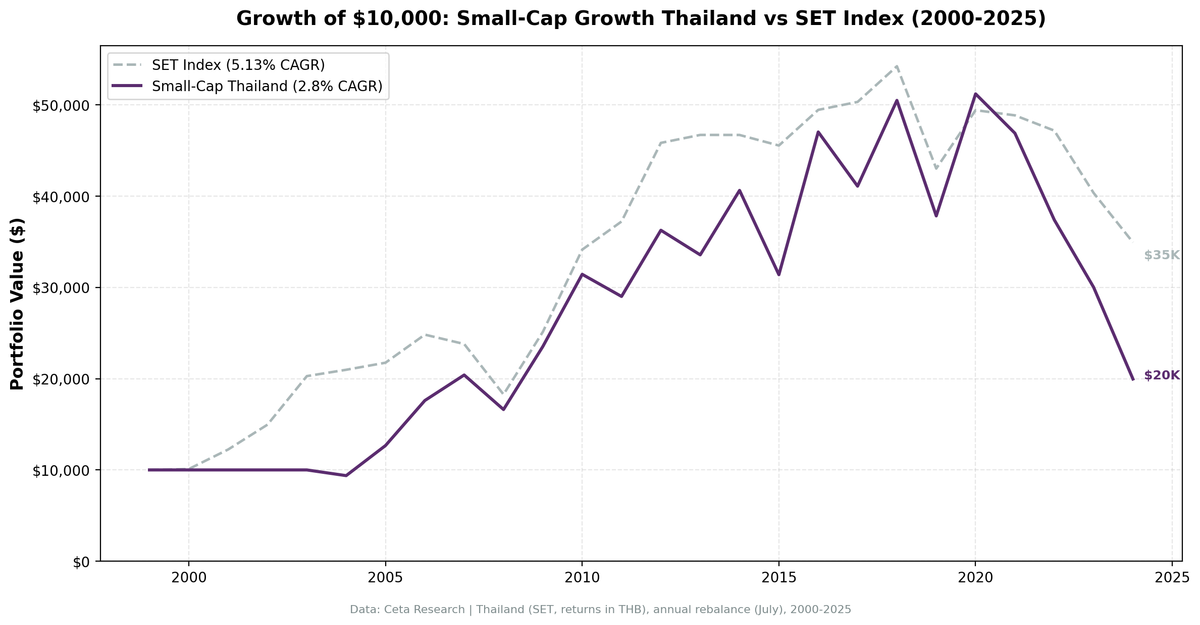
Thailand's small-cap growth screen returned 2.80% CAGR against a SET Index that did 5.13%, with 134% down capture and a -61% drawdown. Emerging market status is not a guarantee.

The academic case for small-cap investing in emerging markets is intuitive. Less analyst coverage, less institutional ownership, more mispricings, higher expected growth. Fama and French documented the size premium. The story should work better in less efficient markets.
Contents
- Executive Summary
- The Method
- What We Found
- Annual Returns
- Why the Emerging Market Thesis Fails Here
- Limitations
- Run It Yourself
- Takeaway
- References
Thailand is the counterexample. 2.80% CAGR over 25 years against a SET Index that returned 5.13%, an excess of -2.33% a year and the second-worst local result in our 14-market study. $10,000 became $19,967. The index turned it into $34,946.
Data: FMP financial data warehouse, 2000-2025. Updated August 2026.
Executive Summary
| Metric | Thailand (SET) | SET Index |
|---|---|---|
| CAGR | 2.80% | 5.13% |
| Excess Return | -2.33%/yr | |
| Sharpe Ratio | 0.013 | 0.160 |
| Sortino Ratio | 0.022 | 0.305 |
| Max Drawdown | -61.02% | -35.59% |
| Win Rate | 40% (10 of 25) | |
| $10,000 becomes | $19,967 | $34,946 |
| Up Capture | 103% | |
| Down Capture | 134% | |
| Average holdings | 18.0 |
The Method
We screened SET-listed stocks each July, with a 45-day filing lag and entry at the next-day close:
- Market cap between THB 500M and THB 20B (small-cap bounds for Thailand)
- Revenue growth >15% year-over-year (fiscal year)
- Positive net income
- Debt/equity ratio below 2.0
Top 30 by revenue growth, equal weight, annual rebalance. Four cash years (2000-2003). Active years: 21, averaging 18.0 holdings.
Full methodology: METHODOLOGY.md
For the US flagship results, see our US small-cap growth backtest.
What We Found
The capture ratios are inverted, which is the whole problem. 103% up capture against 134% down capture. When the SET rose, the portfolio matched it. When the SET fell, the portfolio fell a third harder. That's the opposite of what a quality filter is supposed to produce, and it's the only market in our study where down capture exceeds 100%.
The consequence shows up in the drawdown: -61.02% against the index's -35.59%. The strategy took nearly twice the peak-to-trough loss of the market it was trying to beat.
Eleven of 25 years were negative in absolute terms, including a four-year losing streak from 2021 to 2024: -8.42%, -20.24%, -19.75%, -33.50%. The SET fell in three of those years too, but never by more than 14.5%.
The record is front-loaded and then flat. 2005 through 2010 produced five wins in six years, including +35.18%, +38.94%, +15.89% and +41.60%. From 2011 onward the strategy won 5 of 14 years and lost the rest, mostly badly.
2016 was the one great year. +49.83% against the SET's +8.58%, a 41.25 point excess and the best relative result in the sample. 2014 (+21.06%) and 2018 (+15.09%) are the only other double-digit wins in the last fifteen years.
Annual Returns
| Year | Thailand | SET Index | Excess |
|---|---|---|---|
| 2000 | 0.00% | +1.00% | -1.00% |
| 2001 | 0.00% | +21.19% | -21.19% |
| 2002 | 0.00% | +22.25% | -22.25% |
| 2003 | 0.00% | +35.55% | -35.55% |
| 2004 | -6.25% | +3.43% | -9.68% |
| 2005 | +35.18% | +3.69% | +31.48% |
| 2006 | +38.94% | +14.14% | +24.80% |
| 2007 | +15.89% | -4.13% | +20.01% |
| 2008 | -18.55% | -23.23% | +4.68% |
| 2009 | +41.60% | +37.55% | +4.05% |
| 2010 | +33.60% | +35.85% | -2.24% |
| 2011 | -7.72% | +9.03% | -16.75% |
| 2012 | +25.01% | +23.15% | +1.86% |
| 2013 | -7.44% | +1.90% | -9.34% |
| 2014 | +21.05% | -0.01% | +21.06% |
| 2015 | -22.74% | -2.48% | -20.26% |
| 2016 | +49.83% | +8.58% | +41.25% |
| 2017 | -12.63% | +1.76% | -14.40% |
| 2018 | +22.87% | +7.77% | +15.09% |
| 2019 | -25.07% | -20.67% | -4.39% |
| 2020 | +35.35% | +14.87% | +20.48% |
| 2021 | -8.42% | -1.15% | -7.27% |
| 2022 | -20.24% | -3.42% | -16.81% |
| 2023 | -19.75% | -14.48% | -5.26% |
| 2024 | -33.50% | -13.42% | -20.08% |
Return years run July to July, matching the rebalance date. The 0.00% rows are cash years. Best year: 2016 (+49.83%). Worst year: 2024 (-33.50%). Best excess: 2016 (+41.25%). Worst excess: 2003 (-35.55%, a cash year while the SET rallied 35%).
The four cash years at the start are unusually costly here. The SET rose in all four, by a cumulative 80 percentage points, and the strategy sat them out entirely.
Why the Emerging Market Thesis Fails Here
Thai small-cap revenue growth is cyclical, not structural. The universe is thin and concentrated in tourism, real estate and domestic consumer names. A hotel group or property developer can grow revenue 25% for two years and then contract when the tourism cycle turns or a currency move hits. The screen selects them on the way up and holds them through the reversal, which is exactly what the 134% down capture measures.
Political and macro shocks cluster. The -61.02% drawdown reflects the 2008 crash compounded by domestic political crises in 2010 and 2013-2014. The 2019-2024 stretch adds COVID, which hit a tourism-dependent economy harder than most, and a Thai equity market that has been broadly weak since.
The universe is too thin to diversify. 18.0 average holdings against a 30-stock target means single-company outcomes drive the result, and in a market where the growth is cyclical, those outcomes correlate with each other.
Emerging market status doesn't guarantee a size premium. It creates conditions under which one might exist. Whether it materialises depends on whether the local economy produces companies whose growth persists, and Thailand's largely hasn't.
Limitations
Four cash years at the start, all of them years the SET rose, cost the strategy 80 percentage points of relative return before it bought anything. The 21-year invested record is better than the 25-year headline, though still behind the index.
Currency. Returns are in Thai baht. THB/USD moves add volatility for foreign investors that isn't captured here.
Liquidity. Thai small-caps in the THB 500M-20B range trade thinly with wide spreads. The backtest applies size-tiered costs without modelling market impact, so real execution would be worse than shown.
Fund contamination. Excluding closed-end funds and ETFs moves the Thai result by -0.26pp of CAGR. Thailand is close to clean on this measure. See the US post, where the effect is 3.6 points.
Data revisions. FMP restates and backfills financial history. The identical code run in March 2026 produced 2.60% CAGR and a -2.53% excess. This run produces 2.80% and -2.33%, so the conclusion is stable here even though it moved elsewhere.
Run It Yourself
The screen definition and SQL are in our US flagship post. The Thailand version uses a SET exchange filter with THB 500M-20B bounds.
Query the underlying data at Ceta Research.
Takeaway
Thailand is the emerging market that breaks the emerging market thesis. 2.80% CAGR against a SET Index that returned 5.13%, a Sharpe ratio of 0.013, a -61% drawdown against the index's -36%, and down capture above 100%.
The failure is specific and explicable. Thai small-cap revenue growth is cyclical, the universe is concentrated in tourism and property, and the screen has no way to distinguish a company gaining structural share from one riding a cycle about to turn. Add four cash years while the index rose 80 points and a four-year losing streak to finish, and the 25-year record is what you'd expect.
The general lesson is worth more than the Thai one. "Emerging market" is not a synonym for "inefficient enough to reward a factor screen". It describes a stage of development, not a guarantee that revenue growth means something durable.
References
- Banz, R. (1981). "The Relationship Between Return and Market Value of Common Stocks." Journal of Financial Economics, 9(1), 3-18.
- Fama, E. & French, K. (1992). "The Cross-Section of Expected Stock Returns." Journal of Finance, 47(2), 427-465.
- Fama, E. & French, K. (1993). "Common Risk Factors in the Returns on Stocks and Bonds." Journal of Financial Economics, 33(1), 3-56.
- Van Dijk, M. (2011). "Is size dead? A review of the size effect in equity returns." Journal of Banking & Finance, 35(12), 3263-3274.
Data: Ceta Research (FMP financial data warehouse), 2000-2025. Full methodology: METHODOLOGY.md. Past performance does not guarantee future results. This is educational content, not investment advice.