Small-Cap Growth in Canada: +4.29%/yr Over the TSX, Earned in the 2000s
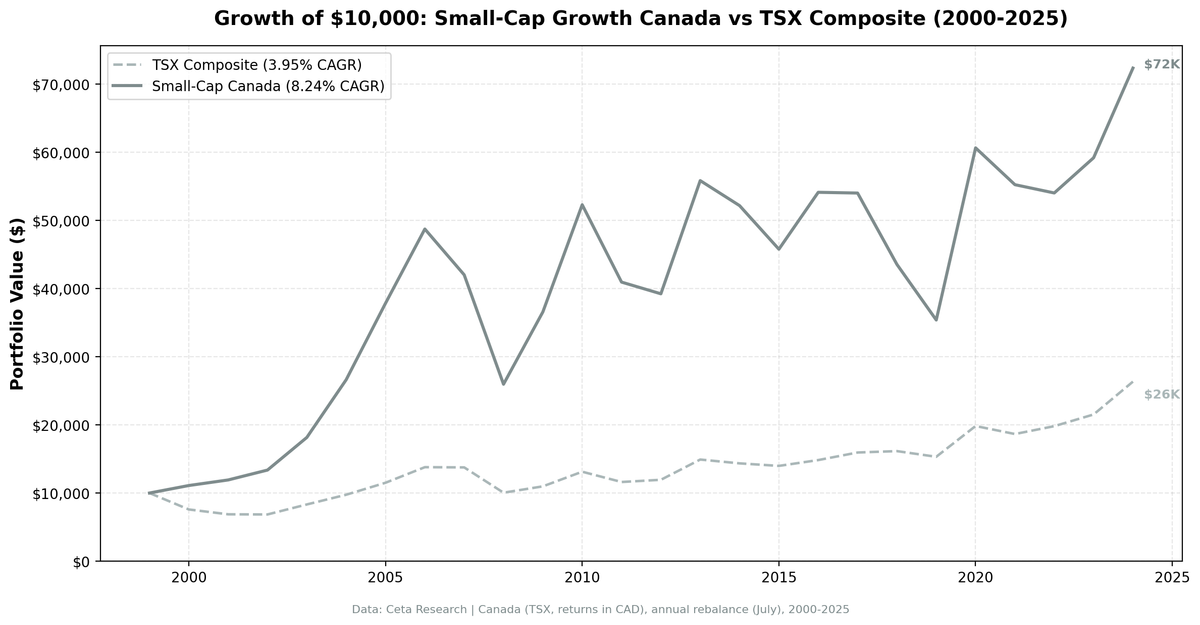
Canadian small-cap growth returned 8.24% CAGR over 25 years against a TSX Composite that did 3.95%. $10,000 became $72,383. Almost all of the edge was banked before 2010.

CAGR: 8.24% | Excess vs TSX Composite: +4.29%/yr | Sharpe: 0.212 | Max Drawdown: -46.72% | Win Rate: 52%
Contents
- The Method
- What We Found
- Annual Returns
- When It Works
- When It Fails
- Limitations
- Run It Yourself
- Takeaway
- References
Canada is one of only five markets in our 14-country study where small-cap growth cleared 8% a year in absolute terms, and it beat its home index by a wide margin. $10,000 became $72,383. The TSX Composite turned it into $26,355.
Two things complicate the story. The excess return was earned almost entirely between 2000 and 2009, and the strategy is not defensive: with a beta of 1.49 and a down capture of 99.7%, it took the full force of every TSX decline and amplified the rallies.
Data: FMP financial data warehouse, 2000-2025. Updated August 2026.
The Method
We screened TSX stocks each July for:
- Market cap between C$25M and C$1B (small-cap range)
- Revenue growth >15% year-over-year (most recent fiscal year)
- Positive net income
- Debt/equity ratio below 2.0
Top 30 by revenue growth, held equal-weight for one year, rebalanced annually in July with a 45-day filing lag and entry at the next-day close. The portfolio was fully invested in all 25 years, averaging 22.7 holdings, the second-highest fill rate of any market we tested.
This follows Fama & French (1993) and Banz (1981) on the size premium, with a profitability and growth filter to avoid the distressed names that dominate raw small-cap universes.
What We Found
The premium is real but it's old. From 2000 to 2009 the strategy beat the TSX Composite in 8 of 10 years by an average of 14.8 percentage points. From 2010 to 2017 it won 3 of 8, averaging +2.0 points. From 2018 to 2024 it won 2 of 7 and the average excess is -0.4 points. Almost the entire 25-year edge was banked in the first decade.
It's a leveraged bet on Canadian equities, not a hedge. Up capture of 175% and down capture of 100% mean the portfolio doubled the index's gains and matched its losses one-for-one. Beta is 1.49. The maximum drawdown of -46.72% is considerably worse than the TSX Composite's -31.44%. You were paid for taking more risk, not for taking better risk.
Commodity exposure drives everything. The TSX skews heavily to energy and materials, and small-cap growth in Canada often means junior producers and miners whose revenues swing violently with commodity prices. That dispersion is what a revenue growth screen exploits. It also explains the 2000-2006 run, when the commodity supercycle inflated revenues for exactly the names this screen selects.
2020 was the defining year. The portfolio returned +71.38% against the TSX Composite's +29.47%, a 41.9 point excess and the best relative year in the sample. COVID crushed Canadian small-cap energy and materials in March 2020, and the fiscal and monetary response drove a violent rebound in commodity-linked names.
2018-2019 tested patience. Two consecutive losses of 19.38% and 18.74% came as trade tensions hit commodity prices and Canadian energy faced pipeline constraints. The TSX Composite rose in 2018, so the excess was -20.66%, the worst in the sample. Investors who bailed after 2019 missed 2020 entirely.
Annual Returns
| Year | Strategy | TSX Composite | Excess |
|---|---|---|---|
| 2000 | +11.03% | -24.12% | +35.15% |
| 2001 | +7.36% | -9.35% | +16.71% |
| 2002 | +12.18% | -0.33% | +12.51% |
| 2003 | +35.80% | +21.42% | +14.39% |
| 2004 | +46.65% | +17.14% | +29.52% |
| 2005 | +42.14% | +18.02% | +24.12% |
| 2006 | +28.79% | +19.87% | +8.92% |
| 2007 | -13.79% | -0.22% | -13.57% |
| 2008 | -38.20% | -26.99% | -11.21% |
| 2009 | +40.86% | +9.27% | +31.59% |
| 2010 | +42.99% | +19.56% | +23.43% |
| 2011 | -21.70% | -11.49% | -10.22% |
| 2012 | -4.19% | +2.78% | -6.97% |
| 2013 | +42.33% | +24.89% | +17.44% |
| 2014 | -6.57% | -3.76% | -2.81% |
| 2015 | -12.26% | -2.59% | -9.67% |
| 2016 | +18.24% | +6.11% | +12.13% |
| 2017 | -0.20% | +7.49% | -7.68% |
| 2018 | -19.38% | +1.28% | -20.66% |
| 2019 | -18.74% | -5.15% | -13.59% |
| 2020 | +71.38% | +29.47% | +41.91% |
| 2021 | -8.91% | -5.92% | -2.99% |
| 2022 | -2.20% | +6.18% | -8.38% |
| 2023 | +9.56% | +8.66% | +0.90% |
| 2024 | +22.23% | +22.39% | -0.16% |
Return years run July to July, matching the rebalance date. Best year: 2020 (+71.38%). Worst year: 2008 (-38.20%). Eleven of 25 years were negative in absolute terms.
When It Works
Commodity cycles. The 2000-2006 run and the 2020 recovery were both commodity-driven. Small Canadian companies growing revenues above 15% during those periods were almost uniformly energy and materials names, and the premium showed up clearly when the resource cycle aligned.
Sharp recoveries. 2009, 2010 and 2013 were all strong, suggesting the portfolio held companies with genuine earnings power that recovered fast from cyclical drawdowns.
When Canadian large caps were falling. 2000, 2001 and 2002 all produced positive absolute returns while the TSX Composite fell. Canadian small-cap growth was insulated from the Nasdaq bubble collapse in a way the index wasn't.
When It Fails
Late-cycle risk-off. 2018 and 2019 were both bad years for commodity-linked risk assets, and the strategy lost far more than the index. High-beta small caps get hit hardest when the cycle turns.
2008. The -38.20% loss was the worst single year and considerably worse than the TSX Composite's -26.99%. When credit froze, small-cap names with any leverage got crushed regardless of revenue growth.
The 2010s generally. Five of the eight years from 2010 to 2017 were negative in absolute terms, and the average excess over that stretch was under two points. The commodity supercycle that made the 2000s work didn't repeat.
Limitations
The -46.72% maximum drawdown is real and sustained, and it's 15 points deeper than the index's. An investor who started in mid-2007 would have been down nearly half at the trough. That requires genuine conviction, and the strategy offers no downside protection to make it easier: down capture is 99.7%.
The commodity tilt is structural, not a design choice. The screen doesn't target energy or materials, but the TSX universe means those sectors dominate. If commodity cycles shift structurally, the historical premium narrows further, and the 2010-2024 record suggests that's already happening.
Excluding closed-end funds and ETFs from the universe, which report investment income as revenue and so can rank on a revenue-growth screen, lowers the Canadian result from 8.24% to 6.91% CAGR. Canada is the second-most affected market after the US. See the US post for the full analysis.
Fees, slippage and liquidity matter at this cap range. Stocks between C$25M and C$1B can have wide spreads, and the backtest applies size-tiered costs without modelling market impact.
The excess is measured against the TSX Composite in Canadian dollars. Against a global index in US dollars, an 8.24% Canadian-dollar return over 25 years looks less impressive once the currency path is included.
Run It Yourself
The screen runs directly on our data warehouse. Full methodology and SQL are in the US flagship post. The Canadian version uses a TSX exchange filter with C$25M-C$1B market cap bounds.
You can query the underlying data on Ceta Research.
Takeaway
Canada produced a +4.29%/yr excess over the TSX Composite and an 8.24% absolute return, which puts it among the best results in this study on both measures at once. That's rare: most markets that beat their index did so only because the index was weak.
The qualifications are serious. The edge was earned in 2000-2009 and has been roughly zero since 2018. The strategy carries a beta of 1.49, matches the index's downside one-for-one, and drew down 15 points deeper than the benchmark. And it's a concentrated bet on the Canadian commodity cycle whether or not you intended one.
For an investor who wants Canadian small-cap exposure and can hold through a -47% drawdown, the historical case is there. Just be clear that you're buying commodity beta with a growth filter on top, not a diversifying factor premium.
References
- Banz, R. (1981). "The Relationship Between Return and Market Value of Common Stocks." Journal of Financial Economics, 9(1), 3-18.
- Fama, E. & French, K. (1992). "The Cross-Section of Expected Stock Returns." Journal of Finance, 47(2), 427-465.
- Fama, E. & French, K. (1993). "Common Risk Factors in the Returns on Stocks and Bonds." Journal of Financial Economics, 33(1), 3-56.
- Van Dijk, M. (2011). "Is size dead? A review of the size effect in equity returns." Journal of Banking & Finance, 35(12), 3263-3274.
Data: Ceta Research (FMP financial data warehouse), 2000-2025. Full methodology: METHODOLOGY.md. Past performance does not guarantee future results. This is educational content, not investment advice.