Hong Kong P/E Compression: -0.69% CAGR, -1.18% vs Hang Seng
P/E compression on Hong Kong stocks returns -0.69% CAGR vs 0.49% for the Hang Seng. Both the strategy and the local market failed to deliver real returns over 25 years. Down-capture is 97% and up-capture 95%, so the strategy offers no protection the index doesn't.

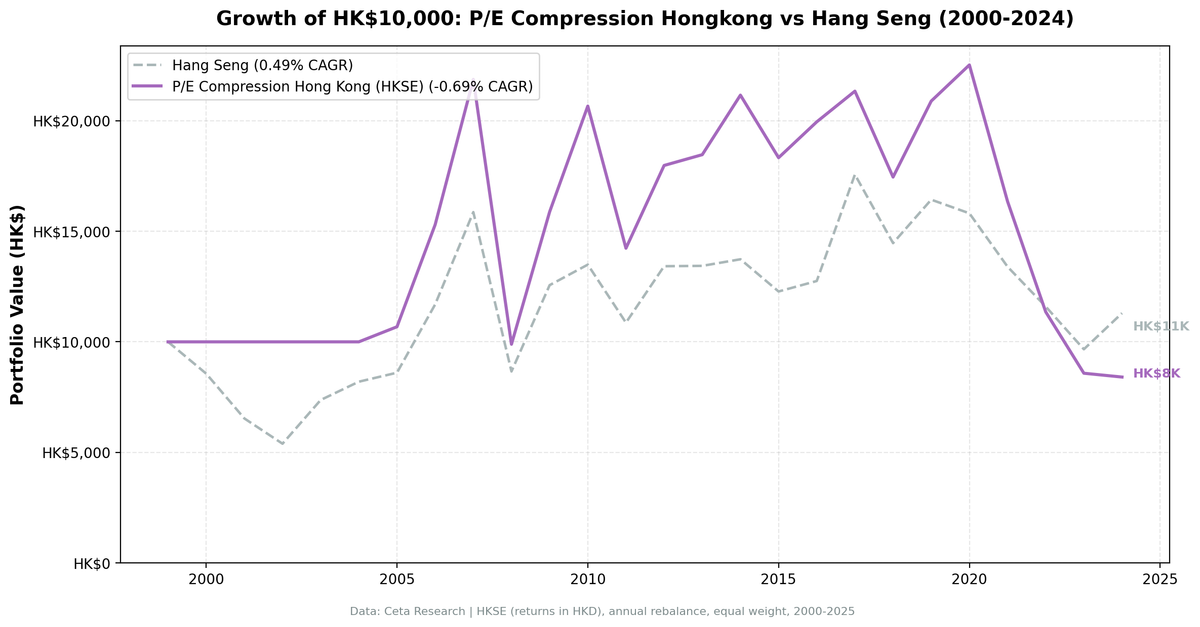
P/E compression on Hong Kong stocks returns -0.69% CAGR vs 0.49% for the Hang Seng, underperforming by 1.18% annually. The Hang Seng itself barely moved over 25 years, so this isn't a story of the strategy failing while the local market thrived. Both failed. What makes Hong Kong worth reading is that the strategy provides no downside protection at all here: 97% down-capture against 95% up-capture.
Contents
Data: FMP financial data warehouse, 2000-2025. Updated August 2026.
Method
Universe: HKSE, market cap > HK$5B Period: 2000-2025 (25 years, 25 annual periods, 20 invested) Benchmark: Hang Seng Index (^HSI, HKD, price index) Execution: Next-day close (mark-on-close) Cash rule: Hold cash if fewer than 10 stocks qualify and can be priced
Returns in HKD. Benchmark in HKD.
What We Found
| Metric | Hong Kong | Hang Seng |
|---|---|---|
| CAGR | -0.69% | 0.49% |
| Total Return | -16% | +13% |
| Excess | -1.18% | - |
| Sharpe | -0.141 | - |
| Sortino | -0.205 | - |
| MaxDD | -62.68% | -46.08% |
| Up Capture | 94.89% | 100% |
| Down Capture | 97.09% | 100% |
| Win Rate | 56% | - |
| Avg Stocks | 20.5 | - |
| Cash | 5 of 25 (20%) | - |
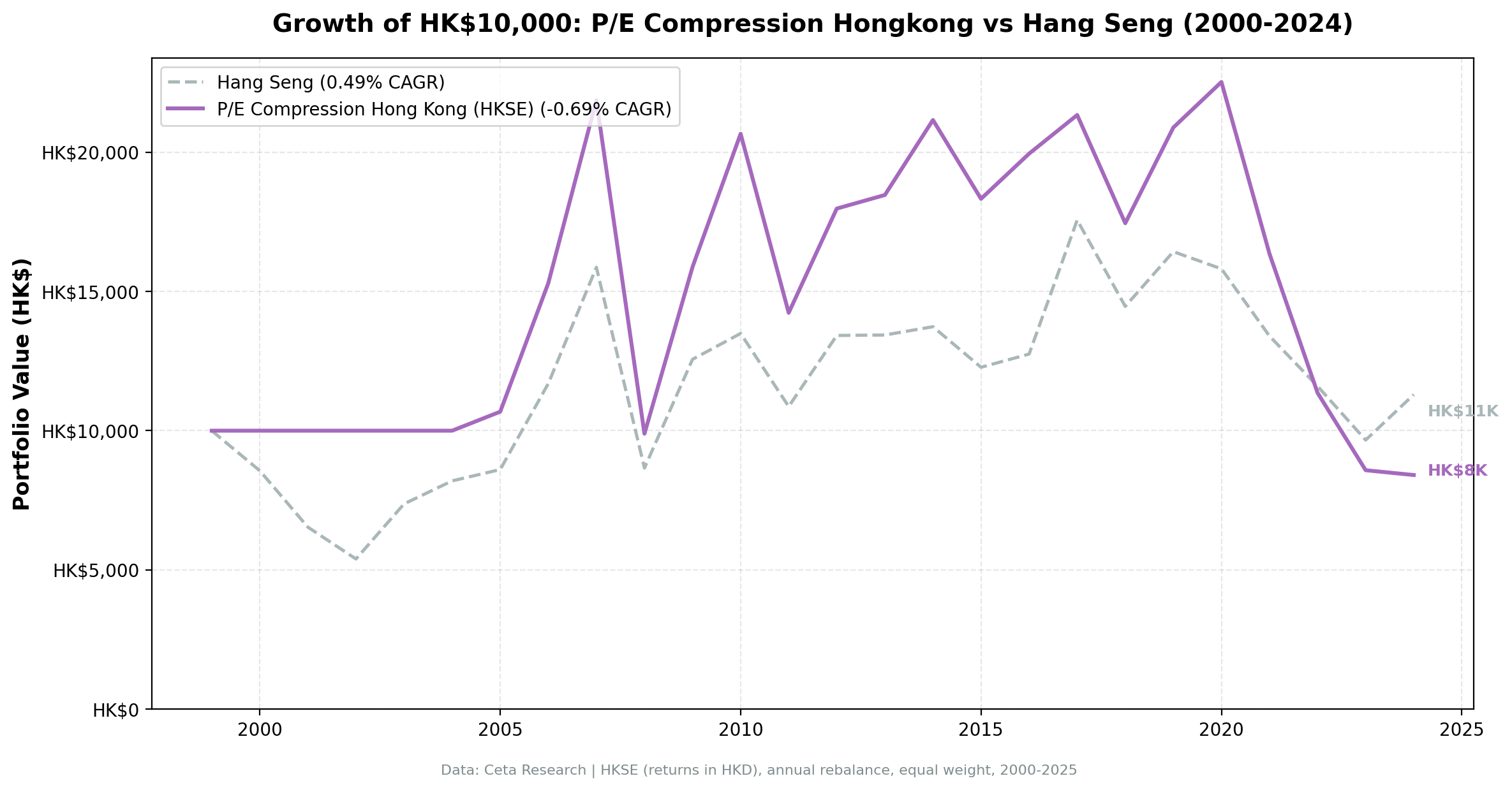
Negative absolute CAGR. HK$10,000 became HK$8,400 over 25 years. Negative Sharpe and Sortino. A max drawdown of -62.68% against the index's -46.08%.
The capture ratios are the point. 97% down-capture and 95% up-capture means the portfolio tracks the Hang Seng almost exactly in both directions while adding a drag. There's no asymmetry, no downside protection, and no reason to prefer the strategy over the index. In most markets tested, compressed-P/E names at least fall less than the index because they've already absorbed bad news. In Hong Kong they don't.
Note the interesting split: the strategy wins in 14 of 25 years but still loses over the full period. The losses when it loses are larger than the gains when it wins. 2017 (-30.8%), 2022 (-17.1%) and 2024 (-18.9%) more than cancel out a longer list of small wins.
The benchmark excludes dividends. Portfolio returns use dividend-adjusted prices, but ^HSI is the Hang Seng price index and does not reinvest dividends. The Hang Seng has yielded roughly 3% a year over this period, so a like-for-like total-return comparison widens the -1.18% deficit substantially. Hong Kong is a worse result than the headline suggests, not a better one.
Five cash years, all at the start. 2000 through 2004 have no position, because FMP's Hong Kong price coverage doesn't reach far enough back to fill a 10-name portfolio. Three of those years the Hang Seng fell and two it rose, so the net effect is roughly neutral, but those years describe the data rather than the strategy.
Why Hong Kong Is a Difficult Market
China exposure. Hong Kong stocks are heavily exposed to China's economy and policy. Political and regulatory risks create volatility that P/E compression can't navigate.
Structural headwinds. Hong Kong experienced property market bubbles, political instability and capital outflows. Compressed P/E ratios often reflected permanent valuation resets, not temporary dislocations. The 2021-2023 stretch is the clearest case: three consecutive years of double-digit portfolio losses while the index also fell.
Value traps. Many Hong Kong financials and property developers traded at compressed multiples for years because their business models deteriorated. These weren't mean reversion opportunities, and the quality filters didn't catch them because reported ROE held up long after the underlying business turned.
Conclusion
Hong Kong P/E compression underperforms the Hang Seng by 1.18% annually, and by more once the index's roughly 3% dividend yield is taken into account. That's cold comfort when both deliver negative or near-zero absolute returns: the Hang Seng returned 0.49% a year, the strategy returned -0.69%.
The reason to avoid this one isn't the size of the shortfall. It's that the strategy offers nothing the index doesn't. 97% down-capture, 95% up-capture, a worse max drawdown, and a negative Sharpe ratio. Whatever mean reversion is supposed to buy you, Hong Kong doesn't supply it.
Data: Ceta Research (FMP financial data warehouse). Returns in HKD. Benchmark: Hang Seng price index, which does not reinvest dividends. Past performance does not guarantee future results. Not investment advice. github.com/ceta-research/backtests