Canada P/E Compression: +5.69% Annual Alpha vs TSX Composite
P/E compression on Canadian stocks returns 10.13% annually vs 4.44% for the TSX Composite. +5.69% annual alpha, 19 wins in 25 years, 44% down-capture and 142% up-capture. The strongest result in a 21-market study.

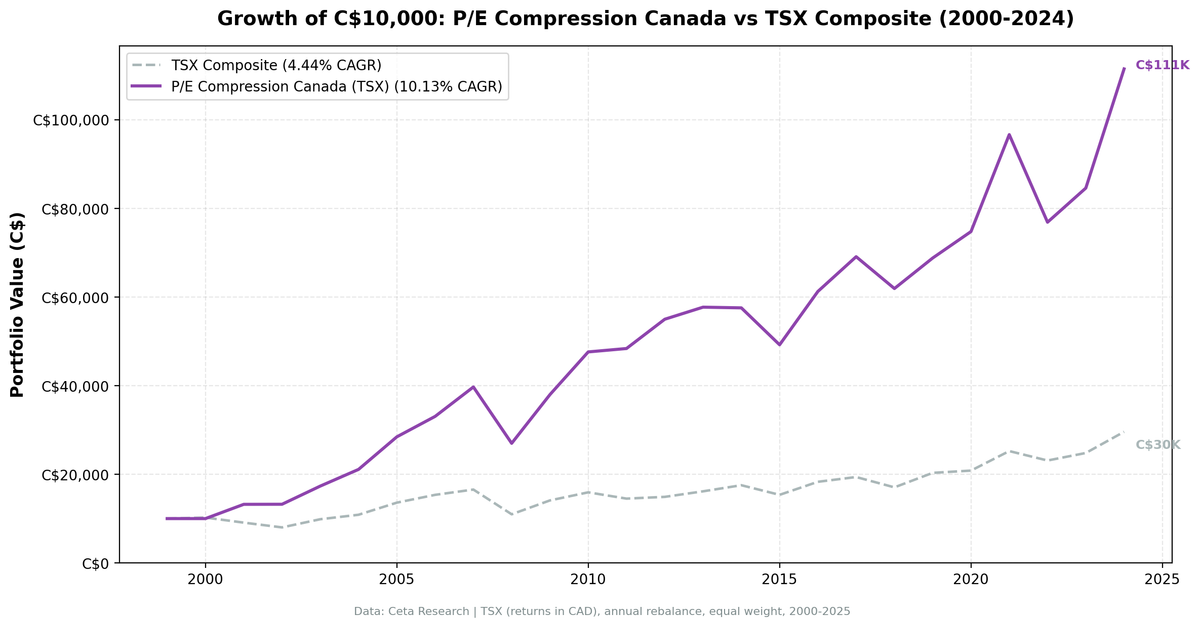
We tested P/E compression mean reversion on 25 years of Canadian stock data from the TSX. The strategy returned 10.13% annually (CAD-denominated) vs 4.44% for the TSX Composite, with +5.69% excess return. It beat the local market in 19 of 25 years. Down-capture is 44% vs the TSX Composite and up-capture is 142%. This is the strongest result in the 21-market study, and it survives the dividend caveat that removes most of the others.
Contents
- Method
- What We Found
- 25 years. +5.69% annual alpha. 19 of 25 years beating the index.
- Year-by-year returns
- Why Canada's alpha holds up
- Backtest Methodology
- Limitations
- Conclusion
Data: FMP financial data warehouse, 2000-2025. Updated August 2026.
Method
Data source: Ceta Research (FMP financial data warehouse) Universe: TSX, market cap > C$500M Period: 2000-2025 (25 years, 25 annual periods, 24 invested) Rebalancing: Annual (January), equal weight, top 30 by compression ratio Benchmark: TSX Composite (^GSPTSE, CAD, price index) Execution: Next-day close (mark-on-close) Cash rule: Hold cash if fewer than 10 stocks qualify and can be priced
Returns are in CAD. The benchmark is in CAD.
What We Found
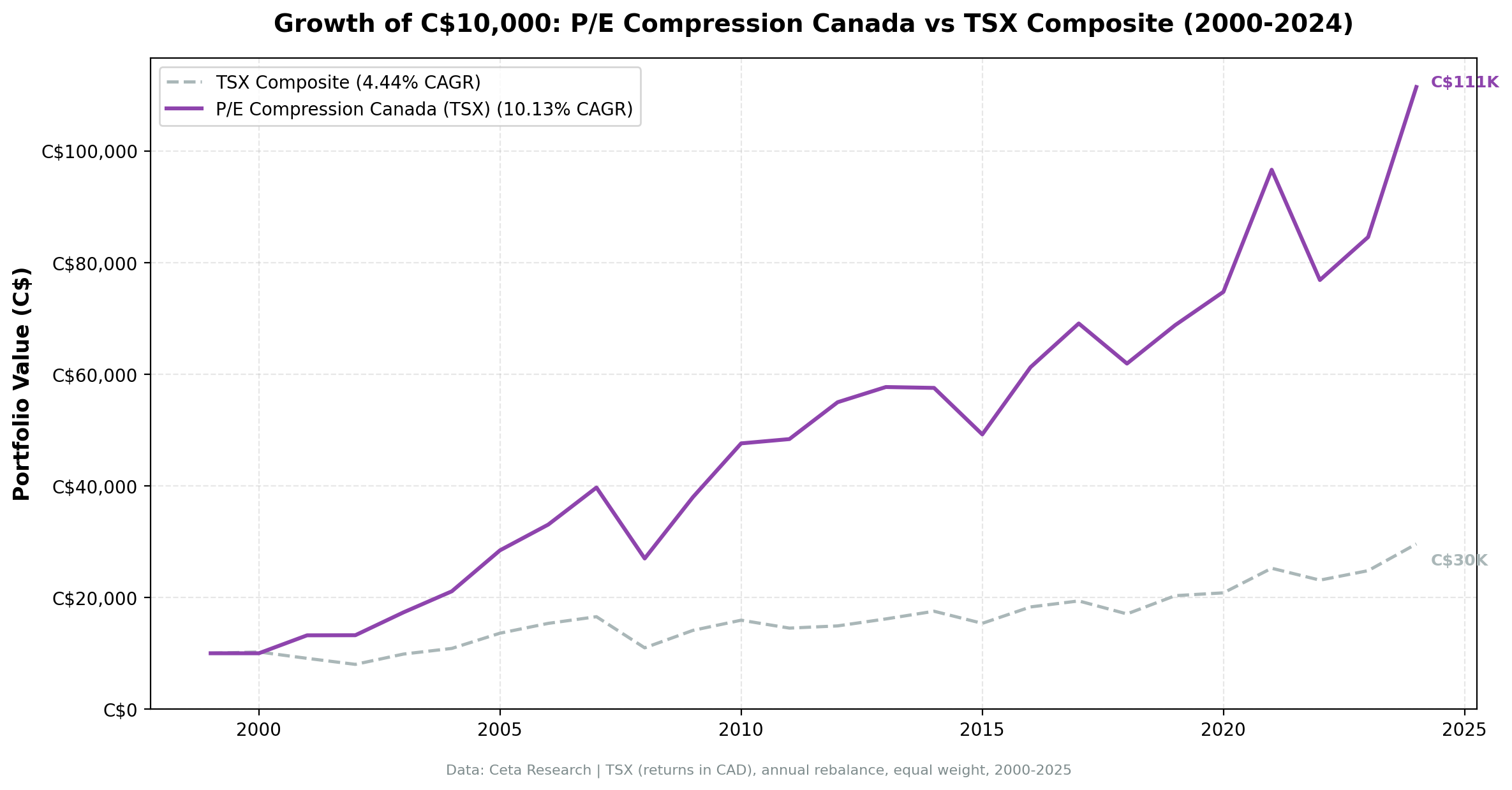
25 years. +5.69% annual alpha. 19 of 25 years beating the index.
| Metric | P/E Compression (Canada) | TSX Composite |
|---|---|---|
| CAGR | 10.13% | 4.44% |
| Total Return | 1,015% | 196% |
| Excess | +5.69% | - |
| Sharpe Ratio | 0.415 | - |
| Sortino Ratio | 0.814 | - |
| Max Drawdown | -32.02% | - |
| Up Capture | 141.87% | 100% |
| Down Capture | 44.10% | 100% |
| Win Rate | 76% | - |
| Avg Stocks per Year | 22.2 | - |
| Cash Periods | 1 of 25 | - |
The 44% down-capture means that in years when the TSX Composite fell, this portfolio captured about 44% of those losses. The 142% up-capture is the more striking number: when the TSX Composite gained 10%, this portfolio gained 14.2%. The strategy doesn't just protect downside in a local-market comparison, it amplifies upside.
Canada is one of only two markets in this study (with the US) that stayed invested in essentially every period. 24 of 25 years had at least 10 priceable qualifying names. That matters more than it sounds: most of the other 20 exchanges tested spend a third or more of the study in cash because FMP's price coverage doesn't reach back far enough to support the screen.
One caveat on the margin. ^GSPTSE is the TSX Composite price index and does not reinvest dividends, while portfolio returns use dividend-adjusted prices. The TSX is a relatively high-yield market at roughly 2.5% to 3% a year over this period, so a like-for-like total-return comparison would cut the +5.69% excess to somewhere near +3%. Canada is still the strongest developed-market result in the study on that basis, but the headline margin overstates it.
Year-by-year returns
| Year | Portfolio | TSX Composite | Excess |
|---|---|---|---|
| 2000 | cash | +2.4% | -2.4% |
| 2001 | +32.1% | -11.2% | +43.4% |
| 2002 | +0.1% | -11.9% | +12.0% |
| 2003 | +31.0% | +23.1% | +8.0% |
| 2004 | +21.7% | +10.2% | +11.5% |
| 2005 | +34.8% | +25.1% | +9.7% |
| 2006 | +16.2% | +12.9% | +3.2% |
| 2007 | +20.1% | +7.8% | +12.3% |
| 2008 | -32.0% | -33.7% | +1.7% |
| 2009 | +40.7% | +28.5% | +12.2% |
| 2010 | +25.4% | +12.9% | +12.4% |
| 2011 | +1.6% | -8.9% | +10.5% |
| 2012 | +13.7% | +2.7% | +10.9% |
| 2013 | +5.0% | +8.4% | -3.4% |
| 2014 | -0.3% | +8.5% | -8.8% |
| 2015 | -14.5% | -12.4% | -2.1% |
| 2016 | +24.5% | +19.1% | +5.3% |
| 2017 | +12.8% | +5.9% | +6.9% |
| 2018 | -10.4% | -12.0% | +1.6% |
| 2019 | +11.1% | +19.2% | -8.1% |
| 2020 | +8.7% | +2.5% | +6.2% |
| 2021 | +29.3% | +21.2% | +8.1% |
| 2022 | -20.4% | -8.4% | -12.0% |
| 2023 | +10.0% | +7.3% | +2.7% |
| 2024 | +31.8% | +19.3% | +12.5% |
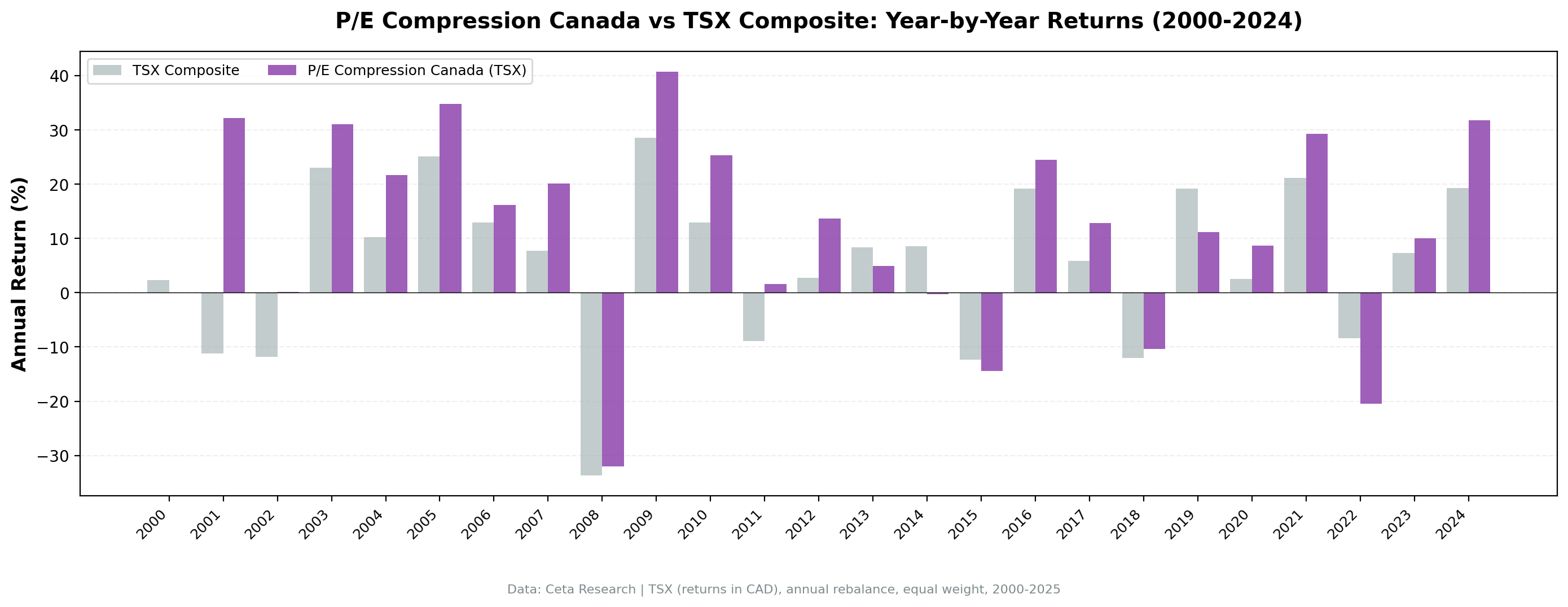
The strategy beats the TSX Composite in 19 of 25 years. The early period was especially strong: 2001-2012 saw outperformance in every single year. The most damaging underperformance came in 2022 (-12.0%) and 2014 (-8.8%). 2024 was the second-best year in the record at +31.8% against the index's +19.3%, which is a useful counter to the idea that the recent stretch is a decline.
Why Canada's alpha holds up
Dense price history. This is the unglamorous reason and probably the biggest one. Canada is one of the few non-US markets where FMP's EOD coverage supports a 25-year test. The strategy gets to run in 24 of 25 years, so the result reflects the signal rather than which stocks happened to be backfilled first.
Defensive sector mix. Canadian markets are heavily weighted toward banks, utilities, telecom, and consumer staples. These sectors have stable earnings and less volatile P/E ratios, making compression-driven mean reversion more predictable.
Commodity diversification. Canadian stocks have exposure to energy, materials, and mining. During equity market selloffs, commodities sometimes hold value or even gain, providing a natural hedge.
Mature, stable businesses. TSX large caps are established companies with predictable cash flows. P/E compression is more likely driven by sentiment than fundamentals, supporting mean reversion.
Low TSX Composite baseline. The TSX Composite returned only 4.44% annually over 25 years. That's a lower bar than most developed markets. Any disciplined value approach with decent stock selection should have an edge here.
Less growth polarization. Canada has fewer extreme-multiple tech stocks. The market doesn't experience the same growth vs value polarization as the US, leading to smoother mean reversion dynamics.
Backtest Methodology
Full methodology documentation: backtests/METHODOLOGY.md
| Parameter | Choice |
|---|---|
| Universe | TSX, Market Cap > C$500M |
| Signal | Current P/E < 85% of 5-year avg, P/E 5-40, ROE > 10%, D/E < 2.0 |
| Portfolio | Top 30 by lowest compression ratio, equal weight |
| Rebalancing | Annual (January) |
| Execution | Next-day close (mark-on-close) |
| Cash rule | Hold cash if fewer than 10 qualify and can be priced |
| Benchmark | TSX Composite (^GSPTSE, CAD, price index) |
| Period | 2000-2025 (25 years, 24 invested) |
| Returns | CAD-denominated (portfolio and benchmark) |
| Transaction costs | 0.3% one-way (C$500M-C$5B market cap tier) |
Limitations
The benchmark excludes dividends. Portfolio returns use dividend-adjusted prices, but ^GSPTSE is the TSX Composite price index and does not reinvest dividends. At a roughly 2.5% to 3% index yield, a like-for-like comparison cuts the +5.69% excess to around +3%. The direction of the result holds; the margin is narrower than the headline.
Commodity exposure. Canadian markets are heavily exposed to energy and materials. The strategy's performance is tied to commodity cycles, which adds a source of return not present in pure equity strategies.
Sector concentration. Without sector caps, the portfolio can cluster in financials, energy, or utilities. This is a feature in terms of defensive characteristics, but it's also concentration risk.
2022 was the worst relative year. The portfolio lost 20.4% while the TSX lost 8.4%. Compressed multiples in rate-sensitive names kept compressing as rates rose. This is the same failure mode the strategy shows everywhere: compression that reflects a changed discount rate isn't a sentiment overshoot and doesn't revert on schedule.
Survivorship bias. Exchange membership uses current profiles. Delistings over 25 years aren't fully tracked.
Conclusion
Canada's P/E compression strategy delivers +5.69% annual alpha vs the TSX Composite over 25 years: 10.13% CAGR vs 4.44% for the index. Down-capture of 44% and up-capture of 142% show an asymmetric profile that favors the strategy, and the 19-of-25 win rate confirms this isn't a result driven by a few outlier years.
Adjust for the TSX Composite's roughly 2.5% to 3% dividend yield and the honest margin is nearer +3%. That is still the best result in a 21-market study, and it comes from the one non-US market where the price data is dense enough to test the idea properly across all 25 years.
Data: Ceta Research (FMP financial data warehouse). Returns in CAD. Benchmark: TSX Composite price index, which does not reinvest dividends. Past performance does not guarantee future results. Not investment advice. See full methodology at github.com/ceta-research/backtests.