EV/EBITDA Sector-Relative Value on Swiss Stocks: 8.96% CAGR With 17% Down-Capture
We backtested sector-relative EV/EBITDA on 23 years of Swiss data (SIX). 8.96% CAGR vs 1.90% SMI (price return), 17.41% down capture, MaxDD -29.0%, Sharpe 0.359. Two caveats: the SMI excludes dividends, and on a Swiss-domiciled universe the +7.07% excess becomes -0.86%.

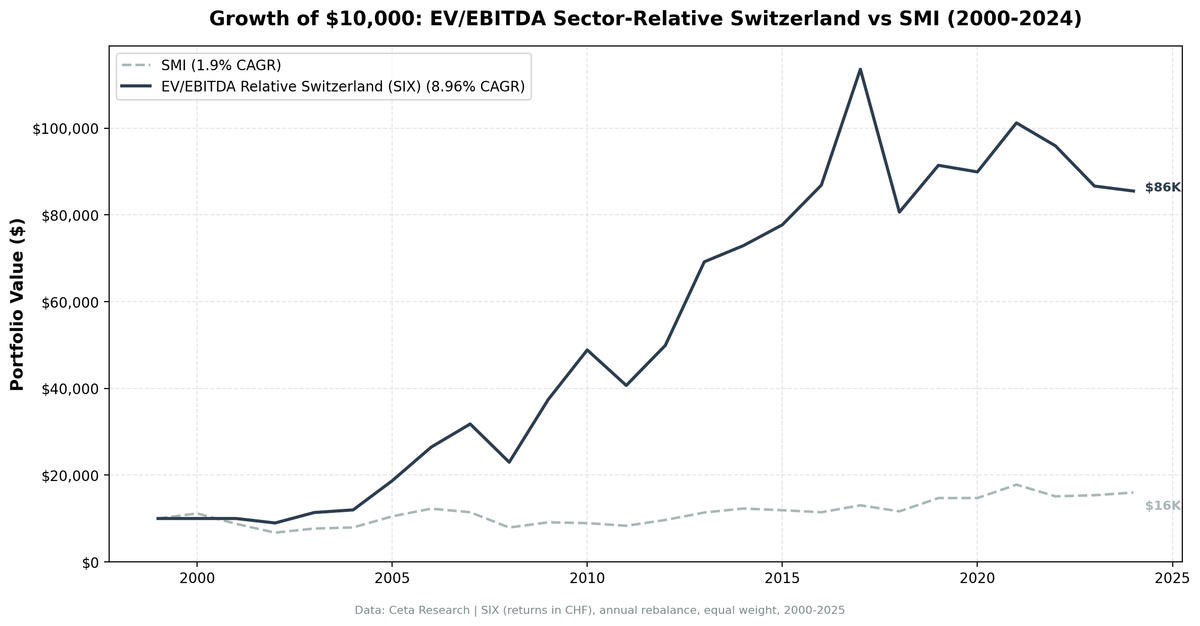
We ran a sector-relative EV/EBITDA screen on 23 years of Swiss stock data from the SIX Exchange. The signal: buy when a stock's EV/EBITDA falls below 70% of its sector median, filtered for quality (ROE > 8%, D/E < 2.0, MCap > CHF 500M). The strategy returned 8.96% annually vs 1.90% for the SMI. But the headline number isn't the return. It's the down capture: 17.41%. When the SMI lost 10%, this portfolio lost only 1.7% on average. Two caveats sit under that, and both are large. The SMI is a price-only index that excludes dividends, so a fair comparison against the total-return SMI would reduce the excess by roughly 3-4% annually. And the universe is everything listed on SIX, not everything Swiss. Restricted to Swiss-domiciled companies the excess turns negative.
Contents
- Method
- The Screen
- Sector-Relative EV/EBITDA Screen for SIX (SQL)
- What We Found
- 23 invested years. +7.07% annual alpha vs the SMI. Exceptional down capture.
- 17% down capture: the real story
- Year-by-year returns
- 2002: falling less than the market
- 2008: -27.7% in a brutal year
- 2005-2007 and 2009-2010: the accumulation phase
- The recent regime shift (2019-2024)
- Backtest Methodology
- Limitations
- Conclusion
Data: FMP financial data warehouse, 2000–2025. Updated August 2026.
Universe caveat, and it's the big one. This screen selects every company listed on the SIX Swiss Exchange, which includes foreign companies' secondary listings. Restricting the universe to companies actually domiciled in Switzerland turns the +7.07% excess into -0.86%, and the screen drops below its 10-stock minimum in 10 of 25 years instead of 2. Switzerland is the market in this study where the listed-versus-domiciled distinction matters most. Every number below describes the SIX listing, not Swiss corporate Switzerland.
Method
| Parameter | Detail |
|---|---|
| Data source | Ceta Research (FMP financial data warehouse) |
| Universe | SIX Swiss Exchange listings, MCap > CHF 500M (includes foreign secondary listings) |
| Signal | Stock EV/EBITDA < 70% of sector median (30%+ discount to peers) |
| EV/EBITDA range | 0.5-25x (exclude negative EBITDA and extreme valuations) |
| Quality filters | ROE > 8%, D/E < 2.0 |
| Portfolio | Top 30 by deepest discount, equal weight |
| Rebalancing | Annual (January) |
| Cash rule | Hold cash if fewer than 10 stocks qualify |
| Period | 2000-2025 (25 years, 2 cash periods) |
| Benchmark | SMI (Swiss Market Index, price return, CHF) |
| Execution | Next-day close after the January signal (market-on-close) |
Financial data sourced from key_metrics_ttm for EV/EBITDA and market cap, financial_ratios_ttm for debt metrics, profile for sector classification. 45-day lag on all financial statements to prevent look-ahead bias.
The Screen
Sector-Relative EV/EBITDA Screen for SIX (SQL)
WITH universe AS (
    SELECT k.symbol, p.companyName, p.exchange, p.sector,
           k.evToEBITDATTM AS ev_ebitda, k.returnOnEquityTTM AS roe,
           fr.debtToEquityRatioTTM AS de, p.marketCap
    FROM key_metrics_ttm k
    JOIN financial_ratios_ttm fr ON k.symbol = fr.symbol
    JOIN profile p ON k.symbol = p.symbol
    WHERE k.evToEBITDATTM BETWEEN 0.5 AND 25
      AND k.returnOnEquityTTM > 0.08
      AND (fr.debtToEquityRatioTTM IS NULL OR (fr.debtToEquityRatioTTM >= 0 AND fr.debtToEquityRatioTTM < 2.0))
      AND p.marketCap > 500000000
      AND p.sector IS NOT NULL
      AND p.exchange IN ('SIX')
      AND p.isFund = false
      AND p.isEtf = false
      AND p.isActivelyTrading = true
    QUALIFY ROW_NUMBER() OVER (PARTITION BY COALESCE(p.cik, p.companyName)
                               ORDER BY p.averageVolume DESC) = 1
),
sector_medians AS (
    SELECT sector,
           PERCENTILE_CONT(0.5) WITHIN GROUP (ORDER BY ev_ebitda) AS median_ev_ebitda,
           COUNT(*) AS n_sector_stocks
    FROM universe GROUP BY sector HAVING COUNT(*) >= 5
)
SELECT u.symbol, u.companyName, u.exchange, u.sector,
       ROUND(u.ev_ebitda, 2) AS ev_ebitda_ttm,
       ROUND(sm.median_ev_ebitda, 2) AS sector_median_ev_ebitda,
       ROUND(u.ev_ebitda / sm.median_ev_ebitda, 3) AS ev_ratio_to_sector,
       ROUND((1 - u.ev_ebitda / sm.median_ev_ebitda) * 100, 1) AS discount_pct,
       ROUND(u.roe * 100, 1) AS roe_pct,
       ROUND(u.de, 2) AS debt_to_equity,
       ROUND(u.marketCap / 1e9, 2) AS mktcap_b
FROM universe u JOIN sector_medians sm ON u.sector = sm.sector
WHERE u.ev_ebitda / sm.median_ev_ebitda < 0.70
ORDER BY u.ev_ebitda / sm.median_ev_ebitda ASC LIMIT 30
Run this screen on Ceta Research
What We Found
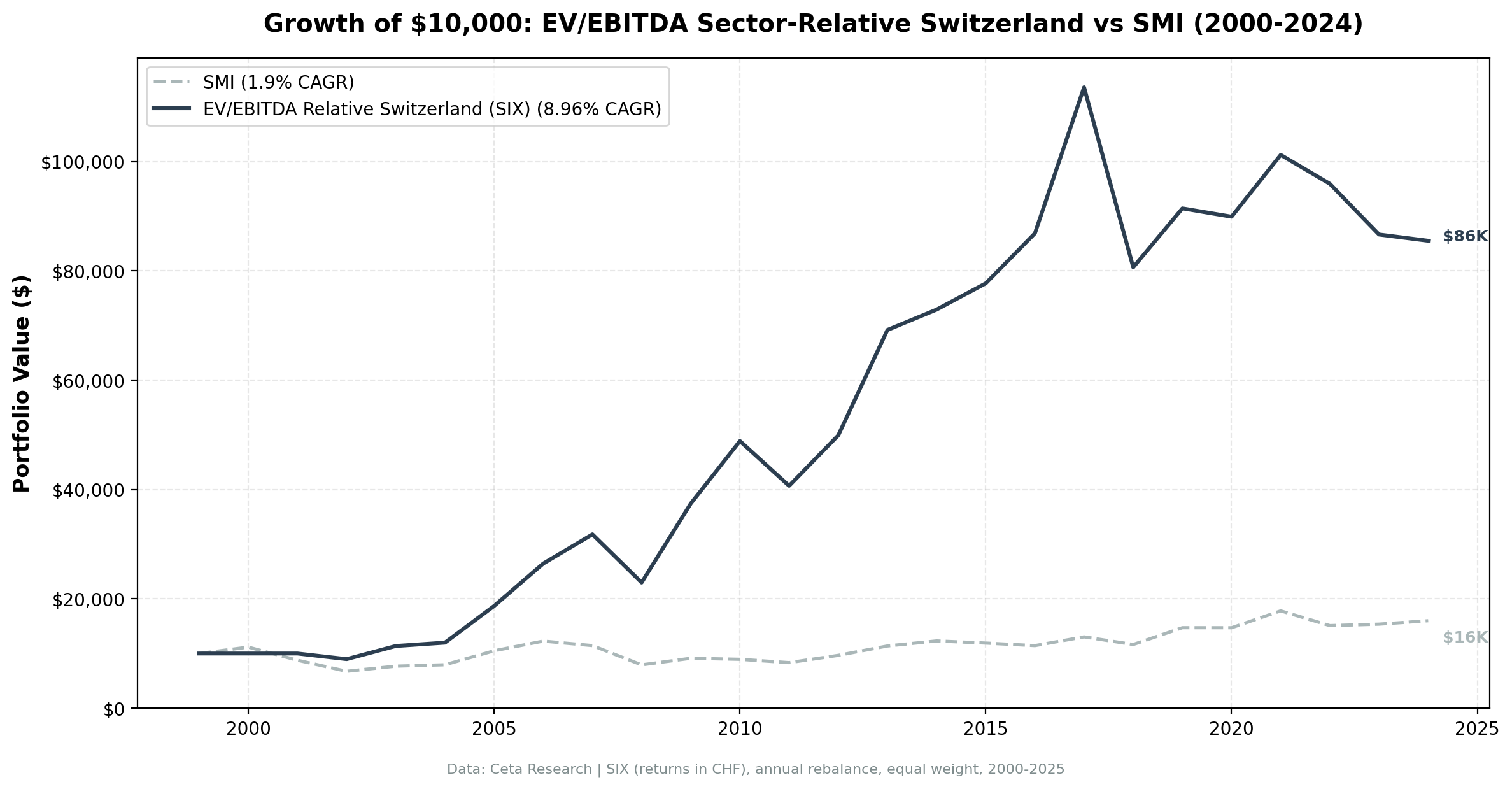
23 invested years. +7.07% annual alpha vs the SMI. Exceptional down capture.
| Metric | EV/EBITDA Sector-Relative (Switzerland) | SMI |
|---|---|---|
| CAGR | 8.96% | 1.9% (price return) |
| Excess return | +7.07% vs SMI price | — |
| True excess (est.) | ~+3-4% vs total-return SMI | — |
| Excess, Swiss-domiciled universe only | -0.86% | — |
| Total Return | 755.22% | 59.93% |
| Sharpe Ratio | 0.359 | — |
| Max Drawdown | -29.0% | -39.65% |
| Up Capture | 150.67% | 100% |
| Down Capture | 17.41% | 100% |
| Win Rate | 64% | — |
| Avg Stocks per Year | 11.8 | — |
| Cash Periods | 2 of 25 (2000, 2001) | — |
The SMI is a price-only index that excludes dividends. Against a total-return SMI, the true excess would be roughly 3-4% lower annually. The +7.07% headline overstates the real advantage before the domicile question is even raised.
Max drawdown of -29.0% is the shallowest of any market in the study that stayed close to fully invested. Korea's -21.31% is lower, but Korea sat in cash 9 of 25 years, so much of that is simply not being in the market. The portfolio averages 11.8 names, which is thin enough that single-stock outcomes move the annual numbers.
17% down capture: the real story
The down capture ratio of 17.41% is the headline finding. When the SMI drops 10%, this Swiss portfolio dropped under 2% on average. That protection compounds substantially over time. Avoiding the full force of down years is worth as much as capturing up years at a discount.
The win rate of 64% reinforces this: the strategy beat the SMI in 16 of 25 years. That combination of a solid win rate and low down capture is what makes the Swiss result the smoothest in the study for anyone who cares about year-by-year consistency.
The caution is that a 17% down capture measured on an 11-stock portfolio drawn largely from foreign secondary listings is a narrower claim than it sounds.
Year-by-year returns
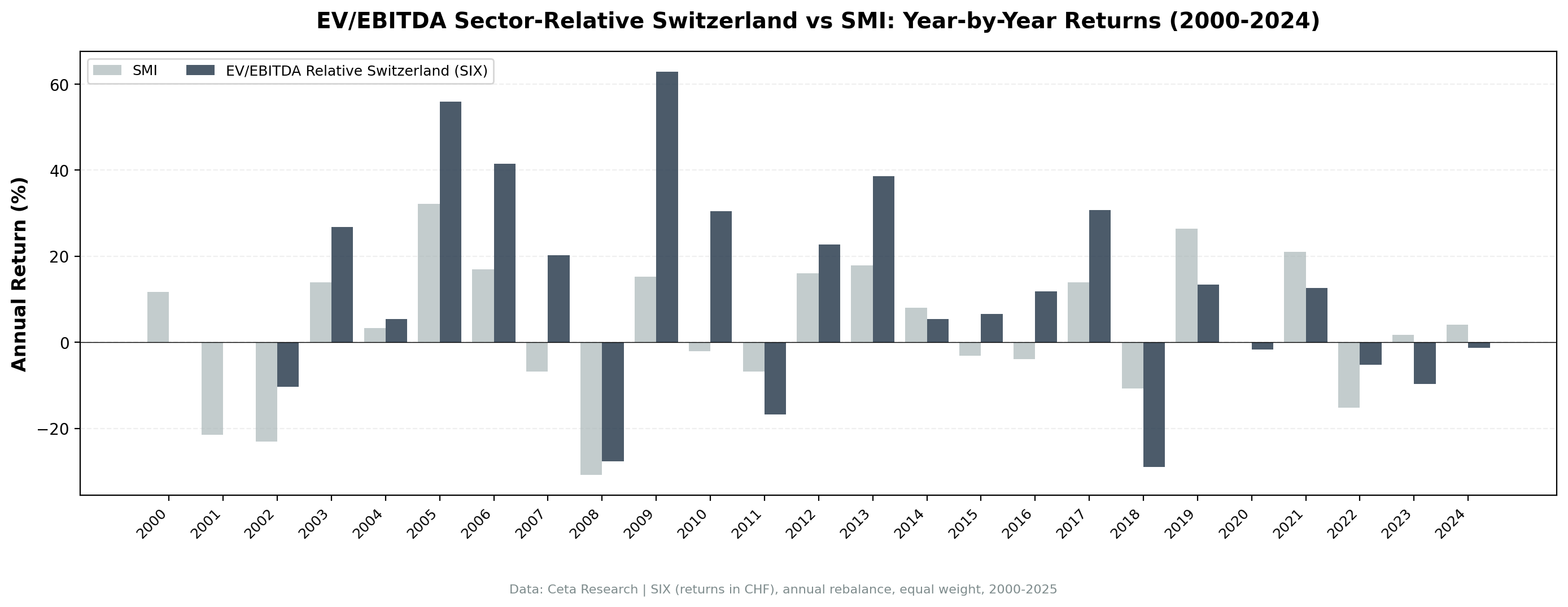
| Year | Strategy | SMI | Excess |
|---|---|---|---|
| 2000 | 0% (cash) | +11.7% | - |
| 2001 | 0% (cash) | -21.5% | - |
| 2002 | -10.3% | -23.1% | +12.8% |
| 2003 | +26.8% | +13.9% | +12.9% |
| 2004 | +5.4% | +3.3% | +2.1% |
| 2005 | +56.0% | +32.2% | +23.8% |
| 2006 | +41.5% | +16.9% | +24.6% |
| 2007 | +20.2% | -6.7% | +26.9% |
| 2008 | -27.7% | -30.8% | +3.1% |
| 2009 | +62.9% | +15.2% | +47.7% |
| 2010 | +30.5% | -2.1% | +32.6% |
| 2011 | -16.8% | -6.8% | -9.9% |
| 2012 | +22.7% | +16.0% | +6.7% |
| 2013 | +38.6% | +17.8% | +20.8% |
| 2014 | +5.4% | +8.1% | -2.7% |
| 2015 | +6.6% | -3.2% | +9.8% |
| 2016 | +11.8% | -3.9% | +15.7% |
| 2017 | +30.8% | +14.0% | +16.8% |
| 2018 | -29.0% | -10.7% | -18.3% |
| 2019 | +13.4% | +26.4% | -13.0% |
| 2020 | -1.7% | -0.1% | -1.6% |
| 2021 | +12.6% | +21.0% | -8.4% |
| 2022 | -5.2% | -15.2% | +9.9% |
| 2023 | -9.7% | +1.8% | -11.4% |
| 2024 | -1.3% | +4.1% | -5.4% |
2002: falling less than the market
The strategy was in cash in 2000 and 2001. Sitting out 2001, when the SMI fell 21.5%, helped; sitting out 2000, when it rose 11.7%, did not. When it deployed in 2002 the Swiss portfolio fell 10.3% while the SMI fell 23.1%, a 12.8 point cushion in a bad year. Swiss quality industrials and healthcare names at sector discounts had already priced in much of the pessimism.
2008: -27.7% in a brutal year
The global financial crisis is the acid test for any value strategy. The portfolio fell -27.7% in 2008, against the SMI's -30.8%. Swiss companies tend to have conservative balance sheets and multi-national revenue diversification. The quality filters (ROE > 8%, D/E < 2.0) kept the most leveraged names out of the portfolio before the crash.
2005-2007 and 2009-2010: the accumulation phase
The five largest excess years in the record all sit in this window: +23.8% in 2005, +24.6% in 2006, +26.9% in 2007, then +47.7% in 2009 and +32.6% in 2010. The strategy caught the mid-2000s European expansion and the post-crisis rebound, while the down capture ratio limited the damage in 2008. Almost the entire 25-year excess was earned in these five years.
The recent regime shift (2019-2024)
The later part of the backtest period was difficult, and the numbers are worse than the aggregate suggests. The strategy lost to the SMI in five of the six years from 2019 to 2024: -13.0% in 2019, -1.6% in 2020, -8.4% in 2021, -11.4% in 2023 and -5.4% in 2024, with only 2022 positive at +9.9%. In absolute terms it lost money in four of those six years.
This is the same growth-regime headwind that hit other Western value strategies. When US tech led global markets, Swiss names at sector discounts didn't get the same re-rating. Anyone starting this strategy in 2019 would still be behind the index.
The honest caveats for Switzerland: the +7.07% is against a price-only SMI, expect materially less against total return, and the entire result depends on a listed universe that includes foreign secondary lines.
Backtest Methodology
Full methodology: backtests/METHODOLOGY.md
| Parameter | Choice |
|---|---|
| Universe | SIX Swiss Exchange listings, MCap > CHF 500M |
| Signal | EV/EBITDA < 70% of sector median, range 0.5-25x |
| Quality | ROE > 8%, D/E < 2.0 |
| Portfolio | Top 30 by deepest discount, equal weight |
| Rebalancing | Annual (January) |
| Cash rule | Hold cash if < 10 qualify |
| Benchmark | SMI (Swiss Market Index, price return) |
| Period | 2000-2025 (25 years) |
| Data | Point-in-time (45-day lag on FY financial statements) |
| Transaction costs | Size-tiered one-way: 0.1% above $10B, 0.3% $2-10B, 0.5% below $2B |
Limitations
Benchmark caveat. The SMI is a price-only index. The +7.07% excess vs the SMI is an overstatement by roughly 3-4% annually when compared to a total-return SMI that includes dividends. The honest excess is closer to +3-4% per year over 23 invested years, before the domicile caveat above.
Small universe. Switzerland averages 11.8 stocks per year, close to the 10-stock minimum. Concentration risk is high and a single company can move an annual result by several points.
The excess is negative on a domiciled universe. Restricted to Swiss-domiciled companies the strategy returns -0.86% against the SMI and sits in cash in 10 of 25 years. This is the single most important caveat on the page: the result belongs to the SIX listing, not to Swiss companies.
Currency effects. Portfolio returns are in CHF. The SMI is also in CHF, so the local comparison is clean. USD-based investors carry CHF/USD exposure. The Swiss franc is a safe-haven currency that historically appreciates in crises, which may have contributed to the down-capture advantage in some years.
2 cash years (2000-2001). The strategy had no qualifying stocks in its first two potential years, so the invested track record starts in 2002. The full 25-year comparison assumes cash returns for 2000 and 2001.
MaxDD worst year (2018: -29.0%). The maximum drawdown came from a single bad year rather than a sustained selloff. That's different from a multi-year drawdown, but a -29.0% single-year loss against an SMI that fell only 10.7% still tests conviction.
Conclusion
Sector-relative EV/EBITDA on the SIX Swiss Exchange delivered 8.96% CAGR over 23 invested years, with a Sharpe ratio of 0.359 and a down capture of 17.41% vs the SMI. The max drawdown of -29.0% is the shallowest of any market here that stayed close to fully invested.
Two things cut that down. The +7.07% excess is against a price-only benchmark, so against a total-return SMI the real figure is closer to +3-4%. And restricted to Swiss-domiciled companies the excess is -0.86%, which means the alpha belongs to companies that list in Zurich rather than to Swiss business.
What survives both caveats is the risk profile. A 17% down capture and a -29.0% worst drawdown, on any universe, is an unusually defensive equity result. That, rather than the headline excess, is the finding worth carrying away from Switzerland.
Data: Ceta Research (FMP financial data warehouse). Returns in CHF (local currency), benchmarked against the SMI price index in CHF. Past performance does not guarantee future results. See full methodology at github.com/ceta-research/backtests.
Past performance does not guarantee future results. This is educational content, not investment advice.