EV/EBITDA Sector-Relative Value on Japanese Stocks: The Screen Loses to the Nikkei
We backtested sector-relative EV/EBITDA on 19 years of Japanese stocks (JPX, 2006-2025). 2.73% CAGR vs 2.95% Nikkei 225, an excess of -0.22%. Over the invested years alone it trails by 1.11 points a year. Even Abenomics in 2013 lifted the index faster than the discount names.

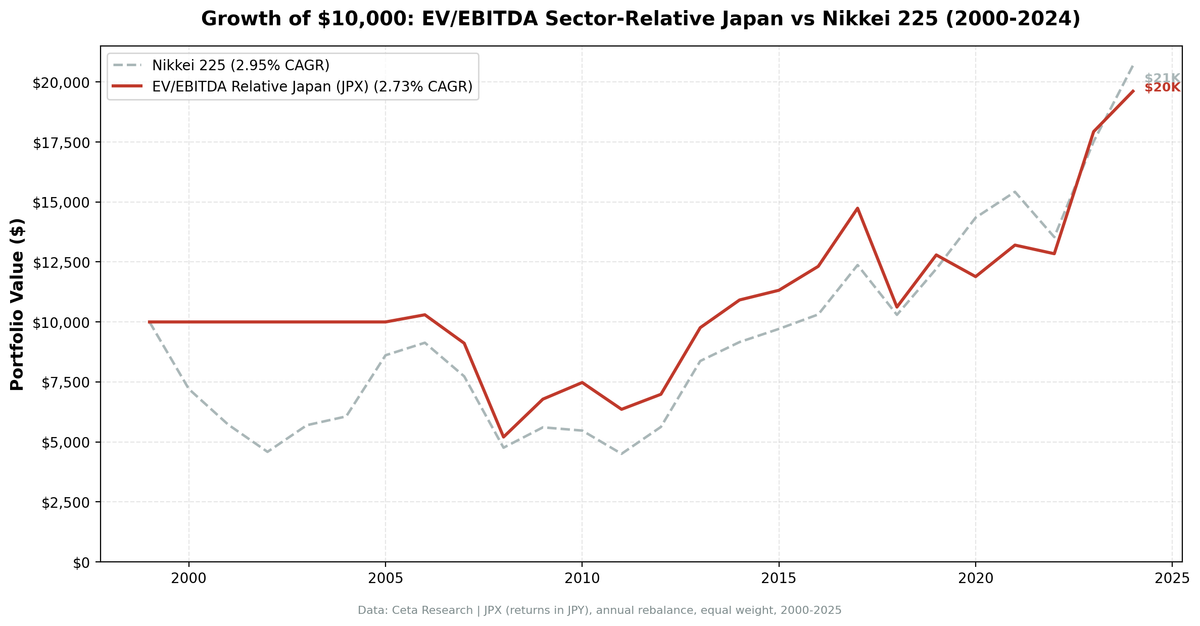
We ran a sector-relative EV/EBITDA screen on 19 years of Japanese stock data from JPX (Tokyo Stock Exchange). The signal: buy when a stock's EV/EBITDA falls below 70% of its sector median, filtered for quality. The result: 2.73% CAGR against 2.95% for the Nikkei 225, an annual excess of -0.22%. The strategy loses to its own market. Restrict the comparison to the 19 years it was actually invested and the gap widens to -1.11 points a year. Japan is the world's most famous deep value market, and this is the clearest case in the study of a market where buying the sector-relative discount doesn't pay.
Contents
- Method
- The Screen
- Sector-Relative EV/EBITDA Screen for JPX (SQL)
- What We Found
- 19 invested years. -0.22% annual excess vs Nikkei. The screen trails its own market.
- The policy years, measured properly
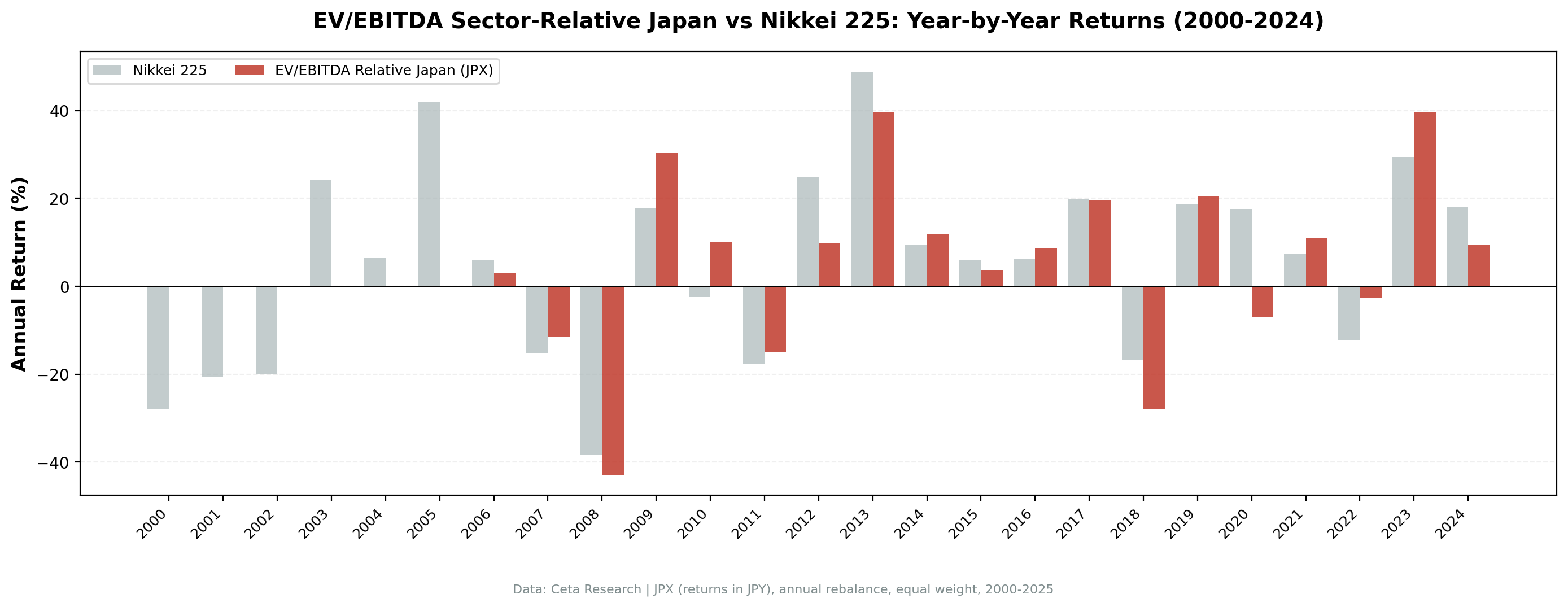
- Year-by-year returns
- Why Japanese discounts are structural
- 2013: Abenomics lifted the index faster
- 2023: TSE governance pressure
- 2018: the painful year
- Backtest Methodology
- Limitations
- Conclusion
Data: FMP financial data warehouse, 2000–2025. Updated August 2026.
Method
| Parameter | Detail |
|---|---|
| Data source | Ceta Research (FMP financial data warehouse) |
| Universe | JPX (Tokyo Stock Exchange), MCap > ¥100B |
| Signal | Stock EV/EBITDA < 70% of sector median (30%+ discount to peers) |
| EV/EBITDA range | 0.5-25x |
| Quality filters | ROE > 8%, D/E < 2.0 |
| Portfolio | Top 30 by deepest discount, equal weight |
| Rebalancing | Annual (January) |
| Cash rule | Hold cash if fewer than 10 stocks qualify |
| Period | 2000-2025 (25 years, 6 cash periods) |
| Benchmark | Nikkei 225 |
Financial data sourced from key_metrics_ttm for EV/EBITDA and market cap, financial_ratios_ttm for debt metrics, profile for sector classification. 45-day lag on all financial statements to prevent look-ahead bias.
The Screen
Sector-Relative EV/EBITDA Screen for JPX (SQL)
WITH universe AS (
    SELECT k.symbol, p.companyName, p.exchange, p.sector,
           k.evToEBITDATTM AS ev_ebitda, k.returnOnEquityTTM AS roe,
           fr.debtToEquityRatioTTM AS de, p.marketCap
    FROM key_metrics_ttm k
    JOIN financial_ratios_ttm fr ON k.symbol = fr.symbol
    JOIN profile p ON k.symbol = p.symbol
    WHERE k.evToEBITDATTM BETWEEN 0.5 AND 25
      AND k.returnOnEquityTTM > 0.08
      AND (fr.debtToEquityRatioTTM IS NULL OR (fr.debtToEquityRatioTTM >= 0 AND fr.debtToEquityRatioTTM < 2.0))
      AND p.marketCap > 100000000000
      AND p.sector IS NOT NULL
      AND p.exchange IN ('JPX')
      AND p.isFund = false
      AND p.isEtf = false
      AND p.isActivelyTrading = true
    QUALIFY ROW_NUMBER() OVER (PARTITION BY COALESCE(p.cik, p.companyName)
                               ORDER BY p.averageVolume DESC) = 1
),
sector_medians AS (
    SELECT sector,
           PERCENTILE_CONT(0.5) WITHIN GROUP (ORDER BY ev_ebitda) AS median_ev_ebitda,
           COUNT(*) AS n_sector_stocks
    FROM universe GROUP BY sector HAVING COUNT(*) >= 5
)
SELECT u.symbol, u.companyName, u.exchange, u.sector,
       ROUND(u.ev_ebitda, 2) AS ev_ebitda_ttm,
       ROUND(sm.median_ev_ebitda, 2) AS sector_median_ev_ebitda,
       ROUND(u.ev_ebitda / sm.median_ev_ebitda, 3) AS ev_ratio_to_sector,
       ROUND((1 - u.ev_ebitda / sm.median_ev_ebitda) * 100, 1) AS discount_pct,
       ROUND(u.roe * 100, 1) AS roe_pct,
       ROUND(u.de, 2) AS debt_to_equity,
       ROUND(u.marketCap / 1e9, 2) AS mktcap_b
FROM universe u JOIN sector_medians sm ON u.sector = sm.sector
WHERE u.ev_ebitda / sm.median_ev_ebitda < 0.70
ORDER BY u.ev_ebitda / sm.median_ev_ebitda ASC LIMIT 30
Run this screen on Ceta Research
What We Found
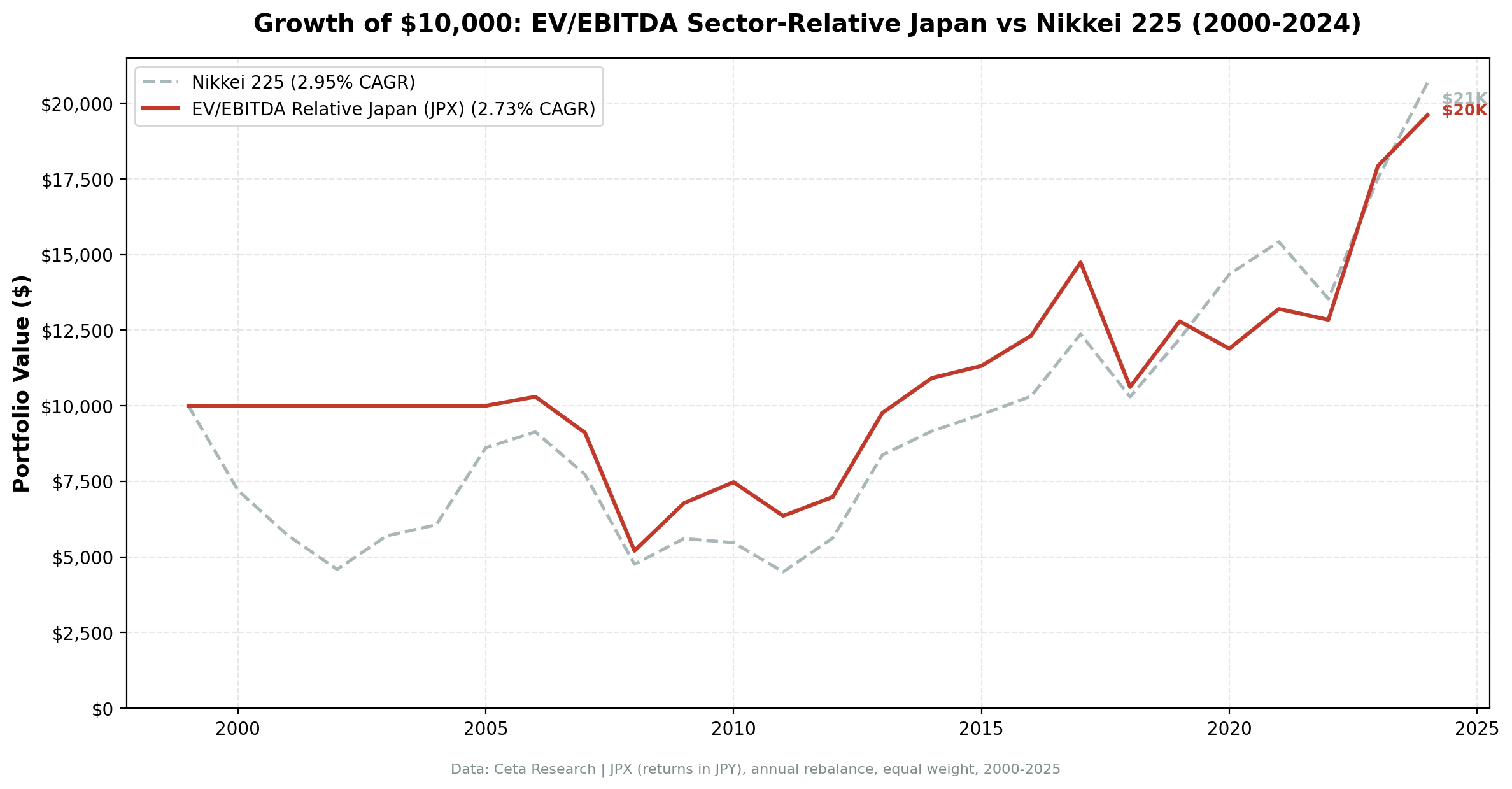
19 invested years. -0.22% annual excess vs Nikkei. The screen trails its own market.
| Metric | EV/EBITDA Sector-Relative (Japan) | Nikkei 225 |
|---|---|---|
| CAGR | 2.73% | 2.95% |
| Excess return | -0.22% | — |
| Total Return | 96.15% | 106.86% |
| Sharpe Ratio | 0.143 | — |
| Max Drawdown | -49.47% | -54.95% |
| Up Capture | 66.14% | 100% |
| Down Capture | 52.44% | 100% |
| Win Rate | 52% | — |
| Avg Stocks per Year | 25.2 | — |
| Cash Periods | 6 of 25 (2000-2005) | — |
The 6 cash periods at the start (2000-2005) reflect genuine data thinness. JPX's FY financial data in the FMP warehouse becomes reliably populated only from around 2006 onward. The effective track record is 19 years.
Those cash years flatter the headline rather than hurting it. The Nikkei lost 13.9% cumulatively from 2000 to 2005, so sitting flat while the index fell added to the 25-year comparison. Strip the cash out and measure only the 19 years the screen was invested, and it returned 3.61% a year against the Nikkei's 4.72%, a shortfall of 1.11 points annually. The full-period -0.22% understates how far the invested years trailed.
The down capture of 52.4% is the one genuinely positive finding: during Nikkei down years the strategy fell roughly half as much. It doesn't rescue the result, because up capture is only 66.1%. The screen gives up more in rising years than it saves in falling ones, and in a market that spent 25 years grinding sideways, that trade lost.
The policy years, measured properly
Japan's two big policy events look very different once the Nikkei is the benchmark instead of the S&P 500:
| Year | Strategy | Nikkei 225 | Excess | Driver |
|---|---|---|---|---|
| 2013 | +39.8% | +48.9% | -9.1% | Abenomics + BOJ QE |
| 2023 | +39.6% | +29.4% | +10.2% | TSE governance reforms |
Both were huge absolute years for the screen. Only one was a good relative year. Abenomics in 2013 was a liquidity and currency event that lifted the whole index, and the large-cap exporters driving the Nikkei rose faster than the sector-relative discount names. Buying the discount in 2013 meant underperforming a rally you correctly predicted.
2023 is the case that fits the thesis. The Tokyo Stock Exchange targeted companies trading below book value specifically, which is close to the population this screen selects, and the screen beat the index by 10.2 points.
The lesson isn't "value in Japan needs a catalyst". It's narrower: it needs a catalyst aimed at cheap companies in particular. Broad monetary stimulus lifts the index more than it lifts the discount.
Year-by-year returns
| Year | Strategy | Nikkei 225 | Excess |
|---|---|---|---|
| 2000 | 0% (cash) | -27.9% | - |
| 2001 | 0% (cash) | -20.6% | - |
| 2002 | 0% (cash) | -19.9% | - |
| 2003 | 0% (cash) | +24.2% | - |
| 2004 | 0% (cash) | +6.4% | - |
| 2005 | 0% (cash) | +42.1% | - |
| 2006 | +3.0% | +6.1% | -3.1% |
| 2007 | -11.5% | -15.3% | +3.8% |
| 2008 | -42.9% | -38.5% | -4.4% |
| 2009 | +30.3% | +17.8% | +12.5% |
| 2010 | +10.2% | -2.4% | +12.6% |
| 2011 | -14.9% | -17.7% | +2.7% |
| 2012 | +9.8% | +24.9% | -15.0% |
| 2013 | +39.8% | +48.9% | -9.1% |
| 2014 | +11.8% | +9.4% | +2.4% |
| 2015 | +3.7% | +6.0% | -2.3% |
| 2016 | +8.8% | +6.2% | +2.6% |
| 2017 | +19.7% | +20.0% | -0.3% |
| 2018 | -27.9% | -16.8% | -11.2% |
| 2019 | +20.5% | +18.6% | +1.8% |
| 2020 | -7.1% | +17.5% | -24.5% |
| 2021 | +11.1% | +7.5% | +3.5% |
| 2022 | -2.7% | -12.2% | +9.5% |
| 2023 | +39.6% | +29.4% | +10.2% |
| 2024 | +9.4% | +18.1% | -8.7% |
Why Japanese discounts are structural
Japan has the world's most extensively documented corporate governance problem. The specific mechanisms that keep EV/EBITDA discounts persistent:
Keiretsu cross-shareholdings. Large industrial groups hold each other's shares as relationship anchors. These cross-holdings suppress activist pressure, reduce management accountability to outside shareholders, and keep capital allocation decisions internal to the group. Companies with cross-held shares trade at structural discounts because investors price in the governance drag.
Zombie company prevalence. Japan's banking system has historically supported loss-making or low-return companies to preserve employment. These companies populate sector rosters and pull sector medians down. The "sector median" EV/EBITDA may itself reflect the universe of poorly-governed companies rather than a fair benchmark.
Cash hoarding. Japanese companies have historically accumulated cash rather than returning it to shareholders. A company trading at 5x EV/EBITDA with ¥500B in cash on its balance sheet isn't cheap by accident. It's cheap because that cash will likely stay on the balance sheet indefinitely rather than be deployed or distributed.
Low ROE culture. Despite the quality filter (ROE > 8%), the broader Japanese corporate culture of prioritizing employment stability and supplier relationships over shareholder returns means that even companies that pass the ROE filter may not aggressively close their valuation gaps.
2013: Abenomics lifted the index faster
Prime Minister Abe's reflation program and the Bank of Japan's QE in 2013 drove the yen weaker and boosted corporate earnings for Japanese exporters. Abenomics also targeted corporate governance, asking companies to increase ROE and return capital to shareholders, and the JPX-Nikkei 400 was introduced to highlight capital efficiency.
The screen returned +39.8% that year, narrowly its best absolute result in the record, a fraction ahead of 2023's +39.6%. The Nikkei returned +48.9%. A weaker yen is worth more to the big exporters that dominate the index than to the discounted domestic names the screen tends to hold, so the strategy was left 9.1 points behind in the year value investors in Japan remember most fondly.
2023: TSE governance pressure
In March 2023, the Tokyo Stock Exchange asked every Prime and Standard Market company to show whether it was earning its cost of capital, and required those trading below 1x book value to disclose a specific improvement plan. Nothing about it was legally binding and there was no delisting threat. The enforcement was reputational: the TSE published a monthly list of who had complied and who hadn't. Companies with EV/EBITDA discounts to sector peers were among those most exposed to that pressure, and management teams that had ignored valuation gaps for years suddenly had a public reason to close them.
Result: +39.6% against the Nikkei's +29.4%, an excess of +10.2%. This is the one clear case where a catalyst aimed at cheap companies paid the screen specifically.
2018: the painful year
The -27.9% in 2018 (-11.1% against the Nikkei) reflects JPY strengthening and global trade concerns hitting Japanese exporters. Companies that passed the sector-relative screen included many export-oriented industrials and cyclicals. When global trade concerns rose, those names fell harder than the quality filters could protect against.
Backtest Methodology
Full methodology: backtests/METHODOLOGY.md
| Parameter | Choice |
|---|---|
| Universe | JPX, MCap > ¥100B |
| Signal | EV/EBITDA < 70% of sector median, range 0.5-25x |
| Quality | ROE > 8%, D/E < 2.0 |
| Portfolio | Top 30 by deepest discount, equal weight |
| Rebalancing | Annual (January) |
| Cash rule | Hold cash if < 10 qualify |
| Benchmark | Nikkei 225 (JPY) |
| Execution | Next-day close after the January signal (market-on-close) |
| Period | 2000-2025 (25 years, 6 cash) |
| Data | Point-in-time (45-day lag on FY financial statements) |
| Transaction costs | Size-tiered one-way: 0.1% above $10B, 0.3% $2-10B, 0.5% below $2B |
Limitations
6 cash years (2000-2005) limit effective track record. The 19-year invested return is less reliable than a 25-year record for statistical significance. Those cash years helped rather than hurt here, because the Nikkei fell 13.9% cumulatively over them.
One policy year carries the record. Remove 2023 and the 19-year result gets materially worse. A strategy that depends on a single regulatory intervention aimed at cheap companies is not a strategy with a reliable mechanism.
MaxDD -49.47%. Japan's export-heavy market amplifies global manufacturing cycle downturns. This is shallower than the Nikkei's own -54.95%, which is the one risk dimension where the screen came out ahead, and it isn't enough to rescue a negative excess.
Currency effects. Returns are in JPY. The Nikkei 225 is also in JPY, so the local comparison is clean. The yen's prolonged weakening trend since 2012 affects USD-based investors who hold JPY-denominated assets, but doesn't distort the local benchmark comparison.
Governance improvement is ongoing but uneven. The TSE's 2023 request pushed some companies to act. Others simply didn't respond, and because the programme is disclosure-based with no penalty attached, nothing happens to them. The pace of governance improvement is uncertain.
Conclusion
Sector-relative EV/EBITDA on JPX delivered 2.73% CAGR against the Nikkei 225's 2.95%, an annual excess of -0.22%. Measured only over the 19 years it held stocks, the shortfall is 1.11 points a year. This screen does not work in Japan.
The reason is visible in the two policy years. Mean reversion is supposed to happen because anomalies attract capital. In Japan the anomalies persisted for decades, because activist investors, hostile takeovers and capital return pressure are all structurally weaker. When policy did move the market, in 2013, it moved the index more than it moved the discounted names. Only the 2023 intervention, which targeted sub-book companies specifically, paid the screen.
The honest summary: buying the sector discount in Japan cost you relative to simply holding the Nikkei, and it did so with a 49% drawdown along the way. Continued TSE pressure on cheap companies is the one plausible route to a different answer, and one year of evidence isn't enough to bet on it.
Data: Ceta Research (FMP financial data warehouse). Returns in JPY (local currency), benchmarked against the Nikkei 225 in JPY. Past performance does not guarantee future results. See full methodology at github.com/ceta-research/backtests.
Past performance does not guarantee future results. This is educational content, not investment advice.