EV/EBITDA Sector-Relative Value on Canadian Stocks: An Honest Assessment
We backtested sector-relative EV/EBITDA on 24 years of Canadian stocks (TSX). 7.83% CAGR vs 4.44% TSX Composite (+3.40% excess), but max drawdown -47.36% and down capture of 104%. Every point of the excess comes from up capture, not from downside protection.

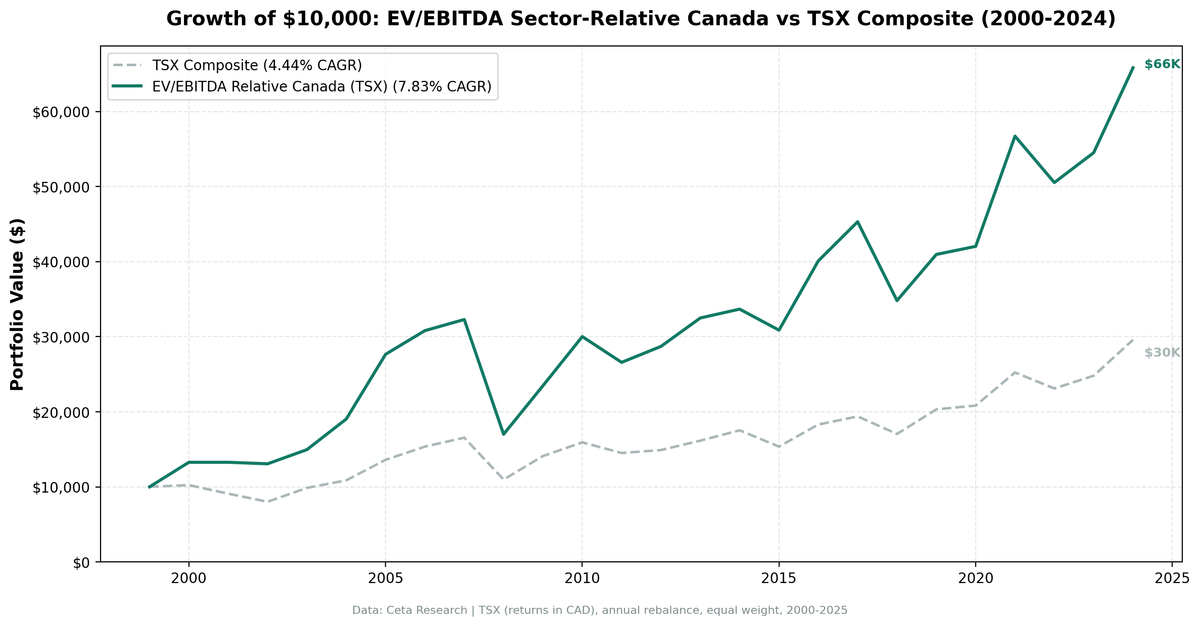
We ran a sector-relative EV/EBITDA screen on 24 years of Canadian stock data from the TSX. The signal: buy when a stock's EV/EBITDA falls below 70% of its sector median, filtered for quality. The result: 7.83% CAGR vs 4.44% for the TSX Composite. On the surface, that's +3.40% excess return. But the max drawdown of -47.36% is severe, down capture is above 100%, and a Sharpe of 0.256 means the risk-adjusted story is weak. Canada is a useful case study in when sector-relative signals work and when they don't.
Contents
- Method
- The Screen
- Sector-Relative EV/EBITDA Screen for TSX (SQL)
- What We Found
- 24 invested years. 64% win rate. +3.40% annual excess vs the TSX Composite. Still a weak risk-adjusted story.
- The years that built the excess
- Year-by-year returns
- 2008: the worst year
- 2012-2015: weak absolute returns, mixed relative ones
- 2016: +10.7% excess, the commodity rebound
- Why Canada's resource composition is a structural problem
- Backtest Methodology
- Limitations
- Conclusion
Data: FMP financial data warehouse, 2000–2025. Updated August 2026.
Method
| Parameter | Detail |
|---|---|
| Data source | Ceta Research (FMP financial data warehouse) |
| Universe | TSX (Toronto Stock Exchange), MCap > CAD $500M |
| Signal | Stock EV/EBITDA < 70% of sector median (30%+ discount to peers) |
| EV/EBITDA range | 0.5-25x |
| Quality filters | ROE > 8%, D/E < 2.0 |
| Portfolio | Top 30 by deepest discount, equal weight |
| Rebalancing | Annual (January) |
| Cash rule | Hold cash if fewer than 10 stocks qualify |
| Period | 2000-2025 (25 years, 1 cash period) |
| Benchmark | TSX Composite (CAD) |
| Execution | Next-day close after the January signal (market-on-close) |
Financial data sourced from key_metrics_ttm for EV/EBITDA and market cap, financial_ratios_ttm for debt metrics, profile for sector classification. 45-day lag on all financial statements to prevent look-ahead bias.
The Screen
Sector-Relative EV/EBITDA Screen for TSX (SQL)
WITH universe AS (
    SELECT k.symbol, p.companyName, p.exchange, p.sector,
           k.evToEBITDATTM AS ev_ebitda, k.returnOnEquityTTM AS roe,
           fr.debtToEquityRatioTTM AS de, p.marketCap
    FROM key_metrics_ttm k
    JOIN financial_ratios_ttm fr ON k.symbol = fr.symbol
    JOIN profile p ON k.symbol = p.symbol
    WHERE k.evToEBITDATTM BETWEEN 0.5 AND 25
      AND k.returnOnEquityTTM > 0.08
      AND (fr.debtToEquityRatioTTM IS NULL OR (fr.debtToEquityRatioTTM >= 0 AND fr.debtToEquityRatioTTM < 2.0))
      AND p.marketCap > 500000000
      AND p.sector IS NOT NULL
      AND p.exchange IN ('TSX')
      AND p.isFund = false
      AND p.isEtf = false
      AND p.isActivelyTrading = true
    QUALIFY ROW_NUMBER() OVER (PARTITION BY COALESCE(p.cik, p.companyName)
                               ORDER BY p.averageVolume DESC) = 1
),
sector_medians AS (
    SELECT sector,
           PERCENTILE_CONT(0.5) WITHIN GROUP (ORDER BY ev_ebitda) AS median_ev_ebitda,
           COUNT(*) AS n_sector_stocks
    FROM universe GROUP BY sector HAVING COUNT(*) >= 5
)
SELECT u.symbol, u.companyName, u.exchange, u.sector,
       ROUND(u.ev_ebitda, 2) AS ev_ebitda_ttm,
       ROUND(sm.median_ev_ebitda, 2) AS sector_median_ev_ebitda,
       ROUND(u.ev_ebitda / sm.median_ev_ebitda, 3) AS ev_ratio_to_sector,
       ROUND((1 - u.ev_ebitda / sm.median_ev_ebitda) * 100, 1) AS discount_pct,
       ROUND(u.roe * 100, 1) AS roe_pct,
       ROUND(u.de, 2) AS debt_to_equity,
       ROUND(u.marketCap / 1e9, 2) AS mktcap_b
FROM universe u JOIN sector_medians sm ON u.sector = sm.sector
WHERE u.ev_ebitda / sm.median_ev_ebitda < 0.70
ORDER BY u.ev_ebitda / sm.median_ev_ebitda ASC LIMIT 30
Run this screen on Ceta Research
What We Found
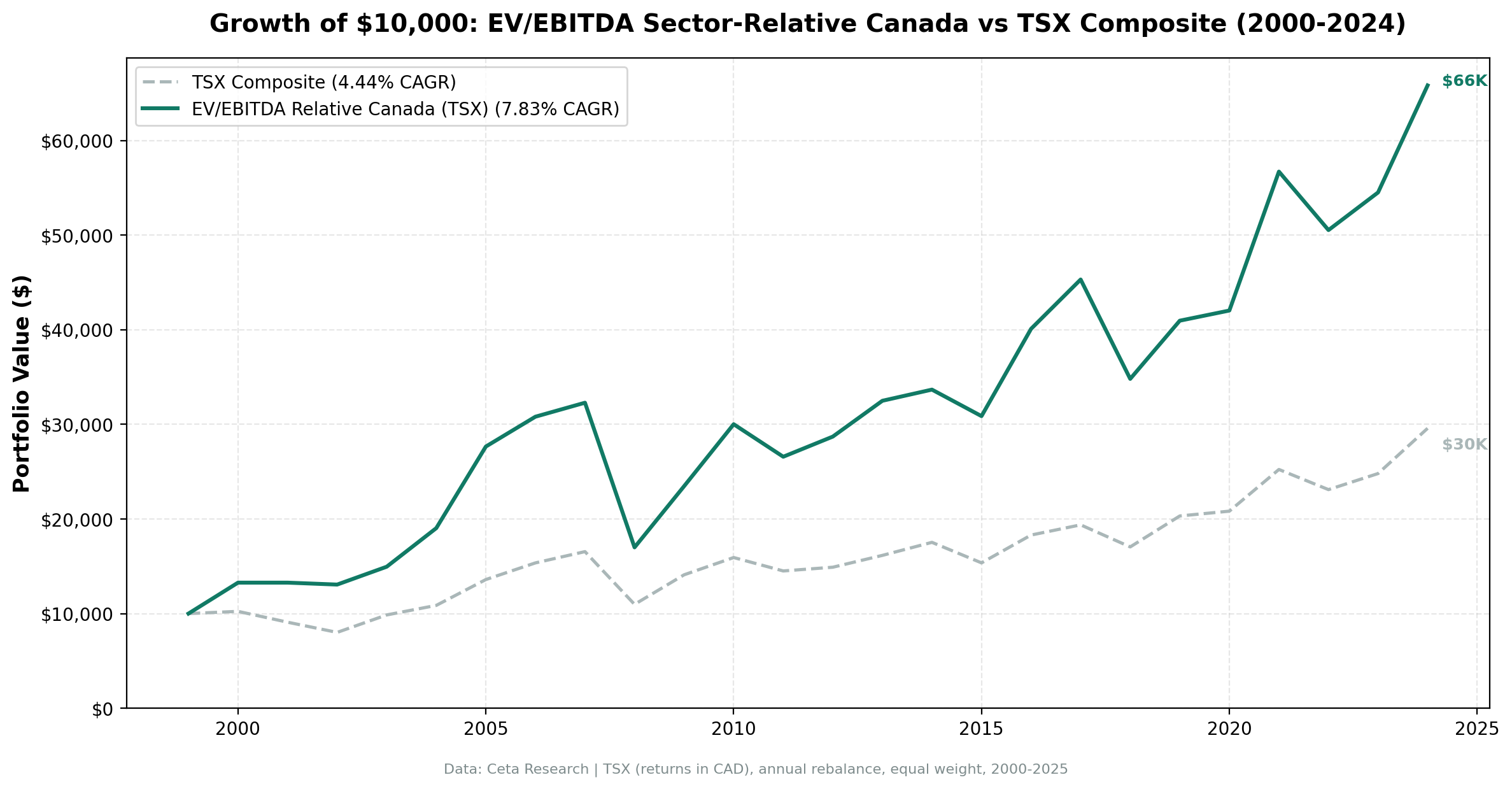
24 invested years. 64% win rate. +3.40% annual excess vs the TSX Composite. Still a weak risk-adjusted story.
| Metric | EV/EBITDA Sector-Relative (Canada) | TSX Composite |
|---|---|---|
| CAGR | 7.83% | 4.44% |
| Excess return | +3.4% | — |
| Total Return | 558.47% | 195.92% |
| Sharpe Ratio | 0.256 | — |
| Max Drawdown | -47.36% | -33.7% |
| Up Capture | 149.09% | 100% |
| Down Capture | 104.29% | 100% |
| Win Rate | 64% | — |
| Avg Stocks per Year | 20.0 | — |
| Cash Periods | 1 of 25 | — |
The down capture of 104.3% means the strategy falls slightly further than the TSX Composite in down years. There is no downside protection here at all, and the max drawdown of -47.36% confirms it. The +3.40% annual excess is real, and it is bought entirely with up capture of 149.1%: the strategy wins by rising more, not by falling less.
The Sharpe ratio of 0.256 is low. On a risk-adjusted basis this strategy is a leveraged-feeling version of the index rather than an improvement on it.
The years that built the excess
The strategy's positive CAGR case rests heavily on a handful of large win years, most of them early:
| Year | Strategy | TSX Composite | Excess |
|---|---|---|---|
| 2000 | +32.7% | +2.4% | +30.4% |
| 2002 | -1.5% | -11.9% | +10.3% |
| 2004 | +27.3% | +10.2% | +17.0% |
| 2005 | +45.3% | +25.1% | +20.2% |
| 2010 | +27.9% | +12.9% | +15.0% |
| 2021 | +34.9% | +21.2% | +13.8% |
Those early years reflect a period when Canadian resource stocks were cheap relative to their own sector peers, and then the commodity supercycle of 2003-2007 began closing those discounts. Energy, metals, and materials stocks that were unloved at the end of the dot-com era repriced sharply. The signal happened to be pointing exactly at those names.
Year-by-year returns
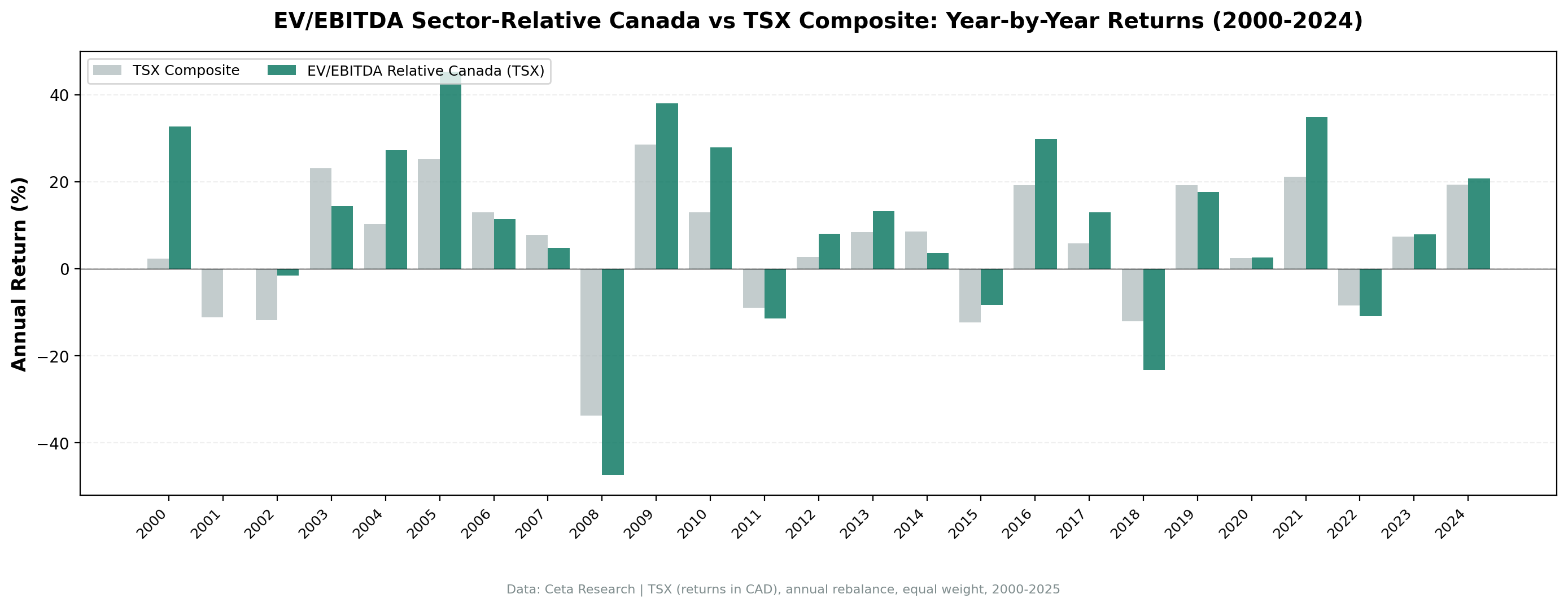
| Year | Strategy | TSX Composite | Excess |
|---|---|---|---|
| 2000 | +32.7% | +2.4% | +30.4% |
| 2001 | 0% (cash) | -11.2% | - |
| 2002 | -1.5% | -11.9% | +10.3% |
| 2003 | +14.4% | +23.1% | -8.6% |
| 2004 | +27.3% | +10.2% | +17.0% |
| 2005 | +45.3% | +25.1% | +20.2% |
| 2006 | +11.4% | +12.9% | -1.5% |
| 2007 | +4.8% | +7.8% | -3.0% |
| 2008 | -47.4% | -33.7% | -13.7% |
| 2009 | +38.1% | +28.5% | +9.6% |
| 2010 | +27.9% | +12.9% | +15.0% |
| 2011 | -11.4% | -8.9% | -2.5% |
| 2012 | +8.0% | +2.7% | +5.3% |
| 2013 | +13.2% | +8.4% | +4.8% |
| 2014 | +3.6% | +8.5% | -4.9% |
| 2015 | -8.3% | -12.4% | +4.1% |
| 2016 | +29.9% | +19.1% | +10.7% |
| 2017 | +13.0% | +5.9% | +7.1% |
| 2018 | -23.2% | -12.0% | -11.1% |
| 2019 | +17.7% | +19.2% | -1.5% |
| 2020 | +2.6% | +2.5% | +0.1% |
| 2021 | +34.9% | +21.2% | +13.8% |
| 2022 | -10.9% | -8.4% | -2.5% |
| 2023 | +7.9% | +7.3% | +0.5% |
| 2024 | +20.8% | +19.3% | +1.5% |
2008: the worst year
The -47.4% in 2008 drove the max drawdown well beyond the TSX Composite's -33.7%, a 13.7 point shortfall in the year protection mattered most. Canadian oil, gas, and mining stocks fell catastrophically as commodity prices collapsed. The EV/EBITDA signal had loaded the portfolio into exactly these sectors because they were trading at discounts to their sector peers. When the global cycle reversed and commodity demand collapsed, those discounts deepened rather than closed.
This is the core problem with sector-relative signals in resource-heavy markets: the signal can't distinguish between a temporary mispricing and a structural repricing of the entire sector.
2012-2015: weak absolute returns, mixed relative ones
After a strong recovery in 2009-2010, the strategy's 2012-2015 record against the TSX Composite was mixed rather than uniformly bad: +5.3%, +4.8%, -4.9% and +4.1%. Canadian energy and materials stocks spent these years undergoing a prolonged re-rating as US shale production reshaped global oil markets, and the absolute returns were poor even where the relative ones held up.
2016: +10.7% excess, the commodity rebound
Oil prices recovered in 2016 and the strategy returned +29.9% against the index's +19.1%. Resource stocks that had been deeply discounted finally repriced. This is the strategy working as intended, a long wait for discount closure, though the excess is far smaller than the absolute number suggests because the whole Canadian market rallied with it.
Why Canada's resource composition is a structural problem
The sector-relative signal works when discount stocks are cheap because of temporary sentiment, not because of fundamental sector-level repricing. In Canadian energy and materials, the "discount" often reflects:
- Lower-quality reserves or assets within the same sector
- Sector-wide commodity price cycles that depress all sector multiples simultaneously
- Canadian producers structurally trading at a discount to US peers due to infrastructure and pipeline constraints
The signal sees "cheap vs sector median" and buys. But if the sector median itself is being dragged down by the same forces affecting the discount stocks, mean reversion doesn't occur on any useful timeline.
Backtest Methodology
Full methodology: backtests/METHODOLOGY.md
| Parameter | Choice |
|---|---|
| Universe | TSX, MCap > CAD $500M |
| Signal | EV/EBITDA < 70% of sector median, range 0.5-25x |
| Quality | ROE > 8%, D/E < 2.0 |
| Portfolio | Top 30 by deepest discount, equal weight |
| Rebalancing | Annual (January) |
| Cash rule | Hold cash if < 10 qualify |
| Benchmark | TSX Composite |
| Period | 2000-2025 (25 years) |
| Data | Point-in-time (45-day lag on FY financial statements) |
| Transaction costs | Size-tiered one-way: 0.1% above $10B, 0.3% $2-10B, 0.5% below $2B |
Limitations
MaxDD -47.36%. Severe, and deeper than the index's -33.7%. Resource sector concentration in down cycles explains most of this. The 2008 crash, where Canadian oil, gas, and mining stocks fell catastrophically, drove the majority of this drawdown.
Concentrated wins. The 64% win rate looks steady, but the CAGR case leans on a handful of large excess years in the commodity supercycle. Strip 2000, 2004 and 2005 out and what remains is a strategy that tracks the TSX Composite with more drawdown.
Sector concentration risk. The TSX is heavily weighted toward energy, financials, and materials. Without a sector cap, the portfolio can cluster in resource stocks. A bad commodity cycle (2012-2015, 2018-2020) creates prolonged stretches of underperformance.
Currency effects. Returns are in CAD. The TSX Composite is also in CAD, so the local comparison is clean. USD-based investors carry CAD/USD exposure, which tracks oil prices and can amplify volatility in commodity-driven years.
The CAGR case is fragile. Remove the 2000-2005 commodity supercycle period and the strategy's edge narrows significantly. The long-run positive result depends heavily on those early years.
Conclusion
Sector-relative EV/EBITDA on Canada's TSX delivers 7.83% CAGR vs 4.44% for the TSX Composite. The honest read: +3.40% annual excess return while carrying a -47.36% max drawdown and a Sharpe ratio of 0.256. The 64% win rate is decent, but down capture of 104.3% means the portfolio falls slightly harder than the index it beats. Every point of that excess comes from up capture of 149.1%, so this is a higher-beta way to own Canada rather than a better one.
The signal works in Canada when sector discounts have a specific catalyst, like the 2003-2005 commodity supercycle or the 2016 oil rebound. Between those windows, it's a waiting game with no guarantee the discount closes on any useful timeline.
For investors in Canada's resource-heavy market, the question isn't whether value investing works in theory. It's whether "cheap vs sector median" is a reliable signal when the sector itself is cyclically distressed. The data suggests it often isn't.
Data: Ceta Research (FMP financial data warehouse). Returns in CAD (local currency). Benchmark: TSX Composite (^GSPTSE) in CAD. Past performance does not guarantee future results. See full methodology at github.com/ceta-research/backtests.
Past performance does not guarantee future results. This is educational content, not investment advice.